Star Anise (Ba Jiao): whole-star ratio, broken control, and foreign matter prevention
Most star anise disputes are not aroma disputes. They are spec disputes. This piece shows where the legal floor sits, why premium buyers need tighter commercial limits, and how to write a star anise spec that survives real handling, real transit, and real audits.
But star anise is one of those ingredients that exposes whether a supplier runs a real system or just a nice catalog, because the same carton can smell rich, look photogenic on top, hide stalk load underneath, shed fragments in transit, and still fail the moment a serious buyer moves from adjectives to limits, methods, and sampling. What are you actually buying?
I’ll say the quiet part out loud: in bulk spice trade, “beautiful whole stars” is often a sales phrase, not a spec. If you start from the site’s own Star Anise (Ba Jiao Hui Xiang) product page and the broader Fruit & Seed Chinese Medicinals category, the commercial lane is obvious: Illicium verum, whole dried fruit, fruit-and-seed positioning, bulk supply, GMP manufacturing, ISO 22000 controls, and third-party testing. That gives you the bones. It does not, by itself, give you a defensible spec.
Table of Contents
Whole stars are not cosmetic
Three words matter.
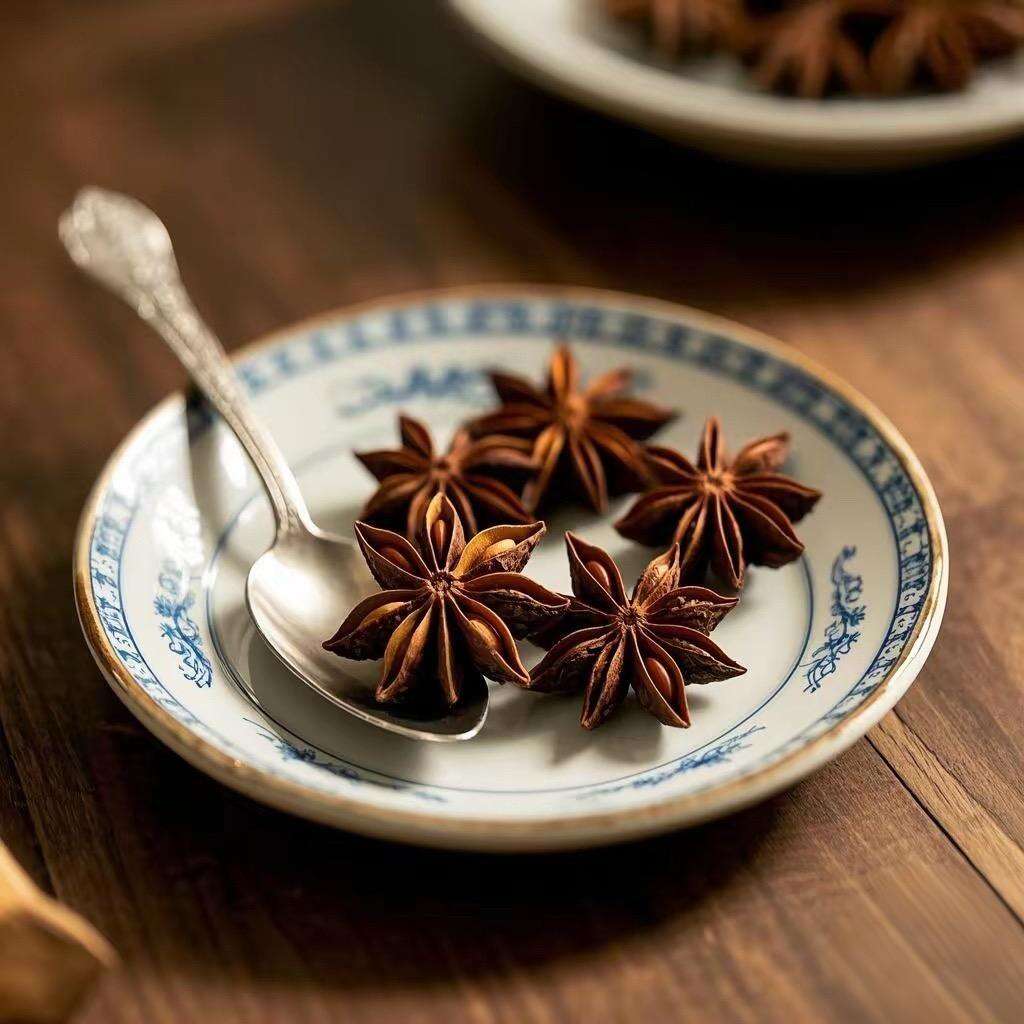
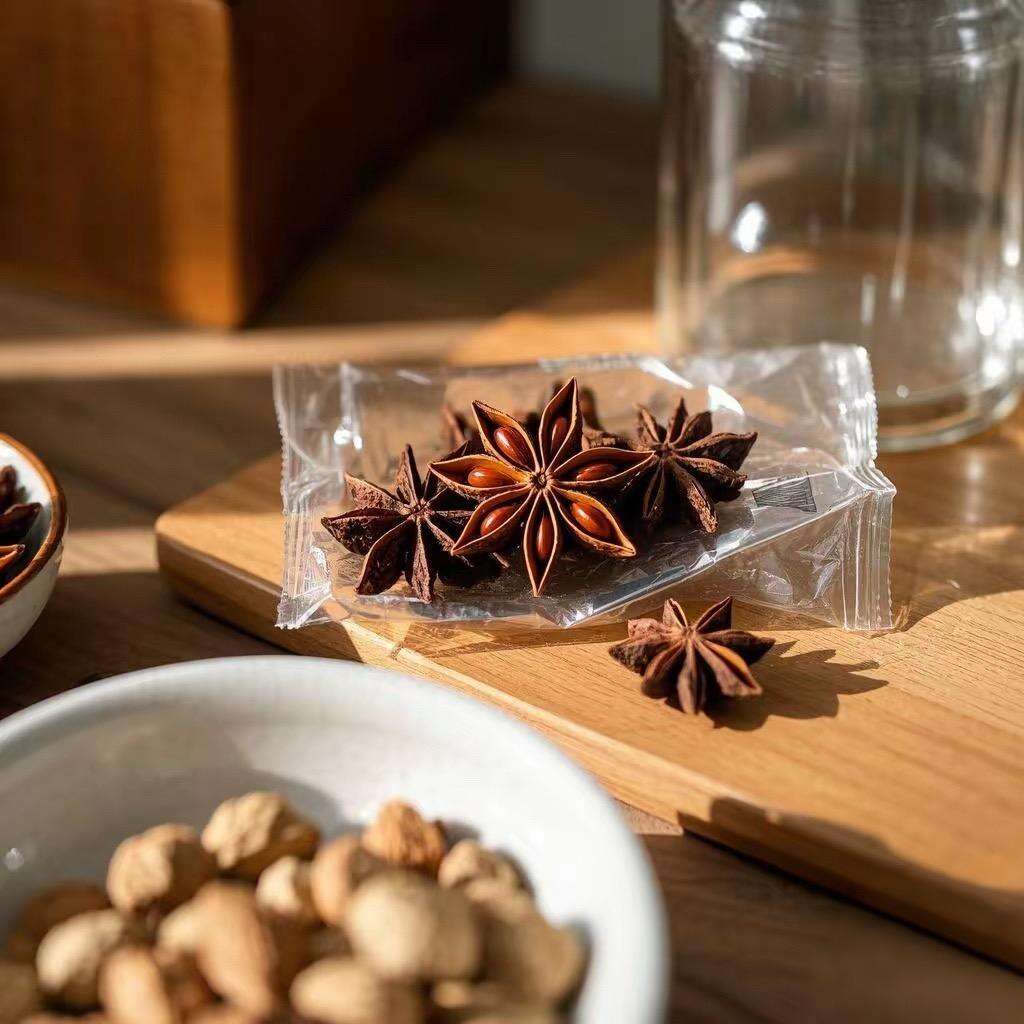
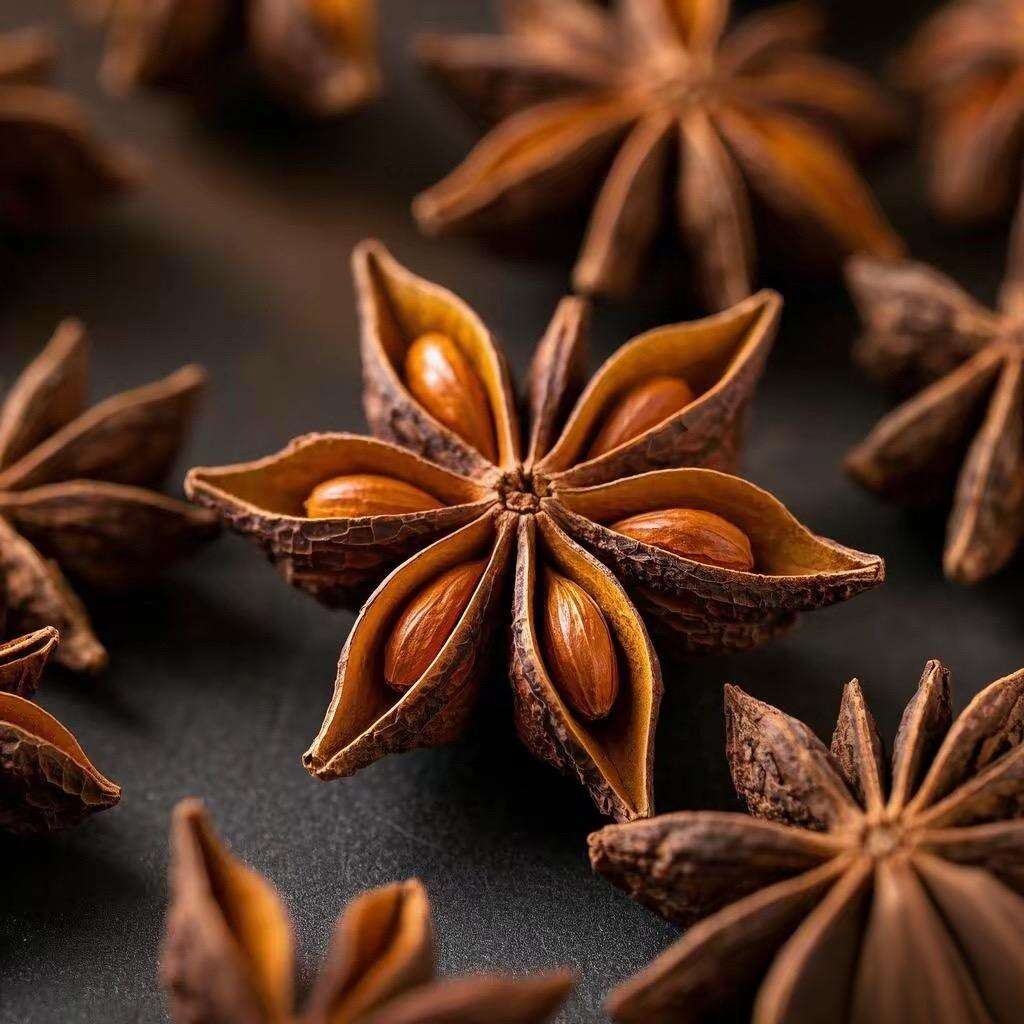
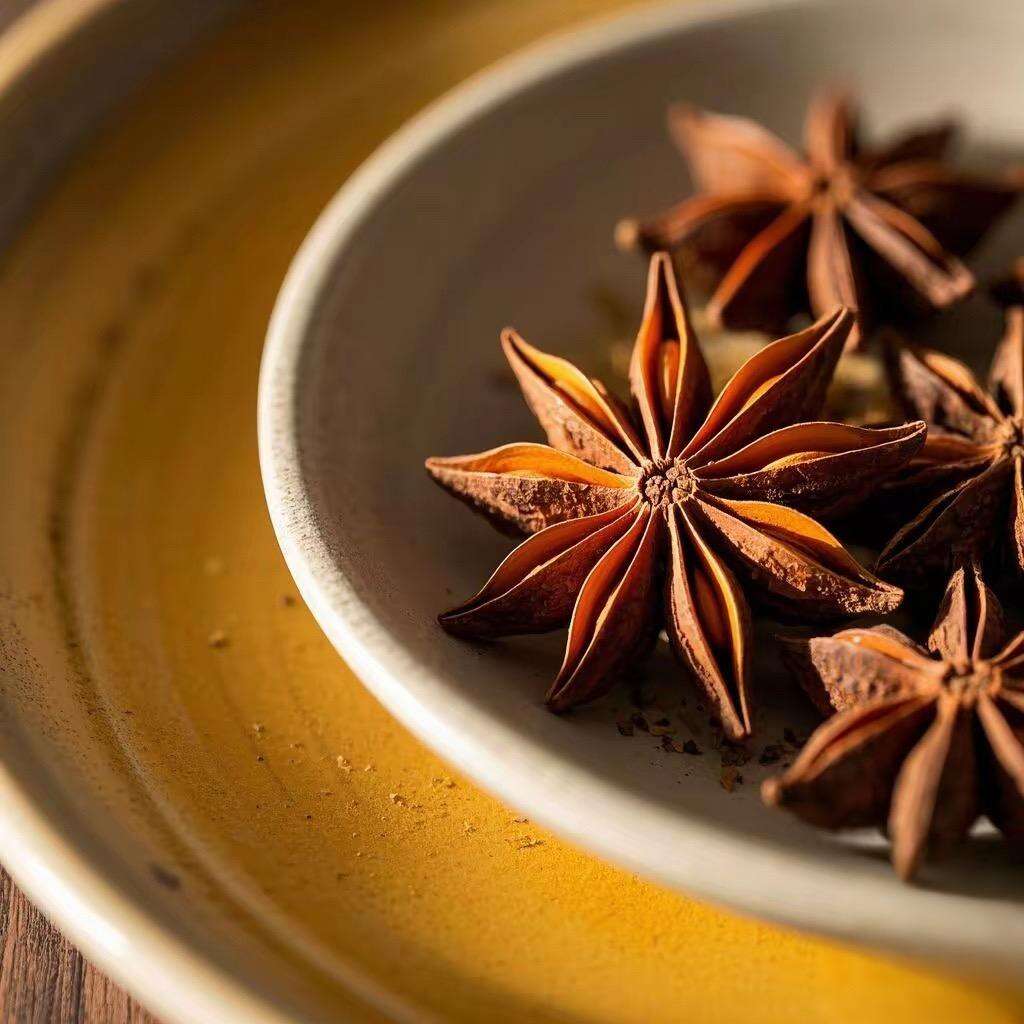
Whole-star ratio decides whether your lot behaves like a premium spice or like an expensive bag of fragments, because breakage changes visual grade, weight distribution, fines load, consumer perception, and sometimes even how consistently the ingredient runs into downstream grinding, tea-cutting, or retail packing lines. Why do buyers still treat it like decoration?
The regulatory baseline is less romantic than most brochures. India’s Food Safety and Standards rules for star anise define star anise as the dried mature fruit of Illicium verum, cap extraneous matter at 1.0%, stalks at 3.0%, broken and abnormal fruits at 25.0%, moisture at 10.0%, acid-insoluble ash at 1.0%, and require volatile oil of at least 8.0 mL/100 g; they also define broken fruits as those with fewer than five follicles. Meanwhile, the FDA’s spice definitions make the broader point buyers forget: spices are whole, broken, or ground forms, and for star anise the measurable quality characteristics are volatile oil, total ash, and acid-insoluble ash. Not pretty photos. Not “premium feel.” Measurable stuff.
The legal floor is useful, but I would not buy to it
Here’s the uncomfortable truth: a legal minimum is there to keep the category from collapsing, not to protect your margin, your retail presentation, or your customer complaints. If you buy to the floor, you should expect floor-grade arguments.
I use the official limits as the baseline, then tighten commercially.
Spec item
Legal / regulatory floor
My premium commercial target
What it really protects
Whole-star ratio
Not specifically required as a premium ratio
75–85% whole stars by count or agreed mass basis
Visual grade, retail trust, consistent packing
Broken fruits
Max 25.0%
Max 10–15%
Dust, ugly fill, grind inconsistency
Abnormal / undeveloped fruits
Included in 25.0% broken+abnormal
Max 2–3%
Weak aroma, poor visual uniformity
Stalks
Max 3.0%
Max 1.0%
Dead weight, false bulk, sorting complaints
Extraneous matter
Max 1.0%
Max 0.2–0.5%
Claims, rework, customs exposure
Moisture
Max 10.0%
8.5–9.5% target, 10.0% hard stop
Mold risk, softening, odor drift
Acid-insoluble ash
Max 1.0%
Max 0.8%
Sand/grit, dirty-mouth complaints
Volatile oil
Min 8.0 mL/100 g
Trend by lot, do not buy blind
Aroma strength and batch repeatability
That table is my bias, and yes, I’m comfortable owning it. Buyers who insist that 25% broken fruit is “still compliant” are usually the same people who get dramatic when the bottom of the carton turns into sweepings.
Broken control is a process problem, not a receiving problem
I’ve seen this movie.
The supplier blames transit, the freight forwarder blames pallet handling, the buyer blames the factory, and nobody wants to admit that breakage usually starts earlier, with an over-dry lot, rough cleaning, weak inner bagging, aggressive compression, lazy carton geometry, and no written definition of what “broken” means. Is that quality control, or is that theater?
Your own site already points to the right internal architecture. The post on Chinese herbal slices quality control: CTQ, spec freeze, and golden sample says the problem plainly: foreign matter, moisture window, and fines are CTQs, and spec freeze plus a golden sample stop the “same product, different batch” nonsense. The companion piece on how to read a Chinese herbal OEM quotation makes the buyer-side move even clearer: ask for cut size or size distribution, ask for a moisture window, and ask for the foreign matter limit together with the inspection method. That is the difference between a purchase order and a future argument.
The clause I would actually write
This is the language I’d put in the PO, not because it sounds elegant, but because it reduces emails later:
Star anise shall be supplied as Illicium verum whole dried fruit, with whole-star ratio measured on an agreed count or mass basis; broken fruit defined as fewer than five follicles; abnormal fruit defined separately; stalks, extraneous matter, moisture, acid-insoluble ash, and volatile oil all stated as lot-release parameters; inspection by visual sort plus sieve where relevant; magnet and metal-detection records retained; and one signed retain sample kept by both buyer and seller.
That is not overkill. That is adulthood.
Foreign matter prevention is won before the warehouse photo
I don’t believe “clean.”
I believe removal steps, logs, retained samples, and a system that can tell me whether the foreign matter risk came from field collection, primary cleaning, drying yards, secondary sorting, packing, or warehouse handling, because “clean” with no method is just a polite lie. Why do so many buyers still accept it?
Here’s my hard rule: foreign matter prevention in star anise should be treated as a five-stage control stack, not a single checkpoint.
What that stack should look like
Field-side exclusion comes first: no mixed plant debris, no opportunistic sweepings, no bag reuse. Then primary cleaning: aspiration, sieving, destoning, and visible defect removal. Then secondary protection: controlled drying, low-damage handling, liner choice, and carton discipline. Then final critical checks: magnet, metal detection where appropriate, lot coding, retain samples. Then receiving verification: defined sampling, photo standard, and disposition rules.
That’s boring. Good. Boring systems keep goods out of recall notices.
The market has stopped forgiving sloppy spice control
This part matters.
In 2024, Reuters reported that MDH had averaged a 14.5% U.S. shipment rejection rate since 2021, and that roughly 20% of its shipments in the 2023–24 fiscal period through May 3 had been rejected after Salmonella failures; Reuters also reported that Hong Kong suspended several MDH and Everest blends, Singapore recalled an Everest fish curry mix over ethylene oxide concerns, and India began inspections plus mandatory ethylene oxide testing for consignments to Hong Kong and Singapore. In the United States, the FDA’s June 30, 2023 public health alert said recalled Everest and Maggi spice products contaminated with Salmonella had reached stores in 11 states, and the remaining product held by the recalling firm was destroyed under FDA supervision. Then, in 2024, the FDA’s cinnamon alert recommended recalls for 11 brands with lead levels ranging from 2.03 to 7.68 ppm. Different spices. Same lesson: weak controls become public, fast.
So no, I do not buy the old excuse that star anise is “just a whole spice” and therefore lower risk. Whole form reduces some issues and masks others. That is exactly why whole-star ratio, broken control, and foreign matter prevention belong in the same conversation.
What a skeptical buyer should demand from a star anise supplier
I’d keep it simple, sharp, and slightly annoying.
Ask for the whole-star ratio basis. Ask how broken fruit is defined. Ask whether abnormal fruit is counted inside or outside the broken limit. Ask for stalk %, extraneous matter %, moisture method, acid-insoluble ash method, volatile-oil method, photo standard, retain sample rule, and fail disposition. Then ask to see whether those limits appear identically on the quote, the COA, and the carton docs.
What is a good whole-star ratio for bulk star anise?
A good whole-star ratio for bulk star anise is a commercially defined share of intact, visually complete fruits that is high enough to protect grade, aroma perception, and pack appearance, while low enough to reflect real handling losses; in practice, I treat 75–85% whole stars as a strong premium range.
Anything looser than that can still be legal, but it stops feeling premium fast. If the seller will not define the basis of measurement, the number is useless.
How should broken star anise be defined?
Broken star anise should be defined as fruit that has lost enough structure to fall outside the agreed commercial grade, with the cleanest operational definition being a fruit containing fewer than five follicles, because that turns a visual argument into a measurable sorting rule.
I prefer writing that definition directly into the PO and matching it to photo standards. Otherwise, buyer and seller end up arguing from different mental pictures.
What counts as foreign matter in star anise?
Foreign matter in star anise is any visible material that does not naturally belong to the fruit lot, including dust, stones, stalk excess, bag debris, insect-related contamination, and unrelated plant or mineral material, measured against a stated limit and checked by a stated method rather than by vague claims of cleanliness.
That last part matters most. “Clean” is not a metric. A limit plus a method is.
Can a COA by itself prevent star anise quality disputes?
A COA by itself cannot prevent star anise quality disputes because it is only one document in a wider control chain that must also include a written spec, sampling rule, inspection method, retain sample, and clear failure disposition, otherwise the certificate becomes paperwork without enforcement power.
I’ve watched teams wave COAs around like magic shields. They are not. A COA without spec alignment is decoration.
Your Next Move
Here’s my blunt recommendation: stop buying star anise with descriptive language alone. Build the page around the buying logic, then move the reader toward action with the pages that actually close the gap between curiosity and procurement: the Star Anise (Ba Jiao Hui Xiang) supplier page, the quality-control framework, the OEM quotation guide, and the GMP/ISO 22000/COA playbook. Then ask suppliers for a real spec, a real sample, and a real method. If they cannot give you those three things, don’t buy the carton.
Our low MOQ of 1 kg (2.2 lb) makes it easy to order Chinese herbal slices or wholesale Chinese medicine herbs. Private-label and bilingual labeling are also available.
Delivery Cycle & Support
We have a fast 7-day lead time. We provide free samples, COA reports, and technical support to help you bring high-quality bulk Chinese herbs to market.
Quality & Certifications
Our products are manufactured in a GMP-certified facility and meet ISO22000 standards. All Chinese herbs are third-party tested for heavy metals, pesticides, and microorganisms.