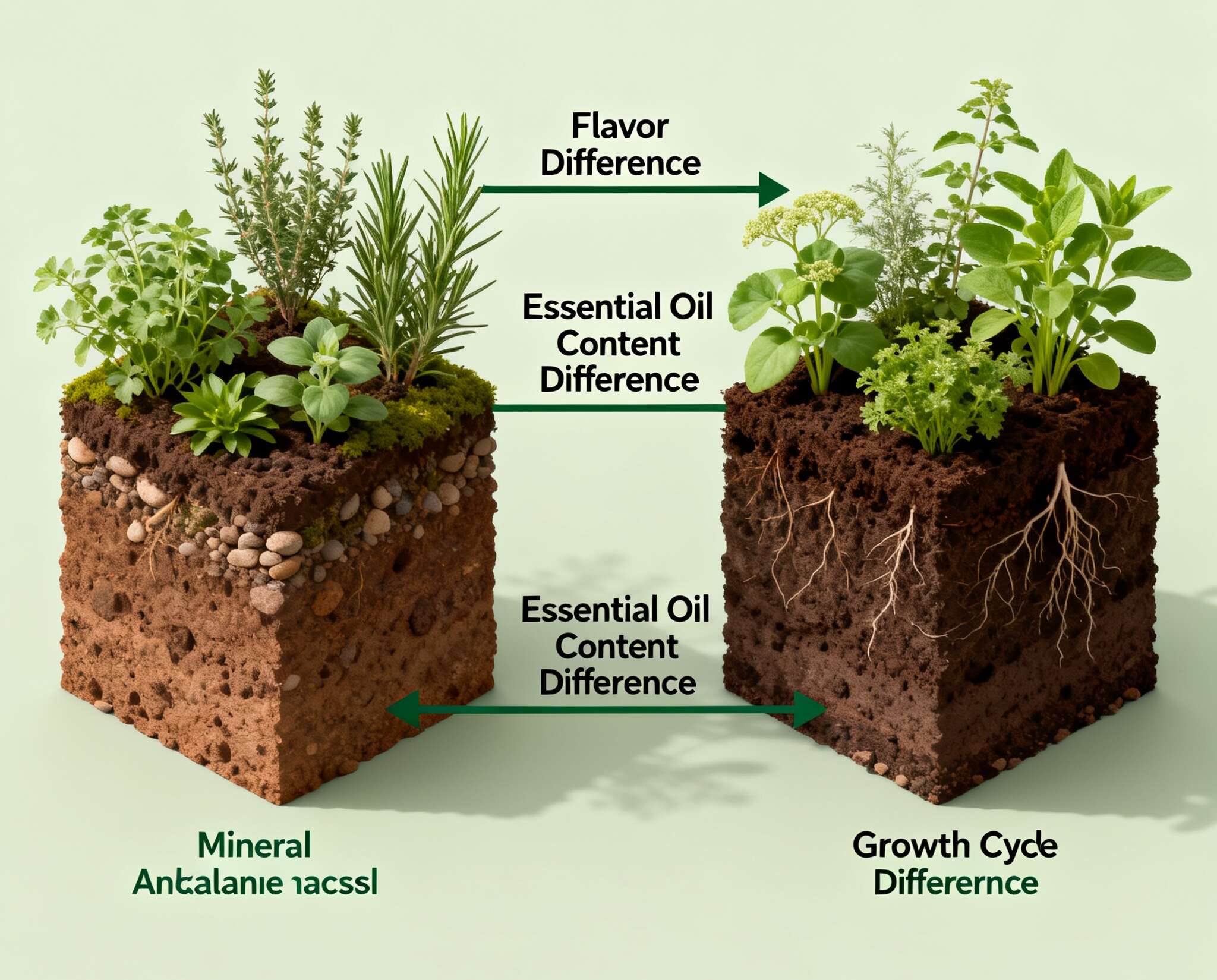
You can taste place. In herbs, you can measure it too—down to the molecule. Terroir isn’t just a wine idea; it’s a practical framework for buyers, formulators, and QA leads. Soil chemistry, climate swings, altitude, and the root-zone microbiome all nudge secondary metabolites—essential oils, phenolics, saponins—up or down. Those nudges show up in aroma, efficacy, and yield. This piece turns that science into simple levers you can pull in sourcing and production, with real-world examples and a short data table for quick decisions.
Season matters more than most people expect. In rosemary, summer lots often show a brighter monoterpene profile (think more volatile, fresh notes), while cooler-season harvests lean toward oxygenated monoterpenes that track with deeper, medicinal tones and stronger antioxidant behavior. These are not tiny blips; they’re clear shifts across the calendar.
How to use it:
If you spec rosemary for rubs or teas that need “lift,” target warm-season harvest windows.
If your balm or tincture prefers stronger oxygenated notes, buy late-season and write that timing into the PO.
Lock down drying parameters. High dryer temps cook off volatiles. Ask for the maximum drying temp and curve in the lot docs.
Post-harvest control (GC-MS markers): Tie acceptance to 1–3 marker compounds (for example, 1,8-cineole, camphor), not vague “smells right.” Your lab will thank you later.
Same plant, different dirt, different fingerprint. Purple basil trials show that soil type, pH, and organic matter shift the essential-oil spectrum—right down to the ratio of sweet vs spicy notes. Available phosphorus is a frequent troublemaker here; push it too high and you can flatten the profile.
What to ask suppliers:
Texture class (sandy loam, clay loam), pH range, organic-matter band.
Basic nutrient snapshot (especially P and K).
Field block IDs, so you can tie chemistry to specific ground.
Why it matters: you don’t buy “basil” in the abstract; you buy a chemotype. Soil points that needle.
Irrigation Regime & Water Stress (basil, agronomy, yield–quality trade-off)
Here’s the honest trade: mild water stress tends to push oil concentration up, but biomass down. That’s been seen in basil again and again. If you chase aroma impact per kilo finished product, a controlled deficit helps; if you need raw tonnage for extracts, keep irrigation steady.
Design it on purpose: If your end use is seasoning-grade intensity, allow a controlled deficit in the agronomy brief. If your line needs throughput for extract feedstock, avoid the stress and prioritize biomass. It’s a dial, not an on/off switch.
Buyer language that works: request “irrigation regime notes” with the field log, plus harvest stage (days after transplant or a simple growth stage scale). Dont leave it to guesses.
Temperature Seasonality & Phosphorus Availability (ginseng, secondary metabolites)
Not all terroir levers weigh the same. For Panax ginseng, climate variables—especially temperature seasonality—often explain a big chunk of the ginsenoside pattern. Soil phosphorus then fine-tunes within that climate ceiling. If you standardize for Rg1/Rb1 or total saponins, map climate bands first, shortlist soils second, and confirm by HPLC.
Procurement move:
Pre-qualify origins by bioclimatic window (heat/cold range and seasonality index).
Add “available P band” to your farm questionnaire.
Expect fewer out-of-spec surprises and faster release decisions.
Stable Isotope Ratio Analysis (saffron origin, traceability)
Terroir leaves fingerprints you can’t fake easily. Stable isotope ratios (H, C, N) can separate saffron origins and align with quality markers like crocin, picrocrocin, and safranal. If you sell a premium SKU where origin is the story, isotope plus chemometrics gives your claims backbone—no drama, just lab work.
QA note: build isotope checks into your COA workflow for high-value botanicals. Keep results in LIMS with the GC-MS profile so your auditors see one clean chain.
Genotype × Ecology Interaction (peppermint, G×E)
Peppermint reminds us that genetics and ecology co-write the spec. A menthol-forward cultivar in one valley can turn oddly flat in another. That’s classic G×E. Pair cultivar with site, and write the pair into your purchase spec. If you swap sites, expect the chemistry to move.
Evidence Table — Terroir Factors and Chemistry (data table)
Terroir factor
What moves
Representative outcome (directional)
Herb example
Why it matters for spec
Season / climate
Monoterpenes vs oxygenated monoterpenes
Warm season → brighter, more volatile; cool season → deeper, more oxygenated
Rosemary
Time harvest window to match target note and activity
Soil type, pH, OM%
Essential-oil component ratios
Soil class and fertility shift sweet/spicy balance; high available P can dull key notes
Purple basil
Ask for soil bands; it predicts flavor and stability
Irrigation / water stress
Oil % vs biomass
Controlled deficit ↑ oil %, ↓ biomass
Basil
Pick your trade-off: potency or throughput
Temperature seasonality & P
Saponin spectrum
Climate sets the ceiling; P fine-tunes ginsenosides
Ginseng
Pre-qualify by climate band; verify by HPLC
Stable isotope signature
Geographical origin markers
H/C/N profile distinguishes producing regions
Saffron
Add origin verification to QA for premium SKUs
Genotype × ecology
Oil yield & composition
Cultivar response depends on site conditions
Peppermint
Lock cultivar+site; avoid silent profile drift
Source notes: peer-reviewed work on rosemary seasonal chemistry, purple basil soil–oil correlations, basil irrigation trials, ginseng climate–metabolite models, saffron isotope origin studies, and G×E in peppermint.
From Science to Spec (GACP, COA, ISO 22000, GMP)
Let’s connect lab talk to paperwork and daily ops:
Make terroir visible in the spec. Add fields for origin coordinates/altitude, soil class (USDA/FAO), pH and OM bands, harvest month, cultivar. Tie each field to marker compounds and limits.
COA + context. Request field logs (irrigation regime, rainfall notes), drying curve and max temperature, and storage notes (RH, air flow). Essential oils hate hot dry rooms with no control.
Risk-based sampling. Sample per micro-lot when terroir variance is high. Don’t composite everything into mush; you’ll hide problems.
GACP at the farm gate. Document agronomy, harvest window, and handling. Then hand off to GMP slicing, sorting, drying, and grinding.
LIMS-ready data. Build GC-MS/HPLC fingerprints, heavy metals, pesticide residue panel, and micro limits into your LIMS so QA can hold/release fast.
Spec knobs that matter. Moisture, water activity (aw), mesh size, ash, volatile oil %, and the 1–3 marker compounds that define your claim.
Plan for seasonality. Bake harvest windows into MRP. It’s awkward to buy summer chemistry in winter and hope for the same note.
No overkill. If an application doesn’t care about terroir (say, neutral base for an extract blend), collapse variants and simplify the SKU tree.
GuoCao manufacturing capabilities (GMP, ISO 22000, OEM/ODM, COA)
You don’t need seven vendors to stitch a spec together. GuoCao runs GMP production lines, an ISO 22000 food-safety system, and third-party COA on every lot, backed by multi-temperature warehousing and scale that actually ships. We support OEM/ODM for blends, cut thickness, and grind levels, plus labeling in multiple languages as needed. Our herbs and spices move to the United States, Europe, Australia, Japan, Korea, Canada, Malaysia, the Philippines, and beyond—serving pharma companies, supplement makers, functional beverage brands, hospitals, cosmetic raw-material buyers, distributors, and local retailers.
Explore product families here (internal links, no external sites):
Rosemary for topical balm (antioxidant-leaning, GC-MS markers)
Goal: stronger oxygenated monoterpene balance for a more medicinal tone. Action: target cool-season harvests; specify harvest months and dryer max temp; verify by GC-MS (cineole/camphor balance). Fit with GuoCao: contract the harvest window and marker-based release via Custom OEM/ODM.
Basil for seasoning line (aroma intensity vs throughput)
Goal: punchy top-note per kilo finished spice. Action: allow mild deficit irrigation in the agronomy brief and accept lower biomass. Confirm oil % and 2–3 key volatiles at intake. Fit with GuoCao: pre-book stress-tilted lots within Dried Spices and keep the drying profile inside your spec.
Goal: consistent saponin profile across lots. Action: shortlist origins by temperature seasonality and soil P bands; confirm by HPLC. Fit with GuoCao: leverage the network under Root & Rhizome Medicinals; include site and soil metadata in the PO and the COA packet.
Saffron for premium beverage flavoring (origin claim, isotope)
Goal: defend origin while holding a defined sensory map. Action: require stable-isotope checks with crocin/picrocrocin/safranal panel; match lots to your flavor target. Fit with GuoCao: source via All Herbs & Spices and park release in QA until isotope and GC-MS data clear.
SEO alignment (herbs & spices wholesale keywords)
This article naturally targets phrases like “wholesale Chinese medicinal herbs,” “bulk spices supplier,” “roots and rhizomes,” “flowers and whole herbs,” “barks,” “fruits and seeds,” and “OEM/ODM herb processing.” It mirrors the way buyers actually search and links into the exact category pages above, so crawlers see clean structure and users land where they can act.
Wrap-up — Terroir as a Procurement Tool
Terroir isn’t magic. It’s a control panel. Climate sets big contours; soil and water fine-tune; cultivar and microbiome add color. When you write specs and POs with those levers in mind, your herbs stop surprising you, your blends stay on note, and your COA inbox gets calmer. If you want help turning this into a one-page sourcing plan—by SKU, by season, by origin—loop in GuoCao. We’ll map the right field to the right form, then keep it consistent at scale. Its not complicated, just needs discipline.
Our low MOQ of 1 kg (2.2 lb) makes it easy to order Chinese herbal slices or wholesale Chinese medicine herbs. Private-label and bilingual labeling are also available.
Delivery Cycle & Support
We have a fast 7-day lead time. We provide free samples, COA reports, and technical support to help you bring high-quality bulk Chinese herbs to market.
Quality & Certifications
Our products are manufactured in a GMP-certified facility and meet ISO22000 standards. All Chinese herbs are third-party tested for heavy metals, pesticides, and microorganisms.