Tangerine Peel Wholesale Guide: Aged Chen Pi vs Standard Dried Peel
Aged Chen Pi and ordinary dried tangerine peel may look similar in a supplier photograph, but they are not commercially identical. This wholesale guide explains how buyers should compare origin, storage age, aroma, chemistry, safety testing, traceability, and intended use before approving a bulk order.
In the dried tangerine peel wholesale business, two products can share the same botanical name, arrive in similarly sized cartons, and photograph almost identically, yet produce very different aroma, extraction behavior, customer expectations, compliance risks, and landed costs once they enter a commercial formula.
So why do buyers still compare them by price per kilogram?
The uncomfortable answer is that “Chen Pi” is often used too loosely. A supplier may apply the name to recently dried mandarin peel, naturally aged peel, warehouse-aged material, Xinhui-origin peel, non-Xinhui peel, whole three-lobed pieces, broken peel, tea-cut granules, or processing leftovers containing excessive white pith.
That naming problem benefits sellers more than buyers.
A serious sourcing decision must separate four variables:
Botanical and cultivar identity
Geographical origin
Verified storage age
Final-product application
Ignore any one of them and the comparison becomes unreliable.
Table of Contents
Chen Pi, Xinhui Chen Pi, and Standard Dried Peel Are Not the Same Product
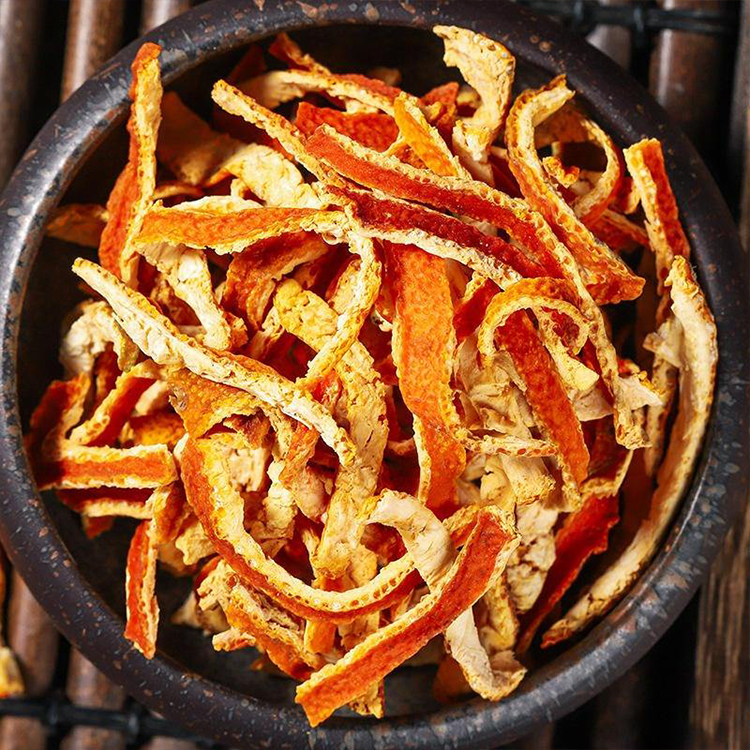
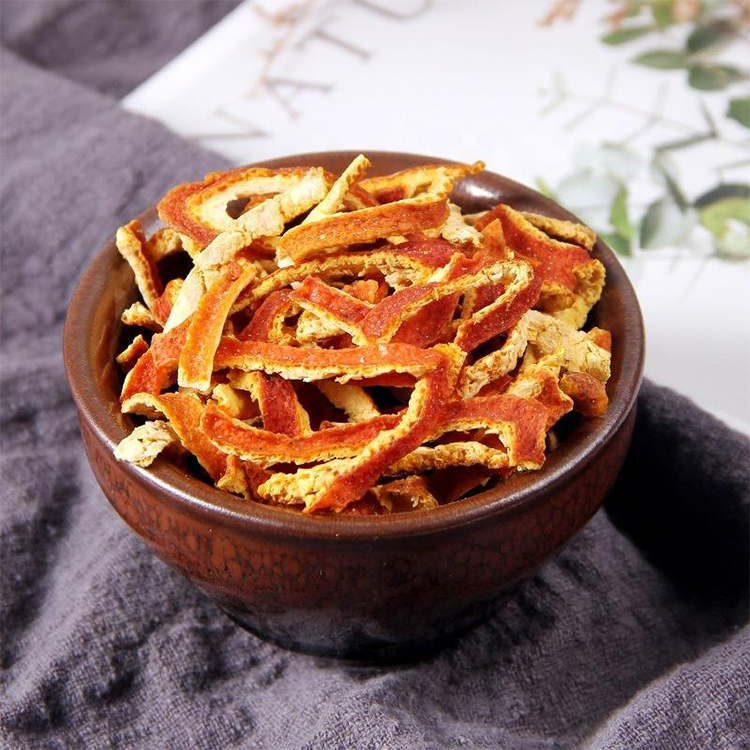
Chen Pi is generally associated with the dried mature peel of Citrus reticulata and related permitted cultivars. In trade, the English names include dried tangerine peel, dried mandarin peel, aged citrus peel, and aged mandarin peel.
But those labels do not automatically describe the same grade.
The website’s bulk Tangerine Peel and Chen Pi product page identifies the material as Citrus reticulata, with dried peel form and orange-to-brown coloration. That is a useful starting identity. It is not, by itself, proof of cultivar, Xinhui origin, harvest year, or verified aging.
That distinction matters.
Standard dried tangerine peel
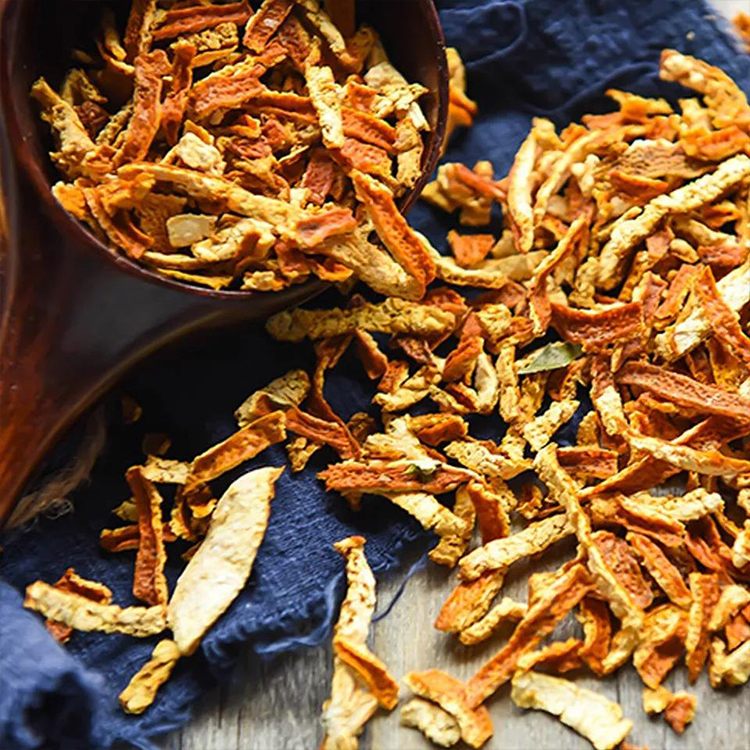
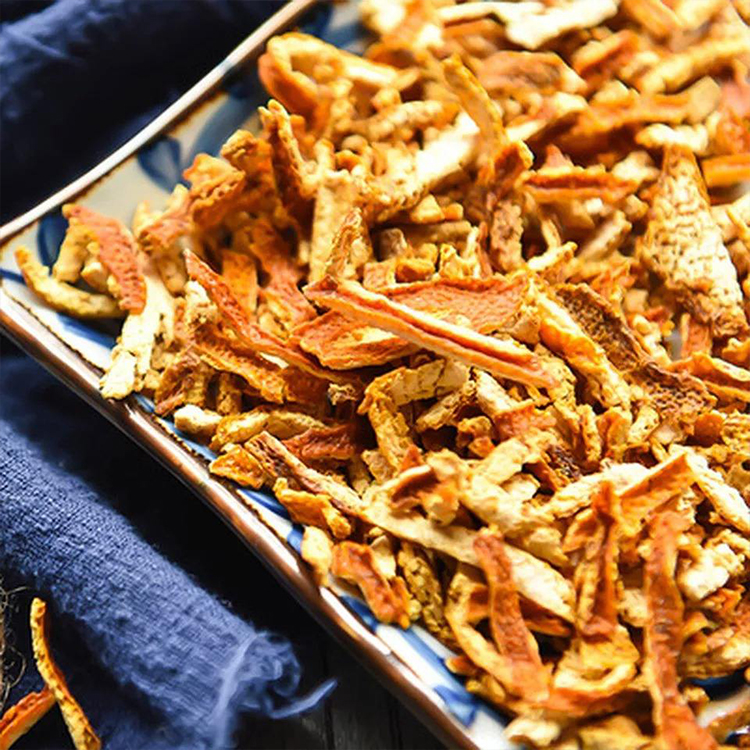
Standard dried peel is commonly produced by separating fresh citrus peel from the fruit, cleaning it, drying it to a stable moisture level, sorting it, and packing it for use in tea, seasoning, extraction, foodservice, or botanical blends.
Its value usually comes from:
Clean citrus aroma
Consistent cut size
Low foreign matter
Controlled moisture
Suitable microbiological quality
Competitive price
Reliable availability
This is not an inferior product. For many applications, it is the rational product.
A tea-bag manufacturer that needs a bright top note, for example, may prefer a clean recent peel because its fresh citrus character can be more direct. A spice blender may care more about particle size, oil retention, and batch consistency than a claimed 10-year age.
Aged Chen Pi
Aged Chen Pi is dried peel stored over time under conditions intended to permit gradual sensory and chemical change without allowing mold growth, pest damage, excessive oxidation, or uncontrolled moisture uptake.
Real aging is slow.
The peel usually becomes darker and less aggressively sharp. The aroma may move from bright, fresh citrus toward deeper woody, herbal, sweet, camphor-like, or mature citrus notes. But age alone does not guarantee quality. Poor raw material stored for ten years remains poor raw material—just older.
Xinhui Chen Pi
Xinhui Chen Pi refers to peel associated with Xinhui District in Jiangmen, Guangdong, particularly material linked to Citrus reticulata ‘Chachi.’ Origin is not decorative storytelling here. It is part of the product identity and premium-value argument.
The legal context supports taking that name seriously. In the signed EU–China agreement on geographical indications, “Xinhui Chen Pi” appears as item 128 in Annex V, translated as “Xinhui Orange Peel.” The agreement text places Annex V names in a staged protection process and also addresses misleading geographical use and conflicting trademarks.
In plain English: do not print “Xinhui” on a specification, label, invoice, or retail pouch merely because the peel came from Guangdong.
Premium reflects origin, age, scarcity, branding, and evidence
Best first order
Representative trial lot
Two age bands for side-by-side evaluation
Verified sample with origin and lot documentation
The Chemistry of Aging Is More Complicated Than “Older Is Better”
Age claims sell.
That does not mean every compound rises with time, every biological effect improves, or every 11-year peel outperforms every three-year peel. The chemistry moves in several directions at once, and anyone reducing the subject to “the older, the better” is selling a slogan rather than a technical specification.
A 2022 Frontiers in Nutrition study compared Citrus reticulata ‘Chachi’ peel stored for 1, 3, 4, 5, 6, and 11 years. The researchers reported that hesperidin decreased as storage time increased, while nobiletin, tangeretin, and 3,5,6,7,8,3′,4′-heptamethoxyflavone increased. They also identified 47 marker compounds capable of helping distinguish storage years.
That is the point buyers often miss: aging does not simply add “more active compounds.” It changes the profile.
The same study reported stronger antioxidant behavior with increased storage time, but it did not find a simple, consistent relationship between age and inhibition of the digestive enzymes α-amylase and α-glucosidase. Growing conditions, harvest, processing, and storage all affected the result.
Older is different. Not automatically superior.
What happens to aroma?
Fresh peel is often rich in volatile terpenes, including compounds associated with citrus aroma such as D-limonene. Storage, oxygen exposure, temperature, humidity, packaging, and microbial activity can alter that volatile profile.
A tightly sealed, low-moisture warehouse does not behave like a humid storeroom with frequent air exchange. Nor does peel packed in a breathable sack age like peel stored in a lined carton or barrier pouch.
That creates a commercial problem: two sellers can both claim “five-year Chen Pi” while supplying products with noticeably different odor, color, brittleness, oil-cell condition, and extract performance.
Age can be tested more objectively
The industry no longer has to rely only on a veteran buyer smelling the carton.
A 2024 Food Chemistry: X study on Chen Pi age discrimination combined Fourier-transform infrared spectroscopy, or FTIR, with a two-dimensional convolutional neural network, or 2D-CNN. The model achieved 97.92% classification accuracy on the original spectral images.
That does not mean every importer needs a deep-learning laboratory.
It does mean a handwritten “2016 harvest” certificate is weak evidence when modern analytical methods can identify chemical patterns associated with age. High-value purchases deserve a higher standard of proof.
My rule is simple: the larger the age premium, the stronger the evidence should become.
Origin Is a Commercial Asset—and a Fraud Target
The premium attached to Xinhui Chen Pi does not exist in isolation. China has built a much broader geographical-indication economy around products whose quality or reputation is linked to a particular place.
Those national figures do not tell us the market value of Xinhui Chen Pi alone. They do show why origin claims attract investment, branding, imitation, and regulatory attention.
Where premiums exist, substitution follows.
Questions I would ask about an Xinhui claim
I would not begin with “How old is it?” I would begin with these questions:
What is the exact cultivation and processing location?
What cultivar was used?
Who produced or collected the fresh fruit?
Is there a farm, cooperative, processor, or authorized-user record?
What harvest year appears in the incoming material record?
Can the seller connect that record to the finished lot number?
Was the material mixed with peel from another region?
Does the commercial invoice use the same origin description as the specification?
What evidence supports the use of the word “Xinhui” on customer packaging?
A supplier who answers with a story but no records has not answered.
For broader product discovery, buyers can compare Chen Pi with other aromatic materials in the site’s bulk dried spices range and fruit and seed herbal ingredient category. Those category relationships matter because Chen Pi frequently sits between three commercial sectors: traditional herbal material, culinary spice, and functional beverage ingredient.
What a Dried Tangerine Peel Wholesale Specification Should Contain
“Premium quality” is not a specification.
Neither is “best Chen Pi.”
A usable purchase specification should convert the buyer’s intended application into measurable or inspectable requirements. That document becomes the basis for quotations, samples, inspections, complaints, and repeat orders.
1. Botanical and origin identity
State the accepted botanical name, plant part, maturity stage, cultivar where required, and permitted production region.
For ordinary dried peel, Citrus reticulata may be sufficient if it matches the intended regulatory and product requirements. For Xinhui positioning, the origin and cultivar requirements need far more detail.
Do not let the supplier quietly replace a narrow identity requirement with “mixed mandarin peel.”
2. Aging statement
The specification should state whether age means:
Time since fruit harvest
Time since peeling
Time since completion of initial drying
Calendar-year designation
Minimum completed storage period
Blended age range
These are not identical.
A lot described as “2021 Chen Pi” could mean harvested in late 2021 and sold in early 2026, which is roughly four years of storage. Or it could mean a blend containing some 2021 material. Ask.
3. Physical form and cut size
Define whether you need:
Whole peel
Three-lobed peel
Broken peel
Strips
Tea-bag cut
Granules
Powder
Extract-grade milling material
Then establish an acceptable size distribution.
A nominal 5–10 mm tea cut with 18% fines is not functionally equivalent to a controlled 5–10 mm cut with less than 5% fines. Fine particles extract faster, create dust, change fill weights, escape some filter papers, and can make the bottom of a retail pouch look cheap.
4. Sensory profile
Create a retained reference sample and define:
Outer color
Inner color
Citrus intensity
Woody or herbal notes
Musty odor
Smoke odor
Sulfur odor
Fermented or sour notes
Bitterness
Pith level
Visible oil glands
Sensory inspection is subjective, but unmanaged subjectivity is worse.
5. Moisture and storage condition
Moisture affects weight, brittleness, microbial stability, aroma retention, and storage loss. The agreed limit should fit the cut form, packaging system, shipping route, and destination requirements.
For aged material, ask for historical storage conditions as well as the final moisture result. A passing result on shipment day does not prove that the peel spent five years in controlled storage.
6. Contaminant testing
At minimum, the risk assessment should consider:
Pesticide residues
Lead, Pb
Cadmium, Cd
Arsenic, As
Mercury, Hg
Total aerobic count
Yeast and mold
Escherichia coli
Salmonella
Sulfur dioxide, SO₂
Aflatoxins where storage history or humidity creates concern
But never copy limits from a general article into a contract without checking the destination market and product classification.
7. Lot-linked documentation
A professional release package should connect the following records:
Purchase order
Approved specification
Sample approval
Production or processing record
Lot number
Packing date
Certificate of analysis
Laboratory report
Pallet or carton labels
Commercial invoice
Packing list
Origin documents where required
One broken link weakens the entire age and origin story.
Food, Tea, Supplement, and Herbal Channels Require Different Decisions
Chen Pi can enter several regulatory channels. That flexibility is commercially attractive, but it also causes sloppy purchasing.
A peel intended as a culinary seasoning is not automatically documented the same way as a traditional herbal medicinal ingredient. A tea ingredient may later appear in a product promoted with digestive or respiratory claims, shifting the regulatory risk even though the raw material did not change.
Particle distribution, fill consistency, formula compatibility
Buy for the formula.
I would rather use an honestly specified recent peel that performs consistently than a supposedly 15-year product with no harvest record, no warehouse history, no retained sample, and an aroma that suggests damp storage.
U.S. importer responsibility
For food entering the United States, the FDA Foreign Supplier Verification Programs rule generally requires covered importers to develop and follow an FSVP for each imported food and foreign supplier, unless an exemption applies.
That shifts the question from “Does the supplier have a COA?” to “Does the importer have an adequate verification program for this food and supplier?”
A generic laboratory report does not replace supplier evaluation.
European pesticide requirements
For EU-bound food ingredients, buyers should verify the applicable commodity classification and active-substance limits through the official EU Pesticides Database. Maximum residue levels are legally permitted limits for specified pesticide and commodity combinations, not a single universal “EU pesticide standard.”
This detail traps inexperienced buyers. They request an “EU-compliant pesticide test” without defining the commodity mapping, residue panel, reporting limits, or applicable legal limits.
That request is almost meaningless.
How to Compare Chen Pi Wholesale Quotations Without Fooling Yourself
The cheapest quote often contains the least information.
A professional comparison should normalize each offer against the same specification:
Suppose Supplier A is only $0.50 per kilogram cheaper, but its lot contains 6% more fines and requires an independent retest. The apparent saving can disappear before the material reaches production.
Price comparisons should also separate:
Standard peel from aged peel
Xinhui from non-Xinhui
Whole peel from broken peel
Recent harvest from verified multi-year storage
Food-grade testing from pharmaceutical-style documentation
Supplier COA from independent laboratory testing
Ex-works price from delivered cost
Net peel weight from moisture-inflated weight
And never compare a 1 kg sample price directly with a 500 kg contract price.
A supplier claiming unlimited stock of three-year, five-year, ten-year, 15-year, and 20-year Chen Pi deserves extra scrutiny. Genuine multi-year inventory requires warehouse space, capital, pest control, humidity management, traceability, and stock discipline.
Age is inventory.
2. The sample is better than the shipment
This is common in ingredients with visible grading differences. Approve the sample in writing, seal a retained portion, photograph it under neutral light, and state that bulk material must match the approved reference.
3. The COA has no lot number
Reject it.
A certificate that cannot be tied to the bags, cartons, invoice, and shipment is marketing material, not batch evidence.
4. “Xinhui” appears only in the sales message
The origin description should be consistent across quotation, specification, contract, label, invoice, certificate, and traceability file.
5. Storage age is based only on peel color
Darkness can result from age, cultivar, harvest maturity, drying method, oxidation, heat, moisture exposure, or deliberate processing. Color is evidence, but weak evidence on its own.
6. The supplier avoids discussing sulfur treatment
SO₂ can affect appearance, stability, sensory quality, and labeling obligations. Ask whether sulfur fumigation or sulfite treatment was used, then test where the risk or market requires it.
7. The sales team cannot explain the cut specification
If the supplier cannot define mesh size, millimeter range, fines, whole-piece percentage, or pith content, production consistency will depend on luck.
FAQs
What is the difference between aged Chen Pi and standard dried tangerine peel?
Aged Chen Pi is dried Citrus reticulata peel that has been stored under controlled conditions long enough to develop a changed aroma, color, and chemical profile, while standard dried tangerine peel is usually sold primarily as a dehydrated citrus ingredient without a verified multi-year aging history, protected origin, or age-linked release specification.
Standard peel may offer a brighter citrus note and lower cost, making it suitable for tea, seasoning, extraction, and food manufacturing. Aged Chen Pi is generally chosen when deeper aroma, traditional positioning, age-specific chemistry, premium branding, or specialty culinary use justifies the added documentation and price.
Is Xinhui Chen Pi the same as ordinary Chen Pi?
Xinhui Chen Pi is a geographically defined form of Chen Pi associated with Xinhui District and typically Citrus reticulata ‘Chachi,’ whereas ordinary Chen Pi may come from other permitted cultivars and producing regions; the two should not be treated as interchangeable when origin, premium positioning, traceability, or protected-name claims matter.
A buyer should request evidence covering cultivation origin, processor identity, cultivar, harvest year, lot genealogy, and any authorization needed to use the protected geographical name. Guangdong origin alone is not sufficient proof of Xinhui origin.
How old should Chen Pi be for wholesale purchasing?
There is no universal best wholesale age for every buyer, but Xinhui Chen Pi is commonly discussed as a product aged at least three years, while tea, culinary, extract, and medicinal channels may require different age bands, sensory profiles, documentation, and budgets depending on the finished product and target market.
Three-year material can be a practical starting point for premium tea and herbal formulas. Longer-aged lots should be selected through side-by-side sensory and analytical evaluation rather than purchased solely because the number on the certificate is higher.
How can buyers verify the age of Chen Pi?
Chen Pi age should be verified through a chain of evidence combining harvest year, lot genealogy, warehouse records, packaging history, retained samples, sensory comparison, and, for higher-value lots, analytical fingerprinting such as HPLC, GC–MS, FTIR, or chemometric classification rather than relying on color, smell, or a seller’s handwritten certificate alone.
No single record is perfect. The strongest verification comes from consistent evidence across farm or collection documents, incoming inspection, storage logs, warehouse movements, release testing, and the physical properties of the final material.
What tests are required when importing dried tangerine peel?
A wholesale Chen Pi test plan should confirm botanical identity and screen the shipped lot for moisture, foreign matter, pesticides, Pb, Cd, As, Hg, microbiological indicators, and sulfur dioxide where relevant, with methods and limits selected for the destination country, product classification, serving size, and buyer specification.
Some buyers may also require aflatoxins, additional elemental contaminants, essential-oil profiling, flavonoid markers, irradiation status, allergen statements, GMO statements, or independent laboratory verification. The correct panel is risk-based, not copied from another product’s COA.
How do I choose a reliable dried mandarin peel supplier?
A reliable dried mandarin peel supplier is a producer or controlled processor that can match a written specification, provide representative pre-shipment samples, issue lot-linked test reports, explain origin and aging records, control cut size and storage, and support corrective action when a batch falls outside the agreed sensory, chemical, or safety limits.
Start with a manageable trial order. Compare at least two lots, test the material independently when commercial risk justifies it, and score the supplier on documentation speed, technical knowledge, sample-to-shipment consistency, packaging, traceability, and response to difficult questions—not friendliness alone.
Build the Specification Before Requesting the Quote
Do not send a supplier one sentence asking for the “best dried tangerine peel wholesale price.”
Send a specification.
State whether you need standard dried peel, aged Chen Pi, or verified Xinhui Chen Pi. Add the application, annual volume, target age, cut size, moisture requirement, packaging, destination country, test panel, labeling plan, and documents required before shipment.
My final advice is blunt: pay for evidence, not adjectives. A defensible three-year lot is worth more than a mysterious ten-year lot, and a clean standard peel that works in your formulation is a better purchase than premium Chen Pi selected for the wrong reason.
Our low MOQ of 1 kg (2.2 lb) makes it easy to order Chinese herbal slices or wholesale Chinese medicine herbs. Private-label and bilingual labeling are also available.
Delivery Cycle & Support
We have a fast 7-day lead time. We provide free samples, COA reports, and technical support to help you bring high-quality bulk Chinese herbs to market.
Quality & Certifications
Our products are manufactured in a GMP-certified facility and meet ISO22000 standards. All Chinese herbs are third-party tested for heavy metals, pesticides, and microorganisms.