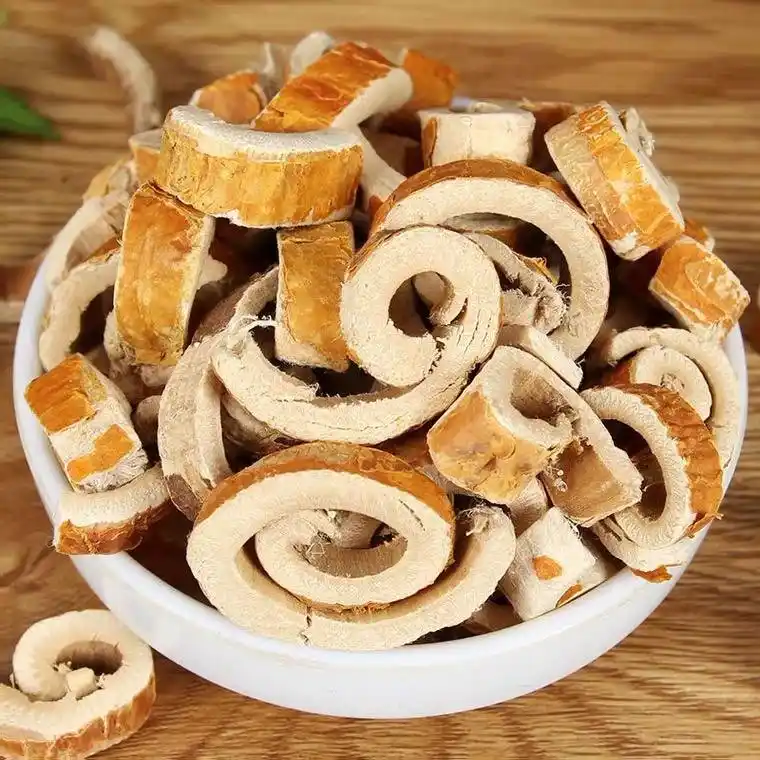
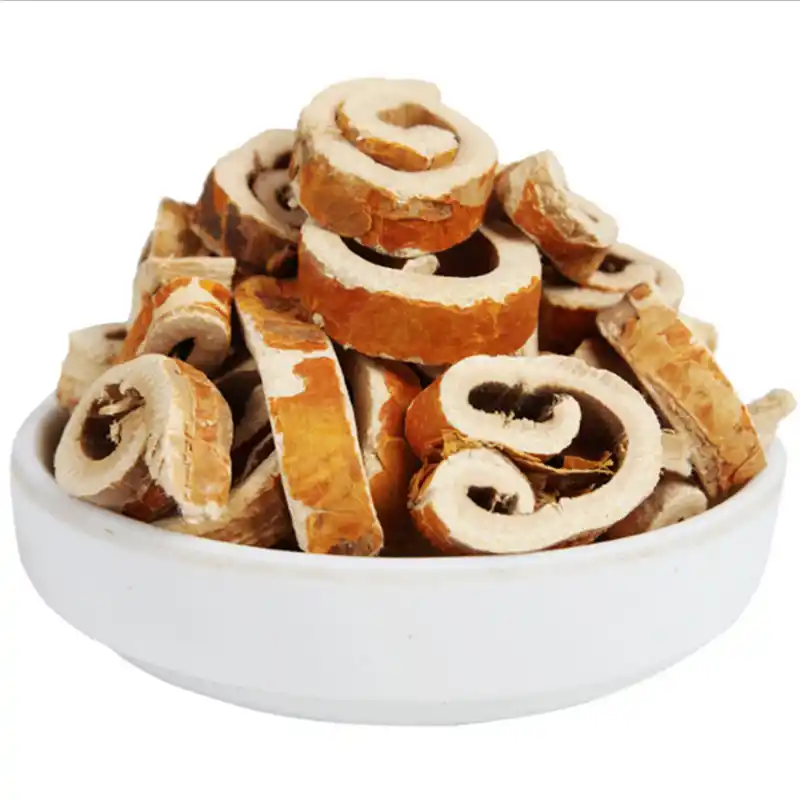
Dust is money. Mulberry root bark (Sang Bai Pi / Mori Cortex / Morus alba root bark) isn’t “messy” by nature—your process makes it messy, especially when you mill, screen, convey, and pack a bark material that loves to shed fines, cling via static, and ride air currents straight into seals, liners, and your neighbor SKU. So why do so many brands still treat “dust complaints” like bad luck?
Let me be blunt: in the herbal supply chain, “cleaning” is usually a vibe, not a system. And vibes don’t survive audits, customer videos, or a distributor who’s sick of wiping brown residue off every case.
If you’re sourcing Sang Bai Pi, start with the boring pages—because the boring pages tell you whether your supplier is building a complaint factory. The Mulberry Root Bark (Sang Bai Pi) bulk supply spec page is a good anchor for what form you’re actually buying (cut, slice, powder-ready), and the surrounding site structure matters too: the Barks (Cortex) Chinese medicines catalog and the master All Herbs and Spices category map tell you whether bark materials are treated as a distinct risk class (they should be).
Table of Contents
The hard truth about dust complaints
Most dust complaints are not “too much powder.” They’re too much uncontrolled powder—fugitive fines that escape the process, then show up where they shouldn’t.
Three common complaint signatures I see over and over:
The “dirty seal” complaint: brown fines trapped in heat seals, zipper tracks, or induction liners → looks like tampering, feels like low quality.
The “cross-contact panic” complaint: Sang Bai Pi dust on the outside of bags, then transferred onto other SKUs in the same carton → triggers allergen-style escalation even when it’s “just botanicals.”
The “warehouse snow” complaint: dust inside master cases, under tape lines, on pallet tops → suggests poor dust capture at packout and sloppy housekeeping.
And here’s the part people hate hearing: your packaging team can do everything right and still lose if the upstream cleaning standard is weak.
What regulators actually care about (and what buyers should mimic)
You can argue about aesthetics all day. Regulators don’t. They argue about records and risk.
FDA warning letters for dietary supplements are remarkably consistent on one point: if you can’t prove cleaning happened—equipment, lines, timestamps—you don’t get credit for claiming it happened. In a 2023 dietary supplement warning letter, FDA explicitly called out missing “date and time of maintenance, cleaning and sanitizing” entries in batch production records under 21 CFR 111.260(c). That is not a “paperwork nit.” That’s FDA telling you they don’t believe your line clearance story. FDA’s 2023 warning letter to Spartan Enterprises spells it out in plain English.
On the worker-safety side, OSHA isn’t shy about dust either. Their combustible dust enforcement isn’t limited to sexy industries like metal powder; organic dust is on the menu. OSHA’s October 3, 2024 release on a grain elevator case is a loud reminder of what “ignored dust” can cost—$536,000 in proposed penalties in that single matter. Different industry, same physics: dust accumulates, dust moves, dust ignites, dust harms. OSHA’s 2024 news release on Legacy Cooperative.
And if you want the uncomfortable benchmark buyers should steal, look at OSHA’s own inspection playbook: the revised Combustible Dust National Emphasis Program (CPL 03-00-008, dated Jan 30, 2023) literally prompts inspectors to ask whether there is dust accumulation of 1/32 inch thick or greater and whether housekeeping frequencies are established. This is not “the law” in one sentence, but it is absolutely how the enforcement mindset is structured. OSHA’s CPL 03-00-008 directive PDF.
So, yes: if you want fewer dust complaints, you build a system that would look sane to FDA and unsurprising to OSHA.
The cleaning standard that actually reduces complaints
Short version: dry-first, contained, verified, logged.
Longer version (the one that survives reality):
1) Process design beats “clean harder”
If you mill Sang Bai Pi (or even run aggressive sizing screens), you created a dust generator. Own it.
Local exhaust ventilation (LEV) at mills, sifters, dump stations.
Negative pressure in dusty rooms so fines don’t drift into packout.
Simple physical separation: raw handling → sizing/milling → packing, with controlled people/material flow.
This is why I like suppliers who openly talk about GMP thinking for powder lines instead of pretending powders are “just another SKU.” That mindset shows up in posts like leaf integrity and powder dust control for OEM lines, which—regardless of herb—makes the right operational point: once you grind, you inherit a different control problem.
2) Your SOP needs a “top-down” sequence (or you’re re-contaminating)
Bad cleaning has a pattern: people clean the floor first. Then they clean ledges. Then dust falls back down. Congratulations, you cleaned twice and still ship dusty cases.
A practical cleaning SOP for herbal powder processing should force this order:
Controlled wipe-down (minimal moisture): food-safe solvent/wipe strategy appropriate to your equipment materials
Filter and bin discipline: change-out schedule, sealed waste removal
Verification step: visual + documented check + optional particle/wipe test
Release: QC signoff tied to the next batch record
Yes, it’s tedious. That’s the point.
3) HEPA vacuum isn’t optional for powders, it’s the baseline
If your “cleaning” includes brooms, dry brushing, or compressed air, you’re not cleaning; you’re redistributing.
For botanical powders, the lowest-drama approach is sealed HEPA vacuuming with tools that reach ledges, cable trays, and machine frames. Operational details that matter:
HEPA reference point people understand: 99.97% efficiency at 0.3 µm (common rating language)
Use grounded hoses and anti-static tooling where feasible (static + bark fines = cling + spread)
If combustible dust classification is a concern, you pick equipment that matches your hazard class (don’t wing this)
And don’t forget the quiet killer: the packing area. A lot of “dust complaints” are really packout cleanliness failures, not milling failures.
4) Documentation is the complaint-reduction lever nobody wants to fund
I’m going to say the thing procurement teams hate: if you aren’t paying for documentation, you are paying for chaos.
At minimum, your batch record trail should be able to answer—fast—these questions:
Which line ran Sang Bai Pi (Mori Cortex) lot GC-SBP-2026-01 (or whatever your scheme is)?
When was the line cleaned before that run?
Who verified line clearance?
What filters were used, and when were they last changed?
Where are the deviations/CAPA if dust exceeded internal limits?
The spec language that stops “dusty shipments” before they exist
If you only specify the herb name, you’re begging for arguments later. Spec the dust risk.
What I’d put into a buyer spec (and yes, it will annoy somebody):
Form: decoction pieces vs cut/sift vs powder-ready granulate
Fines limit: define a sieve cut (example: % passing 80 mesh / 180 µm) if you’re buying a powder or powder-ready form
Packaging cleanliness: “no visible dust on outer bag surfaces; no dust accumulation inside master cases beyond X threshold”
Line clearance requirement: documented cleaning log + QC signoff attached to batch record
Complaint handling SLA: response time, retain samples, root-cause template
Preventive controls: HEPA vacuum-based housekeeping, no compressed-air cleaning in packing zones (unless contained)
You don’t need to be a jerk about it. But you do need to be specific.
Practical comparison: what actually works on bark-powder dust
Method
Dust re-aerosolization risk
Cross-contamination risk
cGMP defensibility
Typical use case
My blunt verdict
HEPA vacuum (sealed)
Low
Low
High (logs + verification)
Routine cleaning on milling/packing lines
Default choice for powders
Damp wipe (controlled moisture)
Low
Medium (if wipes move zone-to-zone)
Medium–High (if defined + recorded)
Detail cleaning of contact-adjacent surfaces
Works, but train people or it spreads residue
Sweeping / dry brushing
High
High
Low
“We’re in a hurry” cleaning
Creates the next complaint
Compressed air blowdown
Very high
Very high
Very low
Maintenance shortcuts
Almost guaranteed to make dust travel
Wet washdown (full)
Low airborne dust, but other risks
Medium
Medium (if validated)
Some equipment, not all botanicals
Often wrong for low-moisture botanicals unless drying is controlled
FAQs
What is Sang Bai Pi (mulberry root bark) in manufacturing terms? Sang Bai Pi (Mori Cortex) is the dried root-bark of Morus alba that’s typically cut, milled, or granulated into decoction pieces or powders; in production, it behaves like a fibrous, bark-based particulate stream that sheds fines during handling and can migrate into packaging zones if air and housekeeping controls are weak. If you treat it like a “clean” whole herb, you’ll be surprised by how fast it turns into airborne nuisance dust once you add milling, vibration, and fast bagging.
What counts as a “dust complaint” for mulberry root bark? A mulberry root bark dust complaint is a documented customer or internal deviation triggered when visible brown fines, airborne haze, or residue appears on liners, seals, or neighboring SKUs, suggesting inadequate containment, poor line clearance, or cross-contact risk—often confirmed by wipe tests, filter checks, or particle counts in the packing area. If your team can’t reproduce the residue path from process → surface → package, you don’t have a complaint investigation; you have a meeting.
What is a cGMP cleaning SOP for herbal powder processing? A cGMP cleaning SOP for herbal powder processing is a written, version-controlled procedure that specifies who cleans what, with which tools and agents, in what sequence, and how cleaning is verified and recorded (equipment ID, date/time, pre/post checks), so each batch record can prove the line was cleared and sanitized before release. FDA has repeatedly flagged missing cleaning/sanitizing timestamps in batch records as a serious CGMP problem for dietary supplements, which is exactly why your SOP must map directly into your batch documentation.
Why HEPA vacuum instead of sweeping or compressed air? HEPA vacuum cleaning for botanical powders is the controlled removal of fine particulates using a sealed vacuum system with high-efficiency filtration (typically 99.97% at 0.3 µm for HEPA) to capture dust without re-aerosolizing it, unlike sweeping or compressed air that suspends fines, spreads cross-contamination, and can raise combustible-dust and worker-exposure risk. If you want a regulator-aligned gut-check, OSHA’s combustible dust enforcement materials push inspectors toward dust-accumulation and housekeeping questions that sweeping and blowdowns tend to fail in practice.
What documentation actually reduces dust complaints during audits? Audit-proof dust control documentation is the bundle of line-clearance forms, equipment cleaning logs, filter-change records, deviation/CAPA notes, and batch production records that explicitly tie maintenance and cleaning timestamps to each run, so an inspector can trace when and how dust risks were controlled rather than relying on verbal assurances. The fastest way to lose credibility is to say “we always clean” while your records can’t show “when, how, and verified by whom.”
CTA
If you want fewer Sang Bai Pi dust complaints, stop negotiating only on price-per-kilo and start negotiating on process controls. Use the Mulberry Root Bark (Sang Bai Pi) bulk supply spec page as your baseline, then pressure-test the supplier’s system through the lens of GMP/ISO 22000/COA documentation and their stated dust-control logic on powder lines. If they can’t show you cleaning logs that would survive a skeptical audit, you’re not buying “mulberry root bark”—you’re buying your next complaint thread.
Our low MOQ of 1 kg (2.2 lb) makes it easy to order Chinese herbal slices or wholesale Chinese medicine herbs. Private-label and bilingual labeling are also available.
Delivery Cycle & Support
We have a fast 7-day lead time. We provide free samples, COA reports, and technical support to help you bring high-quality bulk Chinese herbs to market.
Quality & Certifications
Our products are manufactured in a GMP-certified facility and meet ISO22000 standards. All Chinese herbs are third-party tested for heavy metals, pesticides, and microorganisms.