Nutmeg Bulk Sourcing: Whole, Cracked, and Powder Specifications
Bulk nutmeg quality changes once a seed is cracked or milled. This sourcing guide explains the specifications, testing records, sampling methods, and commercial risks buyers should define before approving a shipment.
Bulk nutmeg is not one interchangeable commodity. Whole kernels, cracked pieces, and powder may come from the same botanical species—Myristica fragrans Houtt.—but they behave very differently during grading, testing, storage, formulation, and international transport.
Form changes risk.
When whole seed becomes cracked material and then powder, the exposed surface area rises, aroma loss accelerates, sampling becomes more representative but adulteration becomes harder to spot, and the supplier’s process control starts mattering more than the farm story.
So why do buyers still compare all three formats on price per kilogram alone?
I would not approve a wholesale nutmeg contract without defining the product style, moisture limit, volatile oil requirement, foreign-matter tolerance, microbiological specification, mycotoxin limits, milling size, treatment status, packaging structure, and sampling method. “Food grade” is not a specification. It is sales language.
Codex also states that powder particle size must be agreed contractually between buyer and seller. In plain language, a quotation saying only “nutmeg powder” is incomplete. It should state the mesh, sieve method, passing percentage, and permitted oversize material.
The following table reproduces the Codex chemical requirements for shelled whole, broken, and ground nutmeg. These figures are international baseline requirements, not automatic proof that a lot matches your destination market, recipe, retailer standard, or internal quality plan.
Specification
Whole Nutmeg
Cracked/Broken Nutmeg
Ground/Powdered Nutmeg
Why Buyers Should Care
Moisture, maximum
10.0%
10.0%
8.0%
Excess moisture raises the risk of caking, mustiness and storage damage
Total ash, dry basis, maximum
3.0%
3.0%
3.0%
High ash can indicate dirt, mineral contamination or undeclared material
Acid-insoluble ash, maximum
0.5%
0.5%
0.5%
Helps identify sand, soil and siliceous contamination
Water-insoluble ash, maximum
1.5%
1.5%
1.5%
Another check on mineral and processing contamination
Volatile oil, dry basis, minimum
6.5 ml/100 g
6.0 ml/100 g
5.0 ml/100 g
Lower oil generally means weaker aroma, older stock or excessive processing
Extraneous matter, maximum
0.5%
0.5%
Not assigned by Codex
Measures plant matter that should not be part of the final product
Foreign matter, maximum
0.5%
0.5%
Not assigned by Codex
Covers stones, metal, bag fibres and unrelated material
Live insects
0 per 100 g
0 per 100 g
0 per 100 g
A basic lot-release requirement
Codex listing “not applicable” or not assigning a number for a powder defect does not mean the buyer should ignore it. Codex itself explains that an unassigned value does not mean zero. I recommend writing measurable powder requirements into the purchase specification rather than letting the supplier decide what “clean” means after production.
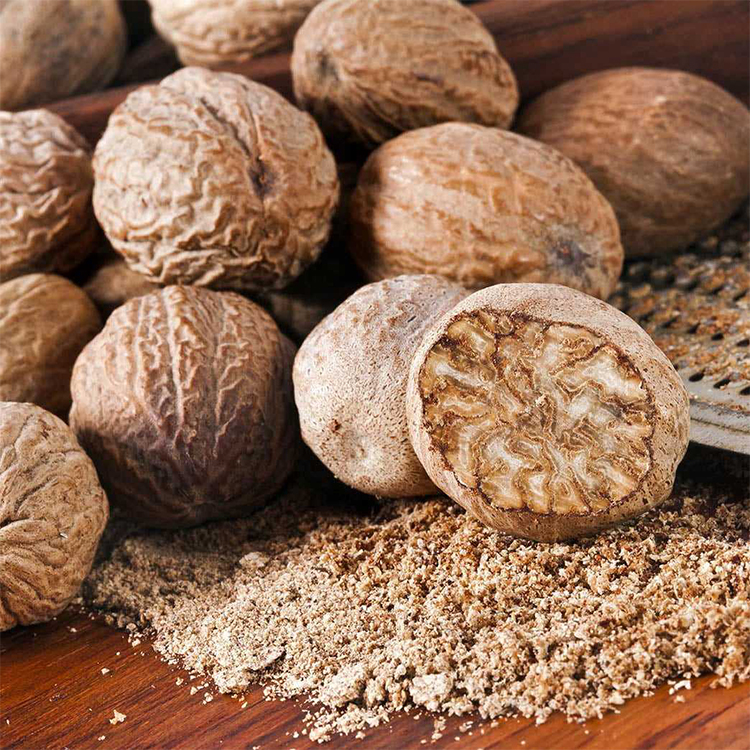
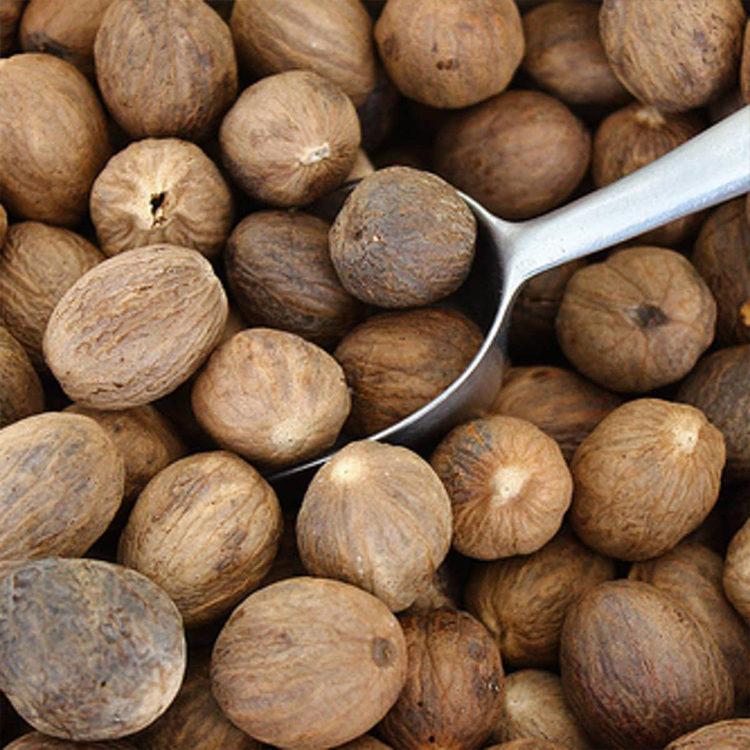
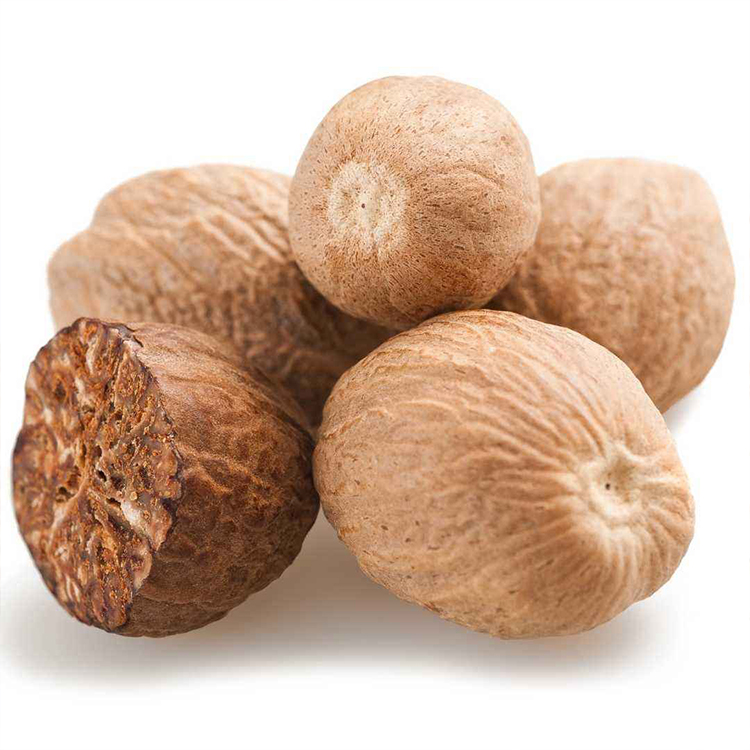
Whole shelled nutmeg gives a buyer the best opportunity to inspect the raw material before it disappears into a grinder. Shape, surface condition, insect damage, shrivelling, broken kernels, mould, abnormal colour and mixed botanical material are easier to detect.
That visibility has value.
Whole nutmeg also carries the highest Codex minimum volatile-oil requirement at 6.5 ml/100 g on a dry basis. This is sensible because intact kernels retain aromatic compounds better than exposed broken pieces or powder. But a high oil number alone does not prove that the entire lot is sound. A supplier can produce one strong laboratory sample from a mixed shipment.
What I Would Put in a Whole Nutmeg Specification
A serious whole nutmeg bulk purchase order should identify:
Botanical name: Myristica fragrans Houtt.
Style: whole shelled or whole in shell
Country of origin and country of harvest
Harvest year or crop season
Count per kilogram or agreed size grade
Maximum moisture: 10.0%
Minimum volatile oil: 6.5 ml/100 g on a dry basis
Maximum broken or damaged material
Maximum shrivelled kernels
Foreign and extraneous matter limits
Visible mould and insect-defect limits
Aflatoxin and pesticide requirements
Microbiological limits
Pathogen-reduction status
Inner liner and outer packaging
Lot code and COA linkage
Codex makes the harvest region and harvest year optional label information, but I would still request both. Nutmeg aroma declines over time, and a supplier who cannot connect the finished lot to a harvest period is asking the buyer to accept an avoidable traceability gap.
Whole seed works well for spice packers, premium retail brands, extraction businesses and manufacturers that grind shortly before use. It is less convenient for factories that need immediate dispersion or fixed particle size.
Buyers reviewing a broader raw-material programme can compare nutmeg with the company’s other factory-direct dried spices before deciding whether a mixed-spice shipment or consolidated purchasing plan makes commercial sense.
Cracked Nutmeg: The Middle Format With Hidden Variation
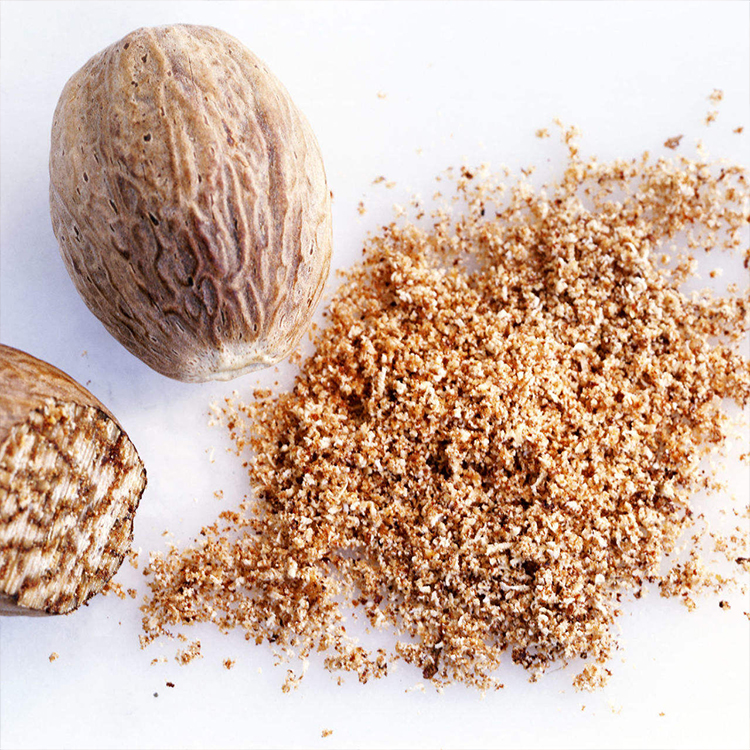
Cracked nutmeg, also called broken nutmeg, reduces milling time and may lower the price. It is widely suited to industrial grinding, extraction, seasoning manufacture and applications where whole-kernel appearance has no value.
But cracked nutmeg has a classification problem: “broken” can describe clean, freshly cracked kernel pieces, or it can become a convenient category for off-size seeds, damaged kernels, fragments, fines and visually rejected material.
That distinction decides the real price.
Codex requires a minimum volatile oil level of 6.0 ml/100 g for broken nutmeg, slightly below the 6.5 ml/100 g requirement for whole shelled kernels. Moisture remains capped at 10.0%, while total ash, acid-insoluble ash and water-insoluble ash use the same limits applied to whole nutmeg.
Ask How the Nutmeg Became Broken
There are two very different supply stories:
Purpose-cracked material: Sound whole kernels are cleaned and mechanically cracked to a defined size.
Recovered broken material: Pieces are collected during sorting, shelling, handling or rejection of whole grades.
Both can be commercially usable. They are not equivalent.
My hard rule is simple: the supplier must declare the feedstock and cracking process. I would also ask for a particle-distribution report showing the percentage retained on each agreed sieve, plus a maximum fines percentage. Otherwise, a buyer ordering 5–15 mm pieces may receive a bag containing large fragments on top and aromatic dust at the bottom.
For cracked nutmeg, the purchase specification should also distinguish seed pieces from shell fragments. Shell is not a harmless visual defect when the material enters a food formulation; it changes fibre, ash, flavour intensity and extraction yield.
Suppliers offering custom cutting, grinding or blended ingredients should be evaluated through a documented bulk herb and spice milling process, not through a photograph of finished bags.
Bulk Nutmeg Powder: Convenient, Fast, and Easy to Misbuy
Nutmeg powder is commercially efficient. It can be dosed directly into seasoning blends, sauces, bakery mixes, meat products, beverage premixes and retail jars. It also removes the buyer’s need to own and clean milling equipment.
That convenience transfers control to the supplier.
Once nutmeg is powdered, a buyer can no longer easily see shrivelled seeds, shell, off-grade pieces, foreign botanical material or uneven raw-material quality. Grinding makes a mixed batch look uniform. This is why I treat bulk nutmeg powder as a processed ingredient, not merely a smaller version of whole nutmeg.
Codex sets a tighter maximum moisture requirement of 8.0% for powder and a lower minimum volatile-oil requirement of 5.0 ml/100 g. The standard does not prescribe one universal mesh; particle size is a contractual matter between the buyer and seller.
A Powder Specification Needs Numbers
Do not write “fine powder.” Define:
Target mesh, such as 40, 60 or 80 mesh
Minimum percentage passing the target sieve
Maximum percentage retained above the target
Maximum ultrafine fraction, when flow behaviour matters
No undeclared carrier, starch or filler
Anticaking-agent status and permitted level
Milling date
Maximum moisture: 8.0%
Minimum volatile oil: 5.0 ml/100 g
Bulk density range
Colour reference or approved sample
Metal-detection sensitivity
Packaging oxygen and moisture barrier
Maximum time between milling and packing
Mesh alone does not define powder performance. Two 60-mesh powders can behave differently because of oil content, temperature during grinding, particle distribution, storage time and natural fat content.
And “freshly ground” means nothing unless the milling date appears in the lot record.
Where private-label packs, custom blends or market-specific packaging are involved, the buyer should define them through a documented herbal and spice OEM/ODM specification process before commercial production begins.
A Clean COA Can Still Represent a Bad Lot
Here is the uncomfortable part: a laboratory result is only as reliable as the sample sent to the laboratory.
Aflatoxins are rarely distributed evenly through a nutmeg shipment. One bag may test acceptably while a cluster of damaged or poorly dried kernels elsewhere in the lot contains a much higher concentration. Grinding the laboratory sample does not repair weak field sampling.
The European Union’s Regulation 2023/2782 on mycotoxin sampling specifically treats large-particle spices such as nutmeg differently. It prescribes incremental samples of approximately 200 g for the applicable large-particle sampling method and directs powdered spices to a separate sampling procedure. This is regulatory recognition that whole nutmeg and powder cannot simply be sampled in the same casual way.
The Legal History Buyers Should Not Ignore
Nutmeg’s aflatoxin history is not theoretical. EU Regulation 2016/24 recorded that nutmeg from India had been subject to increased official controls for aflatoxins since January 2010, while nutmeg from Indonesia had been under increased controls since July 2012. The regulation was later adjusted based on control results, but the commercial lesson remains: origin documentation, drying control and lot-level mycotoxin evidence can directly affect border treatment.
Codex’s Code of Practice for the Prevention and Reduction of Mycotoxins in Spices applies to whole, broken, ground and blended spices. It focuses on prevention through agricultural, manufacturing and storage controls rather than pretending final-product testing can detect every contaminated pocket in every lot.
Before approving a supplier, buyers should review how the factory handles representative samples, retained samples, failed lots and corrective action. The site’s mycotoxin testing guide for herbal ingredients and spices provides a useful starting point for that discussion.
Salmonella Is Not Eliminated by Low Moisture
Nutmeg is a dry product. Dry does not mean sterile.
FDA examined 7,250 retail spice samples collected between November 2013 and March 2015. Estimated Salmonella prevalence for each of the 11 tested spice categories was below 1% at retail. However, imported shipments sampled at entry between fiscal years 2012 and 2015 showed much higher rates for several spices: 6.7% for black pepper, 18% for ground coriander, 8.5% for cumin and 11% for ground red pepper. Nutmeg was not included in that survey, so those numbers should not be misrepresented as nutmeg-specific data; they demonstrate the broader risk difference between untreated bulk imports and finished retail spice.
FDA concluded that the sharp reduction between entry and retail was consistent with most bulk shipments receiving pathogen-reduction treatment after import, although the data also suggested that some treatments may have been ineffective, omitted or followed by recontamination.
For bulk nutmeg, I would request:
Salmonella: absent in the agreed sample size
Aerobic plate count
Yeast and mould
Enterobacteriaceae or coliforms where required
Treatment method and treatment date
Process validation or supplier validation summary
Post-treatment environmental controls
Evidence that treated and untreated lots are physically segregated
Steam treatment, irradiation and other approved methods may affect aroma, colour and microbial load differently. The contract should identify which treatments are permitted, which are prohibited and whether the volatile-oil requirement applies before or after treatment.
How I Would Verify a Nutmeg Supplier
A low quotation is not proof of purchasing skill. Sometimes it simply means the buyer has not yet discovered what was removed from the specification.
Confirm the botanical name, origin, crop year, whole-versus-broken feedstock, shell status and whether material from different origins or harvest periods is blended.
Factory Process
Review cleaning, sorting, cracking, milling, sieving, magnets, metal detection, pathogen reduction, allergen control and rework handling.
Ask an awkward question: can rejected whole kernels be diverted into powder?
A supplier should have a direct answer.
Laboratory Control
Request the test method, laboratory name, accreditation scope, sampling procedure, limit of detection, limit of quantification and actual numeric result. “Pass” is weaker than “2.1 μg/kg.”
Lot Traceability
The incoming raw-material code, production batch, treatment record, packing record, COA and shipping documents should refer to the same traceable lot structure.
Commercial Behaviour
Check whether specifications survive the quotation, sample, pro forma invoice, production order and final COA. Many sourcing failures begin when a detailed approved sample quietly becomes a vague mass-production order.
Packaging and Storage by Nutmeg Format
Whole, cracked and powdered nutmeg should not automatically receive identical packaging.
Whole Nutmeg
Whole kernels tolerate handling better and retain aroma longer, but bags still need a clean food-contact liner, moisture protection and protection against crushing, infestation and warehouse odours.
Cracked Nutmeg
Cracked pieces release more aromatic compounds and generate fines during transport. Use a strong inner liner and specify a maximum fines level at destination, not only at the factory.
Nutmeg Powder
Powder requires the strongest moisture and aroma barrier. Heat-sealed multilayer liners, controlled headspace, clean filling conditions and rapid sealing after milling help reduce aroma escape and moisture pickup.
For sea freight, buyers should assess:
Container humidity
Route duration
Seasonal temperature changes
Pallet condition
Carton compression
Liner seal integrity
Desiccant placement
Separation from odorous cargo
Warehouse relative humidity
A supplier may pass every departure test and still deliver caked powder if the packaging was designed for a short domestic shipment rather than a six-week ocean route.
FAQs
What is bulk nutmeg?
Bulk nutmeg is dried Myristica fragrans seed purchased in commercial quantities as whole shelled kernels, broken pieces, or ground powder, with the buyer defining grade, moisture, volatile oil, contaminants, microbiological limits, packaging, treatment status, origin, and lot documentation before approving shipment.
It is commonly purchased by spice distributors, food processors, seasoning manufacturers, extractors, beverage companies, retail packers and private-label brands.
What is the difference between whole, cracked and powdered nutmeg?
Whole nutmeg is intact shelled seed with the highest Codex minimum volatile-oil requirement, cracked nutmeg is broken seed sold for faster processing, and powder is milled material with tighter moisture control but greater exposure to aroma loss, oxidation, blending errors, and hidden foreign material.
Whole nutmeg provides the best visual inspection. Cracked nutmeg reduces processing time. Powder offers immediate use but demands stronger process, mesh, purity and packaging controls.
What tests should a buyer request for wholesale nutmeg?
A reliable bulk nutmeg test programme combines identity confirmation, moisture, total ash, acid-insoluble ash, water-insoluble ash, volatile oil, aflatoxins, pesticide residues, heavy metals, Salmonella, yeast and mould, mesh verification for powder, and representative lot sampling tied to the supplier’s batch code.
Testing should match the destination country, final application and customer requirements. The laboratory report should show methods and numeric results rather than only “pass” or “complies.”
What moisture level is acceptable for bulk nutmeg?
Codex sets maximum moisture at 10.0% for whole and broken nutmeg and 8.0% for ground or powdered nutmeg, because milled material has more exposed surface area and needs tighter control against clumping, aroma decline, microbial persistence, and storage instability during long-distance transport.
A buyer may set a lower internal target where humid routes, long storage periods or moisture-sensitive formulations create added risk.
How do I choose a reliable nutmeg supplier?
A qualified nutmeg supplier is one that can prove botanical identity, origin, lot segregation, controlled drying, validated cleaning or pathogen-reduction steps, representative sampling, laboratory competence, traceable COAs, packaging suitability, complaint handling, and consistent performance across repeat shipments—not merely send an attractive sample and low quotation.
Review documents before paying a deposit, and require the approved specification to appear in the purchase contract and production records.
Request a Lot-Specific Nutmeg Specification
Before requesting a quotation, define whether you need whole, cracked or powdered nutmeg; your destination country; annual volume; target mesh or piece size; volatile-oil requirement; contaminant and microbiological limits; permitted treatment; packaging format; and required shipment documents.
Send those details through the GuoCao wholesale nutmeg and spice enquiry page and request a lot-specific specification, representative sample, COA format and packaging proposal before approving commercial production.
Our low MOQ of 1 kg (2.2 lb) makes it easy to order Chinese herbal slices or wholesale Chinese medicine herbs. Private-label and bilingual labeling are also available.
Delivery Cycle & Support
We have a fast 7-day lead time. We provide free samples, COA reports, and technical support to help you bring high-quality bulk Chinese herbs to market.
Quality & Certifications
Our products are manufactured in a GMP-certified facility and meet ISO22000 standards. All Chinese herbs are third-party tested for heavy metals, pesticides, and microorganisms.