Mulberry Leaf Wholesale Guide for Tea and Functional Beverage Brands
Mulberry leaf looks like a simple botanical ingredient until harvest timing, DNJ variation, pesticide testing, cut size, and beverage compliance enter the purchase order. This guide shows tea and functional beverage brands what to specify, test, question, and reject before buying bulk mulberry leaves.
Not literally, of course, but a low mulberry leaf wholesale quote can hide a surprising amount of commercial uncertainty: the wrong botanical identity, too much stem, poorly controlled drying, seasonal chemistry shifts, inconsistent particle size, weak pesticide documentation, or a COA that has little connection to the batch sitting in the warehouse.
And buyers still start with price per kilogram?
I would start somewhere else.
For tea and functional beverage brands, bulk mulberry leaves should be treated as a specification-controlled botanical ingredient rather than a generic dried herb. The botanical name matters. The harvest matters. Leaf maturity matters. Processing matters. And if your product strategy depends on functional compounds such as 1-deoxynojirimycin, better known as DNJ, buying only by color and appearance is not serious procurement.
The commercial search intent behind mulberry leaf wholesale is therefore straightforward: buyers want supply, but intelligent buyers also want repeatability.
That is where this guide starts.
Why Mulberry Leaf Is Harder to Standardize Than It Looks
The first name I want on a supplier document is not “mulberry tea leaf.”
I want Morus alba L.
Then I want the plant part.
Leaf.
Not “aerial parts.” Not an undefined leaf-and-stem mixture. Not whatever passed through the cutter that afternoon.
This sounds excessively technical until you look at the chemistry. A study measuring DNJ in mulberry leaves from 132 varieties across nine Morus species found that DNJ concentrations in mature leaves ranged from 0.1341 to 1.472 mg/g dry leaf, while younger leaves generally contained more DNJ than older leaves.
That is not a rounding error.
It means two shipments can both be genuine mulberry leaf while behaving very differently if a functional beverage formulation depends on consistent phytochemical composition.
Season makes it messier. Research from Japan’s Shimane Agricultural Technology Center followed mulberry leaves from May through October and recorded DNJ concentrations ranging from 53 to 199 mg/100 g dry weight, with the highest level appearing around mid-August in that particular cultivation system. Chlorogenic acid and flavonol patterns moved differently across the season.
So when a mulberry leaf supplier says, “Same product, same quality all year,” I want evidence.
Wouldn’t you?
Mulberry leaf chemistry commonly discussed in research includes 1-deoxynojirimycin or DNJ (C6H13NO4), chlorogenic acid (C16H18O9), rutin (C27H30O16) and other flavonoids and iminosugars. PubChem confirms the molecular formulas for DNJ, chlorogenic acid, and rutin.
But there is an important procurement distinction here.
A tea brand buying mulberry leaves for aroma, appearance, clean infusion, and traditional positioning does not necessarily need standardized DNJ.
A functional beverage company making composition-based claims might.
Those are different specifications. They should probably be different RFQs.
What Tea and Beverage Brands Should Put in a Mulberry Leaf Specification
“High-quality dried mulberry leaf” is not a specification.
It is advertising copy.
A commercial purchasing specification should force the supplier and buyer to agree on what the material actually is, how it will be judged, and which deviations will cause rejection.
Here is the framework I would use.
Specification Area
Loose Tea / Tea Bag Use
Functional Beverage Use
Why Buyers Should Care
Botanical identity
Morus alba L. confirmed
Morus alba L. confirmed
Prevents substitution and vague botanical naming
Plant part
Leaf; stem percentage controlled
Leaf; stem percentage controlled
Stem dilution changes appearance and composition
Form
Whole, broken or defined tea cut
Cut leaf, powder or processing input
Final format affects extraction and manufacturing
Cut size
Buyer-defined and sample-approved
Process-specific
Controls infusion speed, dust and filling behavior
Leaf maturity
Declared where relevant
More important if composition matters
DNJ varies with maturity
Harvest period
Record preferred
Strongly recommended for standardized programs
Functional compounds vary seasonally
Moisture
Batch-tested to agreed specification
Batch-tested to agreed specification
Poor moisture control increases storage risk
Foreign matter
Defined buyer limit
Defined buyer limit
Prevents stems, soil, stones and unrelated material
Microbiology
Destination- and product-specific panel
Destination- and process-specific panel
Beverage ingredients can receive limited downstream treatment
Pesticide residues
Destination-market compliant
Destination-market compliant
Imported foods remain subject to residue rules
Heavy metals
Buyer-market specification
Buyer-market specification
Botanical ingredients can concentrate environmental contaminants
Marker compounds
Usually optional
DNJ or another agreed marker when commercially relevant
Supports consistency rather than vague “functional” positioning
Packaging
Food-contact inner liner plus protective outer carton
Moisture-controlled food-contact packaging
Protects dried material during storage and shipping
Documentation
Lot COA and traceability
Lot COA, traceability and relevant analytical data
A generic COA tells you surprisingly little
The phrase that matters most is buyer-defined.
Do not copy somebody else’s moisture number, pesticide panel, microbial limits, or assay specification because it looked professional in a PDF. Your product format, destination market, brewing process, shelf life, and claims strategy should determine the finished requirement.
Brands building a broader botanical sourcing program can also compare requirements through the site’s wholesale Chinese herbs and herbal slices sourcing guide, particularly when mulberry leaf will eventually sit beside chrysanthemum, honeysuckle, goji, ginseng, or other herbal tea ingredients.
The Pesticide Problem Is Commercial, Not Theoretical
Here is a number worth putting in a procurement meeting.
In its FY2023 pesticide monitoring program, the U.S. FDA analyzed 3,577 human-food samples, including 2,574 imported samples from 84 countries or economies. FDA reported that 86.5% of imported samples complied with federal pesticide requirements, compared with 97.2% of domestic samples. No pesticide chemical residues were detected in 39.2% of imported samples. FDA FY2023 Pesticide Residue Monitoring Report
Read that carefully.
The report does not say imported mulberry leaves have a 13.5% violation rate. FDA uses risk-based sampling, so extrapolating that percentage directly to mulberry would be sloppy.
But the purchasing lesson is still uncomfortable: “natural,” “herbal,” and “sun-dried” are not pesticide specifications.
The U.S. EPA establishes pesticide tolerances, commonly called maximum residue limits or MRLs in many other markets, and those tolerances apply to imported food as well as domestically produced food. Residues exceeding an applicable tolerance can trigger enforcement, while residues of pesticides without an applicable tolerance or exemption can also create compliance problems. EPA pesticide tolerance guidance
This is why I dislike a supplier response that simply says:
“Pesticide free.”
Show the test.
Better still, show the lot-specific test and tell me which analytical scope was used.
If your purchasing team needs a broader framework, the site’s quality standards for Chinese herbal slices in international markets provides useful context around pesticide residues, microbiological testing, heavy metals, sulfur dioxide, identity and destination-market specifications.
U.S. Buyers Should Understand FSVP Before They Negotiate Price
Paperwork gets expensive when you postpone it.
For U.S. importers subject to the Foreign Supplier Verification Programs rule, FDA requires risk-based activities intended to verify that foreign suppliers produce food in accordance with applicable U.S. safety standards.
The requirements can include hazard analysis, supplier evaluation, approval procedures, verification activities, corrective actions and records. FDA also states that, when an importer obtains the same food from several suppliers, a separate FSVP is generally required for each foreign supplier. FDA FSVP key requirements
That changes how I evaluate a mulberry leaf supplier.
A nice sample is useful.
A supplier that can repeatedly produce the correct sample and support the importer’s verification file is more useful.
I would therefore ask whether the supplier can provide lot-linked traceability, manufacturing or processing information, relevant food-safety records, analytical reports, corrective-action history where applicable, and reliable responses when the importer needs supporting documentation.
If you are still screening factories, the site’s guide on how to choose a high-quality Chinese herbal supplier is a logical internal reference because it focuses heavily on traceability, COAs, contaminant control and supplier verification instead of appearance alone.
Tea Cut, Powder or Extract? Decide Before You Ask for a Quote
Form follows product.
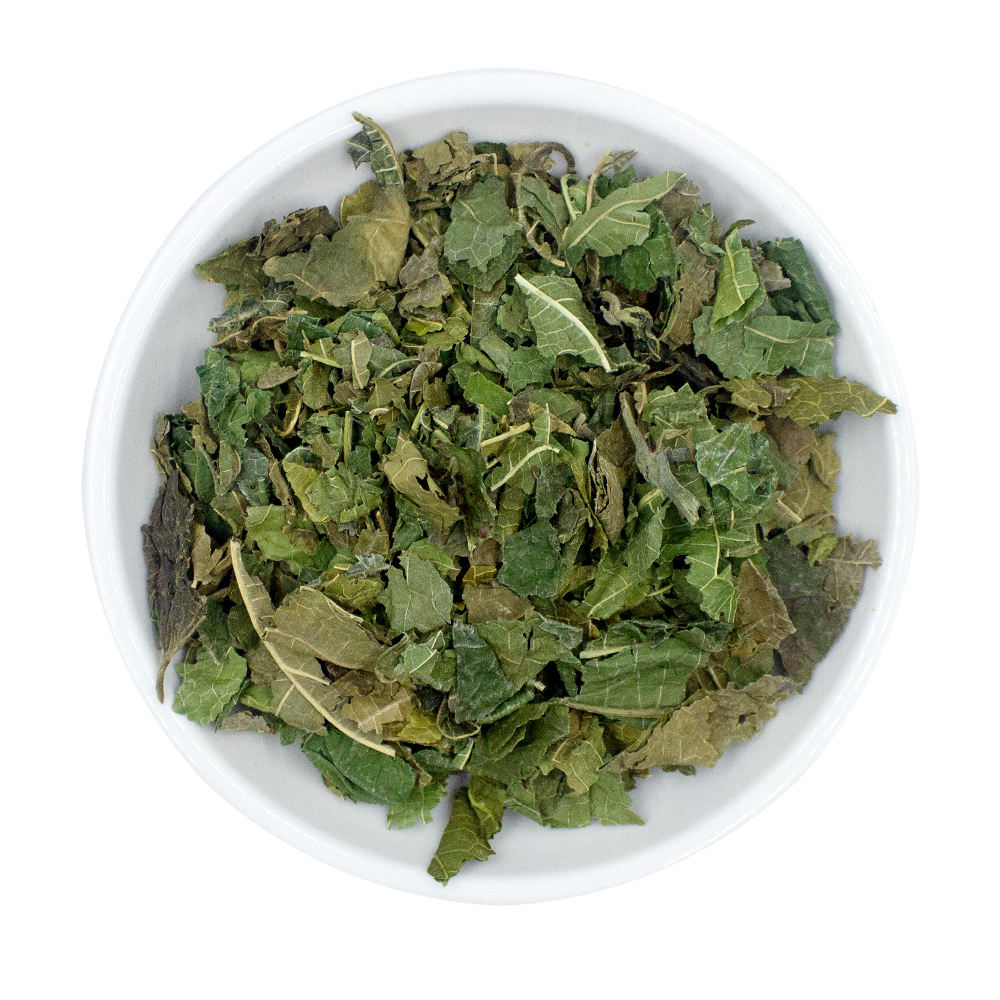
For a loose-leaf tea, attractive leaf pieces matter because the customer sees them. Very fine material may infuse quickly but create dust, cloudiness and a cheaper visual impression.
For a tea bag, consistency becomes more mechanical. Particle distribution affects filling accuracy, infusion speed, filter performance and the amount of powder escaping into the cup.
And for a functional beverage?
Now the conversation changes.
A beverage developer may want smaller cut material for extraction, powder for suspension-based formats, or a further processed extract if tighter marker standardization is needed. A leaf format that performs beautifully in a five-minute tea steep may be inconvenient for an industrial liquid formulation.
This is where pilot testing beats theory.
For example, a tea company can compare illustrative cuts such as 2–5 mm and 5–10 mm during development, not because either range is universally correct, but because testing two deliberately different distributions helps expose differences in infusion color, sediment, aroma release and filter behavior.
Do the test.
Then write the winning result into the specification.
For brands moving from raw botanical material into finished sachets, the site’s herbal slices to tea bags manufacturing process breakdown covers the production chain from raw herb handling through cutting, blending, dosing and packaging.
Functional Beverage Brands Need to Separate Science From Marketing
Mulberry leaf attracts functional beverage developers for a reason.
DNJ has been investigated extensively as an α-glucosidase inhibitor, and human studies have examined mulberry leaf extracts in relation to post-meal carbohydrate responses.
But this is where marketing teams routinely outrun the evidence.
One exploratory crossover study involved only 15 healthy volunteers. Participants consumed carbohydrates with mulberry leaf extract, and the researchers reported reductions in measured glycemic index of 53.11% for maltose, 33.51% for sucrose, 31.00% for maltodextrin and 8.12% for glucose under the study conditions. PubMed study on mulberry leaf extract and carbohydrate glycemic index
Interesting?
Yes.
Permission to print “controls blood sugar” on a bottled drink?
No.
The study used an extract, had a very small sample, and evaluated specific acute experimental conditions. That is a long way from proving that any random batch of dried mulberry leaf tea produces the same outcome.
Research is continuing. A randomized, double-blind, placebo-controlled crossover study published in 2025 evaluated a mulberry leaf and water chestnut tea blend in 31 participants using continuous glucose monitoring. Another randomized controlled study appeared in 2026 examining mulberry-leaf and water-chestnut-husk tea. But both involve combination products, another reason buyers should resist turning research headlines into ingredient claims.
This matters commercially because consistency data and marketing evidence are not the same thing.
A DNJ assay may help you control raw-material variation.
It does not automatically authorize a disease claim.
“Functional Beverage” Is Not a Regulatory Category You Can Hide Behind
The answer affects ingredient review, labeling, claims and documentation.
FDA also distinguishes among health claims, nutrient-content claims and structure/function claims. For dietary supplements, certain structure/function claims require substantiation, a disclaimer and notification to FDA no later than 30 days after first marketing the product with the claim. Conventional foods operate under a different claims framework.
My rule is simple:
Classify first. Formulate second. Write claims last.
Doing it backwards is how a clever beverage concept becomes an expensive label revision.
What a Serious Mulberry Leaf Supplier Should Be Able to Answer
I would send these questions before approving either a sample or a commercial purchase:
What is the exact botanical name?
Is the material Morus alba L.?
What plant part is supplied, and how is stem content controlled?
What region and country produced the material?
What harvest period does this batch represent?
Are leaf maturity or picking position controlled?
Is the material whole leaf, broken leaf, tea cut, powder or another format?
What cut-size or particle-size specification can you guarantee?
What is the moisture specification and test method?
Can you provide a lot-specific COA?
Which pesticide residues are screened, and is the test suitable for the destination market?
Which microbiological parameters are tested?
Are Pb, Cd, As and Hg included in the heavy-metal panel?
Is sulfur dioxide tested when relevant to the processing history?
Can DNJ or another marker compound be tested if the formulation requires it?
What food-contact packaging is used inside the export carton?
How is each commercial lot linked to raw-material and production records?
Can you retain reference samples from shipped batches?
Can the same specification be reproduced on the next order?
What happens if incoming inspection fails?
Question 19 is my favorite.
Anybody can ship one beautiful sample.
Repeatability is the business.
The Red Flags I Would Not Ignore
A Perfect COA With No Lot Connection
A COA without a clear relationship to your batch is decoration.
Check lot number, sampling date, testing date, product name, botanical identity and laboratory information. Compare those details against the carton labels and shipping paperwork.
“Organic” Used as a Substitute for Testing
Organic certification and contaminant testing answer different questions.
Do not let a marketing descriptor replace pesticide, heavy-metal or microbiological review.
No Answer on Harvest Timing
Not every tea buyer needs a fixed harvest month.
But if the supplier cannot tell you when the leaves were harvested at all, traceability is weak before you have even placed the order.
Functional Claims Before Functional Data
If the supplier promises diabetes treatment, blood-sugar control or other medical outcomes while failing to provide batch-specific marker data, I become more skeptical, not less.
Good technical suppliers usually understand where ingredient specifications end and finished-product claims begin.
Sample Quality That Cannot Be Locked
The phrase “bulk production will be similar” is dangerous.
Photograph the approved sample. Record color, aroma, cut size, dust level, stem percentage, moisture and any analytical criteria that matter. Make that approved reference part of the purchasing agreement.
Price per Kilogram Is Only One Part of the Real Cost
Suppose Supplier A is cheaper.
But Supplier A requires another laboratory test after arrival, delivers inconsistent cut sizes, has weak traceability and forces your team to spend four days chasing a pesticide report.
Supplier B costs more per kilogram but sends the right specification every time.
Which one is actually cheaper?
This is why serious buyers calculate landed usable cost, not just quoted raw-material cost.
The usable-cost equation includes ingredient price, testing, freight, customs, rejected material, reprocessing, production downtime, formulation adjustments, QA labor and the cost of explaining a failed batch to a retailer.
That last one is rarely included in the spreadsheet.
It should be.
For brands that eventually want to move from raw ingredients into private-label formats, the site’s Chinese herbal tea bag range and OEM supply options also provides a logical next step after raw-material qualification.
FAQs
What is mulberry leaf wholesale?
Mulberry leaf wholesale means purchasing commercial quantities of dried Morus alba L. leaves, cut leaf, powder, or another agreed format under a defined specification covering botanical identity, plant part, origin, moisture, foreign matter, microbiological quality, pesticide residues, heavy metals, packaging, documentation, and repeatable batch quality.
The important word is “defined.”
A kilogram price tells you almost nothing about whether the leaf is suitable for premium loose tea, tea bags, extraction, powdered beverages or a formulation that needs marker-compound consistency. Establish the intended use before comparing suppliers.
How do you choose the best mulberry leaf supplier?
The best mulberry leaf supplier is a producer or controlled processor that can repeatedly provide the correct botanical species and plant part, traceable origin, agreed cut or particle size, batch-specific COAs, suitable contaminant testing, stable sensory quality, export documentation, responsive technical support, and evidence that commercial production matches the approved sample.
I would rank documentation and repeatability ahead of price.
Then test samples under your actual brewing or beverage-production conditions. A supplier that looks excellent on Alibaba, a trade show booth or a polished catalogue can still fail when the second batch arrives.
Is DNJ content the same in every batch of mulberry leaves?
DNJ content is not naturally identical across every mulberry leaf batch because research shows that 1-deoxynojirimycin concentrations vary with cultivar, leaf maturity, harvest timing, temperature and growing conditions, meaning two authentic Morus alba leaf lots can contain materially different amounts even when their external appearance seems broadly similar.
This is one of the strongest arguments for analytical testing when DNJ matters to the product concept.
If your tea is sold mainly for flavor and traditional botanical positioning, DNJ standardization may not be necessary. If formulation performance depends on a declared marker level, specify the assay before buying.
Are mulberry leaves better for tea or functional beverages?
Mulberry leaves can work in both tea and functional beverage products, but tea applications usually prioritize visible leaf quality, aroma, color, cut size and clean infusion, while functional beverage programs may place greater emphasis on extraction behavior, particle size, marker compounds, formulation compatibility, analytical consistency and the regulatory status of the finished beverage.
Do not force one grade into every SKU.
A beautiful whole leaf may make an attractive loose tea but be inefficient for industrial extraction. Fine powder may work in processing but look terrible inside a transparent pyramid sachet.
Use case first.
Format second.
How should a brand source mulberry leaf in bulk?
To source mulberry leaf in bulk, define Morus alba L. leaf, intended product use, required physical form, cut or particle size, contaminant testing, destination market, packaging, documentation and any required marker-compound assay before requesting quotations, then compare representative samples and approve a written specification before releasing commercial production.
That order matters.
Requesting “your best price for mulberry leaves” attracts generic quotes.
Sending a technical RFQ attracts technical answers. Once samples arrive, brew them, inspect them, run the required tests, compare the COA with the actual lot and document the approved reference before scaling.
Your Next Step: Approve the Specification Before You Approve the Price
Mulberry leaf wholesale looks simple because the raw material looks simple.
It is not.
For a tea brand, the winning batch must look right, smell right, infuse correctly and remain consistent from pouch to pouch.
For a functional beverage brand, the same material may also need controlled particle size, stronger analytical documentation, destination-specific contaminant testing and, when justified by the formulation, marker data such as DNJ.
So start with the specification.
Confirm Morus alba L. Confirm the leaf fraction. Define the cut. Ask when it was harvested. Review the lot COA. Check pesticides, microbiology and heavy metals against your target market. Test the actual sample in the actual product.
Our low MOQ of 1 kg (2.2 lb) makes it easy to order Chinese herbal slices or wholesale Chinese medicine herbs. Private-label and bilingual labeling are also available.
Delivery Cycle & Support
We have a fast 7-day lead time. We provide free samples, COA reports, and technical support to help you bring high-quality bulk Chinese herbs to market.
Quality & Certifications
Our products are manufactured in a GMP-certified facility and meet ISO22000 standards. All Chinese herbs are third-party tested for heavy metals, pesticides, and microorganisms.