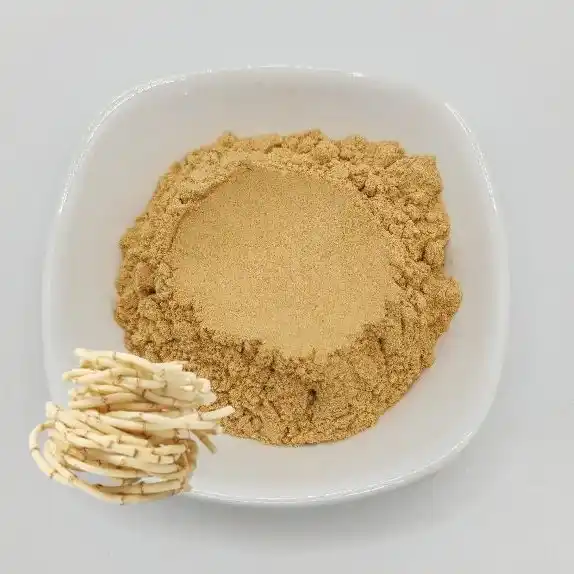
3-Oxododecanal (Decanoyl Acetaldehyde) and the “Fishy” Odor
When people say Fish Mint smells fishy, they’re not just being dramatic. There’s chemistry behind it.
Research and reference materials commonly point to decanoyl acetaldehyde, also discussed as 3-oxododecanal, as a key odor-active compound linked to that fishy character. A 2025 odor-active compound study identified 3-oxododecanal as a major odor driver with strong odor impact in different plant parts.
Procurement translation: if your spec only says “odor acceptable,” you’ve basically written “we will argue later.” Nobody can measure “acceptable” the same way twice.
Instead, you want a spec that says:
what “fishy” means in your context (identity vs defect),
how you test it, and
how you decide pass/fail.
Organoleptic Inspection: Rub Test, Aroma Notes, and Astringent Taste
In some traditional acceptance practices, Fish Mint’s characteristic odor is part of identity confirmation. Standards and purchasing guidelines sometimes describe Fish Mint as producing a distinct fishy odor when rubbed/crushed and having an astringent taste.
That matters because buyers live in two different worlds:
Hospital and clinical dispensing world: odor can be part of “does this match the herb.”
Consumer product world (tea, beverage, capsules): odor can be the reason customers complain, return, or leave harsh reviews.
Same botanical. Different acceptance target. If you don’t choose the target, the spec turns into spaghetti.
Odor Control System Specification: Outlet H2S 0.1 ppm and EBRT as a Mindset
Let’s borrow a trick from engineering odor control.
In municipal odor control system specs, you’ll see clear, enforceable requirements like:
outlet hydrogen sulfide at 0.1 ppm (or 1% of inlet, whichever is greater), and
minimum empty bed residence time (EBRT) targets such as 13 seconds for a biological stage and 4 seconds for a carbon stage.
You are not building an H2S scrubber for Fish Mint. But the mindset is gold:
define conditions,
define the test method,
define the limit,
define decision rules.
That is what makes a spec survivable in the real world.
Odor Control Performance Testing: 95% Confidence Interval and 200 ouE/m3 Example
Odor testing has noise. It just does. If you ignore that, your acceptance process becomes a coin flip.
Odor performance testing literature shows why decision rules matter. It discusses how a requirement such as 200 ouE/m3 can be evaluated using repeated sampling and statistical boundaries (for example, a 95% confidence interval) to avoid overreacting to one spiky sample.
You don’t need to turn your warehouse into a statistics lab. But you do need:
repeatable sampling,
a defined way to calculate results,
a retest rule when results sit in the gray zone.
Otherwise, you’ll see this pattern on repeat: one person sniffs, says “too strong,” and the shipment freezes. Then everyone burns time trying to “prove” a smell.
In product teams, acceptance criteria exist for one reason: stop endless debates about “done.”
The same principle works for botanicals. Your acceptance criteria should be:
clear,
testable,
outcome-focused (what you get, not how they make it).
Bad: “Supplier must dry using method X.” Better: “Moisture must fall within agreed window, verified by method Y. If out of window, product is HOLD pending investigation.”
This keeps you from locking your supplier into a brittle process while still protecting your quality.
Fish Mint (Yu Xing Cao) Acceptance Spec Template You Can Enforce
Below is a practical template. It uses real ops language buyers and QA teams actually use: incoming QC, AQL, HOLD/RELEASE, CAPA, sieve curve, moisture window, golden sample.
GuoCao’s production and OEM/ODM materials emphasize GMP herbal slice production lines, documented QC steps, third-party COA testing, and a structured approval flow (prototype, master spec, then scale). That’s the kind of system that makes specs easier to execute, not just easier to write.
Visual inspection + documentation + lot code check
Must match approved reference and paperwork. Mismatch = reject
Organoleptic odor target
“Signature odor” vs “controlled odor” (choose one)
Standardized sniff test under fixed conditions (container size, time, temperature)
Must meet target profile under defined conditions. Borderline triggers retest per sampling plan
Rub test (identity check)
Confirms characteristic odor release when rubbed
Rub/crush test with documented steps
For identity spec: must show characteristic odor when rubbed. For consumer spec: odor must not exceed target threshold
Off-odor screen
Prevent musty, chemical, rancid, or solvent-like taint
Sniff + visual for discoloration, dampness
Any taint odor = reject. No debates
Moisture window
Prevent clumping, microbial risk, odor drift
Moisture test + batch record review
Must fall within agreed window. Out of window = HOLD and CAPA
Cut size and sieve curve
Consistent extraction and blending behavior
Sieve analysis
Must match agreed sieve curve band. Drift triggers CAPA and possible rework
Foreign matter
Reduces complaints and audit risk
AQL-style incoming inspection
Above limit = reject or rework plan
Micro, heavy metals, pesticides
Audit compliance and customer requirements
Third-party COA per lot
Must pass COA. Fail = HOLD and corrective action
Packaging integrity
Prevent volatile loss and cross-contamination
Seal check + barrier packaging check
Must meet packaging spec. Defects = HOLD
Storage and shipment
Preserve aroma stability and prevent moisture uptake
Warehouse condition logs + pre-ship check
Must follow defined storage class (ambient/cool/controlled). Nonconformance triggers investigation
This is not fancy. It’s workable. And workable beats “beautiful” every day.
Sampling Plan: Stop Letting One Sniff Decide a Container
Here’s a sampling plan that doesn’t waste your time:
Take 3 samples from different positions (top, middle, bottom).
Let samples rest sealed at room temperature for a fixed time (example: 30 minutes).
Run two sniff rounds using the same test conditions.
Decide using a defined rule:
majority agreement, or
average score from a small panel (even 3 people is better than 1).
It dont need to be perfect. It needs to be consistent.
Decision rule table (simple and practical)
Situation
What you do
Why it helps
All samples pass
Release
No drama
One sample fails, two pass
Retest that position + check packaging seal
Catches localized issues
Two or more fail
HOLD and investigate (moisture, storage, contamination)
Prevents bad lots from slipping
Results sit near the boundary
Apply retest rule and use the same calculation method every time
Reduces argument loops
Odor Control for Fish Mint: Practical Levers That Actually Work
No made-up stories here, just what usually works in real supply chains:
Storage class matters (a lot)
If you store aromatic herbs wrong, you get:
odor drift,
moisture pickup,
musty notes,
and that weird “warehouse smell” customers hate.
GuoCao’s stated infrastructure includes ambient, cool, and modified-atmosphere style warehousing options. That’s a serious lever for volatile stability and moisture control.
Moisture window is your quiet MVP
High moisture can amplify off-notes and increases microbial risk. Low moisture can make material dusty and fragile, and aroma might “flash off” faster. A moisture window plus stable packaging reduces lot-to-lot surprises.
Packaging is part of the spec, not an afterthought
If odor is a key attribute, packaging must be a barrier system, sealed properly, and consistent by lot. Otherwise you’ll chase ghosts: “it smelled fine at origin” but arrives different.
Buyer Pain Points: Where Specs Usually Break
Spec drift
First you ask for authenticity odor. Then marketing wants “less fishy.” Then R&D wants “still authentic.” Then QA wants “no variability.” That’s not a spec, that’s a fight schedule.
Fix: write two variants of the spec:
Identity-focused
Consumer-friendly odor-controlled
“Outcome” vs “process” confusion
If you over-prescribe process steps, you block supplier optimization. If you write only outcomes without test method, you create disputes.
Fix: primary outcomes + audit-ready process guardrails (GMP, COA, CAPA).
No escalation path
When there’s no HOLD/RELEASE logic and no CAPA trigger, problems bounce between teams forever.
Fix: define gates and who owns next action in each failure scenario.
Where GuoCao Fits (Naturally, Without the Salesy Noise)
If you’re buying Fish Mint at scale, you’re usually buying more than a herb. You’re buying:
consistency,
audit readiness,
and a supplier who can speak QA language without blinking.
GuoCao positions itself as a one-stop wholesale supplier for medicinal herbs and spices, with:
GMP herbal slice production lines,
an ISO 22000 food safety system,
third-party COA testing capability,
OEM/ODM customization support,
and functional formats like herbal enzyme products.
That stack matters because odor specs fail most often when the supplier lacks process control and documentation discipline. A strong QMS makes acceptance specs easier to maintain and easier to defend.
If you’re building a private label SKU, the best move is to lock your golden sample and master spec early using a structured OEM/ODM flow:
Our low MOQ of 1 kg (2.2 lb) makes it easy to order Chinese herbal slices or wholesale Chinese medicine herbs. Private-label and bilingual labeling are also available.
Delivery Cycle & Support
We have a fast 7-day lead time. We provide free samples, COA reports, and technical support to help you bring high-quality bulk Chinese herbs to market.
Quality & Certifications
Our products are manufactured in a GMP-certified facility and meet ISO22000 standards. All Chinese herbs are third-party tested for heavy metals, pesticides, and microorganisms.