Fish Mint Bulk Buying Guide for Herbal Tea and Extract Manufacturers
Buying Fish Mint in bulk is not simply a matter of comparing color and price. This guide explains how herbal tea and extract manufacturers should evaluate Houttuynia cordata by plant part, aroma, drying process, chemical profile, contaminant testing, traceability, and supplier documentation before approving a commercial lot.
Fish Mint is easy to recognize and surprisingly easy to buy badly.
Known botanically as Houttuynia cordata Thunb., this aromatic Asian herb enters several very different commercial channels: dried herbal tea, cut-and-sifted botanical material, powders, concentrates, and extraction feedstock. Those uses may share one Latin name, but they do not share one quality specification.
That distinction matters.
Cheap lots lie.
A Fish Mint shipment can look green enough, smell strong enough, and arrive with a polished certificate of analysis, yet still be wrong for your production line because the supplier has not controlled plant part, harvest conditions, drying temperature, volatile retention, pesticide residues, sulfite treatment, microbial status, or extract-relevant chemical markers.
So what should a serious manufacturer actually buy?
Not a photograph.
Buy a specification.
Fish Mint Bulk Is Not One Commodity
Houttuynia cordata belongs to the Saururaceae family and is widely used as both an edible plant and a traditional botanical in Asia. The leaves, stems, rhizomes, and whole aerial material do not have identical sensory or chemical profiles, which immediately creates a procurement problem when a quotation merely says “dried Fish Mint.” Research comparing different plant parts has demonstrated measurable differences in volatile compounds, including compounds associated with Fish Mint’s characteristic aroma.
For a tea manufacturer, those differences affect cup aroma, visual appearance, cut consistency, extraction during brewing, and consumer acceptance.
For an extract manufacturer, they can change extraction yield, marker profiles, solvent behavior, filtration load, and batch-to-batch standardization.
This is why I would reject any Fish Mint wholesale quotation that does not identify at least:
Botanical name: Houttuynia cordata Thunb.
Plant part
Whole, cut, powdered, or extraction-grade form
Cultivation or collection origin
Harvest period or crop year
Drying method
Post-harvest treatments
Batch number
Moisture or loss-on-drying result
Microbiological status
Pesticide residue testing
Heavy-metal testing
Relevant chemical or chromatographic identity data
The same logic applies across serious botanical procurement. The site’s broader Chinese Medicine Purchasing Guide is useful when building specifications across multiple herbal SKUs rather than buying by appearance alone.
Tea Grade and Extract Grade Fish Mint Need Different Specifications
This is where buyers often make their first expensive mistake.
“Food grade” is not enough.
A tea company wants the raw herb itself to survive consumer inspection. A botanical extractor may care far more about reproducible chemistry and processing behavior than whether every piece looks attractive in a transparent pouch.
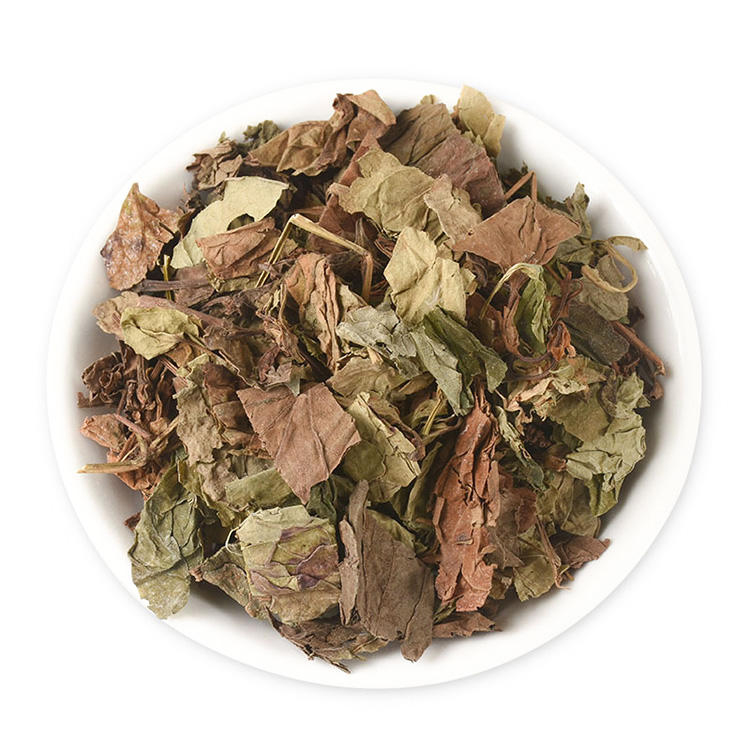
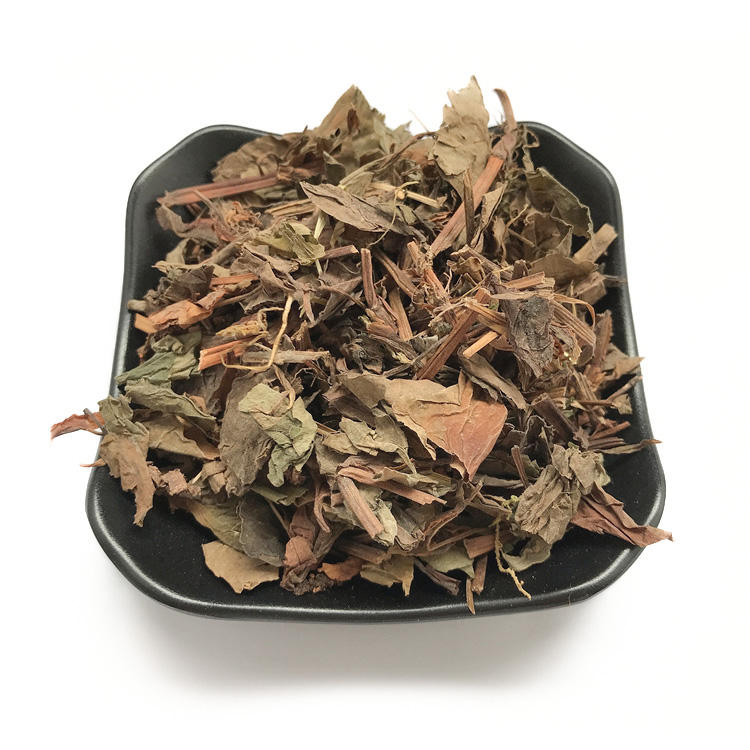
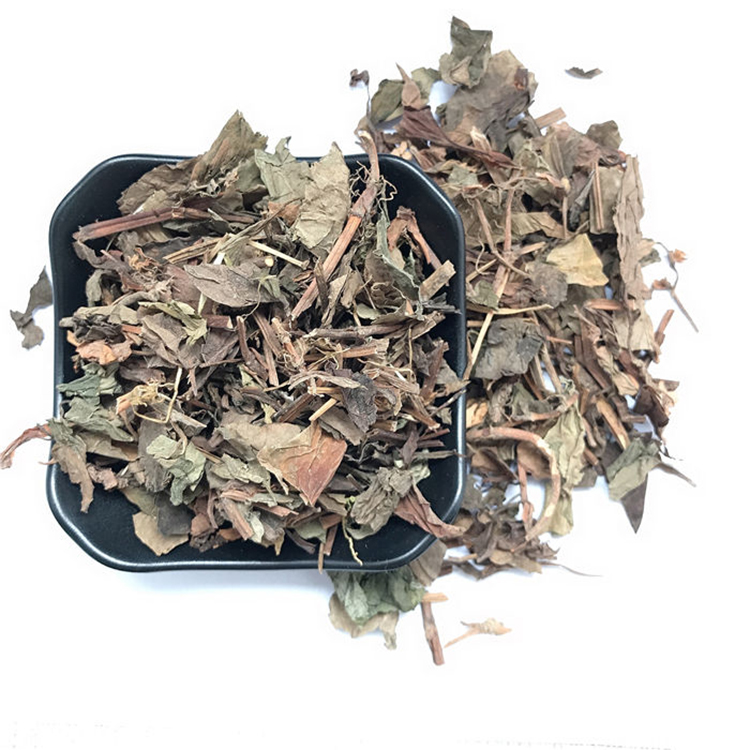
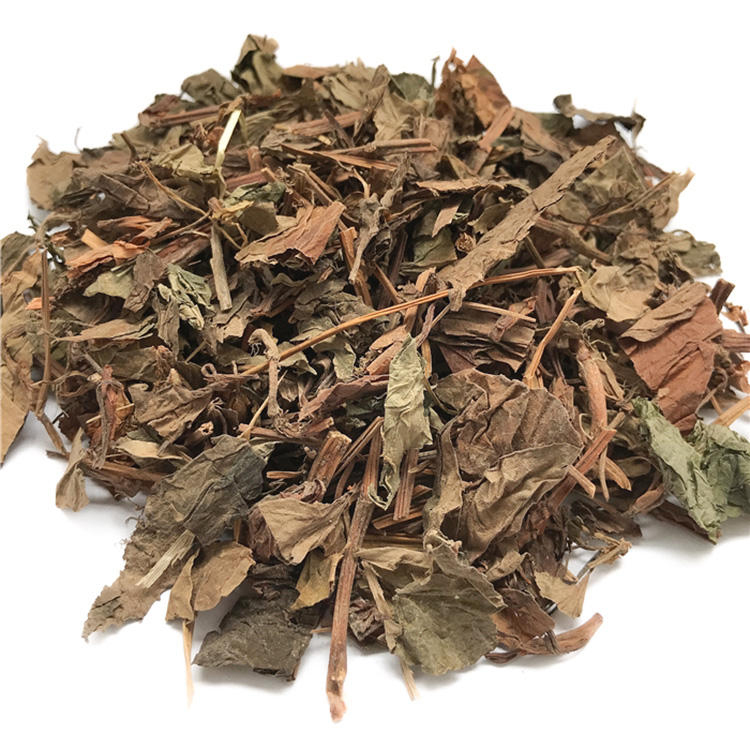
Dried Fish Mint for Herbal Tea
For dried Fish Mint for herbal tea, I would put more weight on:
Recognizable botanical morphology
Controlled leaf-to-stem composition
Consistent cut size
Natural green-to-olive coloration appropriate to the process
Characteristic aroma without mustiness
Low foreign matter
Controlled moisture
No insect activity
Microbial suitability for the intended process
Packaging that limits moisture uptake and aroma loss
Clear declaration of post-harvest treatment
Consumers can see this material.
That changes everything.
A dark fragment, excess stem fraction, stale aroma, visible dust, or inconsistent cutting may not make a laboratory assay fail, but it can still destroy the commercial value of a loose-leaf or bagged herbal tea.
Houttuynia cordata for Extraction
Extract manufacturers should think differently.
I would ask the Fish Mint supplier to define the target plant part and chemical fingerprint first, then establish processing specifications around the extraction process. Relevant constituents reported in Houttuynia cordata include flavonoids and phenolic compounds such as quercitrin, hyperoside, chlorogenic acid, and rutin, while volatile constituents add another layer of variability.
A 2014 HPLC-DAD study did something buyers should notice: researchers simultaneously evaluated 16 phenolic compounds and applied the method to 35 Houttuynia cordata samples. Analytical recoveries for those 16 compounds ranged from 98.93% to 101.26%, showing that multi-marker profiling is technically feasible rather than theoretical. Read the PubMed study.
That does not mean every commercial lot needs a 16-marker release specification.
It means one vague line reading “Houttuynia cordata: Pass” is not sophisticated quality control.
The Specification I Would Put in Front of a Fish Mint Supplier
There is no single universal Fish Mint specification that fits every country, product category, extraction method, and customer. Your legal and technical team must set limits according to the destination market and intended application.
But the structure should look something like this:
Control Point
Herbal Tea Manufacturer
Extract Manufacturer
Why It Matters
Botanical identity
Houttuynia cordata Thunb.
Houttuynia cordata Thunb.
Prevents species substitution
Plant part
Defined leaf/stem/aerial ratio
Defined target plant part
Different parts can have different chemical profiles
Drying Is a Manufacturing Variable, Not a Footnote
Drying changes everything.
When a supplier turns fresh Houttuynia cordata into dried commercial material, temperature, time, airflow, loading depth, and drying technology can alter color, aroma, tissue structure, volatile retention, and the chemical profile that ultimately reaches a tea kettle or extraction vessel.
A 2025 study compared freeze-drying with hot-air drying at 40°C, 50°C, and 60°C, specifically examining drying kinetics, chemical composition, flavor characteristics, biological activity, and compounds including chlorogenic acid, quercetin, rutin, and scutellarin. See the 2025 PubMed record.
That is not an argument that every buyer should demand freeze-dried material.
It is evidence that “dried” is not a process specification.
Ask the uncomfortable question:
How was it dried?
Then ask for the processing record.
For tea material, sensory retention may dominate the decision. For extraction feedstock, the better question is whether the supplier’s drying regime produces a reproducible chemical profile from commercial batch to commercial batch.
The lowest drying cost may not produce the lowest formulation cost.
Origin Alone Does Not Predict Fish Mint Chemistry
Buyers love origin stories.
Laboratories love data.
I side with the laboratory.
A 2024 Heliyon study compared conventionally soil-grown Fish Mint with hydroponically cultivated material grown using selected plant-growth-promoting additives. In that experimental system, growing time was reduced by half and quantified flavonoid glycosides plus caffeoylquinic acid derivatives increased by 143% relative to the soil-grown comparison group. Read the PubMed record.
Do not turn that result into a marketing slogan.
Do turn it into a procurement lesson.
Cultivation method can move chemistry.
So can geography, harvest maturity, rainfall, fertilizer practice, plant part, storage, and processing. A supplier saying “same origin as last year” does not prove that this year’s lot will behave identically in your extractor.
For manufacturers buying Houttuynia cordata bulk year after year, I prefer:
Approved botanical specification.
Approved reference sample.
Lot-specific identity testing.
Lot-specific contaminant testing.
Chemical fingerprint or marker testing where technically relevant.
Retention samples.
Defined change-notification requirements.
That is procurement control.
Watch for Bleaching and Post-Harvest Processing
Here is a Fish Mint-specific issue that deserves more attention.
A 2024 Food Chemistry: X study investigated Houttuynia cordata treated with sodium metabisulfite after researchers reported concerns about bleaching during field processing. The metabolomics work identified 34 differential metabolites when comparing treated and untreated material, illustrating that post-harvest chemical treatment can affect far more than appearance. See the PubMed study.
Pretty is suspicious.
Not always, of course. But when a dried herb looks unnaturally uniform, unusually bright, or materially different from your approved reference without an explained process change, I would investigate instead of celebrating.
Ask the Fish Mint supplier:
Was sodium metabisulfite used?
Was sulfur fumigation used?
Was any whitening or color-preservation treatment used?
Was an antimicrobial treatment used?
Was the material steam-treated?
Was irradiation applied?
Did the processing method change from the approved sample?
Then document the answer in the purchase specification.
A COA Does Not Qualify a Fish Mint Supplier
The industry is drowning in attractive PDFs.
A certificate of analysis is useful only when it belongs to the actual commercial lot, uses appropriate methods, reports meaningful specifications, and can be tied back to traceable production and testing records.
For manufacturers that sell dietary supplements in the United States, FDA’s 21 CFR Part 111 framework is particularly instructive. FDA states that manufacturers must establish specifications and conduct at least one appropriate test or examination to verify the identity of each dietary ingredient, unless an approved exemption applies. FDA’s dietary supplement CGMP guidance also requires controls for component specifications and lot traceability.
And FDA enforcement shows that these are not decorative requirements. Warning letters have cited dietary supplement manufacturers for failures involving identity specifications and ingredient identity verification.
If you need a more aggressive prequalification process, use a structured Chinese herbal slices supplier checklist instead of emailing, “Please send all certificates.”
Ask named questions.
Get named evidence.
Pesticide Testing Must Follow the Destination Market
One of the fastest ways to expose a weak Fish Mint supplier is to ask:
“Which pesticide standard did you test against?”
If the answer is simply “international standard,” keep asking.
The European Commission defines a maximum residue level, or MRL, as the highest pesticide residue legally tolerated in or on food or feed when pesticides are used according to good agricultural practice. Those limits are pesticide- and commodity-dependent rather than one universal number.
The scale of enforcement is worth noting. EFSA reported in May 2026 that its 2024 pesticide-residue assessment covered more than 125,000 food samples across Europe. Within the EU-coordinated program, 98.8% of 9,842 samples complied with EU legislation; among 39,433 imported-food samples under increased import controls, 5.5% exceeded EU limits, with 3.6% classified as non-compliant after measurement uncertainty was considered. EFSA’s 2024 pesticide-residue results.
Fish Mint was not the sole commodity in those statistics.
The procurement lesson is broader: imported botanical materials live inside an active residue-control system.
For U.S. food applications, EPA likewise establishes pesticide tolerances by pesticide and food commodity.
So I would never approve “pesticides: pass” without seeing:
Analytical scope
Individual analytes
Method
Reporting limits
Results
Applicable market criteria
Laboratory identity
Lot number
Herbal Tea Manufacturers Should Buy Aroma Before They Buy Color
Fish Mint has a problem and an advantage: it smells like Fish Mint.
That signature odor comes from a complex volatile profile, and research using GC-MS has demonstrated differences among leaves, stems, rhizomes, and whole-plant material.
That makes aroma a useful incoming-quality signal.
Not a replacement for testing.
A signal.
For tea production, I would keep sealed retention samples from approved lots and perform standardized sensory comparison during incoming inspection. Use the same sample weight, water temperature, steeping time, cup type, and evaluation sheet each time.
Manufacturers developing functional drinks or tea products can also review the site’s material on how functional drink brands use Chinese herbs when connecting raw-material control to finished beverage formulation.
How I Would Source Fish Mint in Bulk
If I were qualifying a Fish Mint supplier for a commercial tea or extract program, I would not begin with a 10-ton annual forecast.
I would begin with evidence.
Step 1: Freeze the Identity
Specify:
Houttuynia cordata Thunb.
Then define the plant part.
Never let “Fish Mint,” “Houttuynia,” “Yu Xing Cao,” and a supplier’s local trade name float around four different documents without reconciliation.
Step 2: Define the Commercial Use
Write one primary application:
Loose herbal tea
Tea bag
Powder
Water extraction
Hydroalcoholic extraction
Standardized botanical extract
Other defined manufacturing use
The application determines what matters most.
Step 3: Request a Representative Sample
Do not approve a hand-selected showroom sample and assume the production lot will match it.
Ask how the sample was taken.
Keep it.
Photograph it.
Test it.
Step 4: Review the Lot-Level Evidence
At minimum, align identity, moisture, contamination testing, treatment declarations, traceability, and packaging with the destination market and your process.
Risk-based independent testing is especially valuable during supplier qualification, specification changes, origin changes, abnormal sensory findings, complaint investigations, and early commercial shipments.
Step 6: Lock Change Control Into the Purchase Agreement
Require notification before changes involving:
Growing origin
Plant part
Harvest season
Drying system
Sulfite or sulfur treatment
Microbial reduction
Milling
Packaging
Testing laboratory
Specification
Subcontracted processing
Otherwise the sample you qualified in March may quietly become a different ingredient in October.
Step 7: Build the Import File Before Shipping
Botanical name, plant part, intended use, invoice description, COA, lot code, packaging marks, and regulatory documents must tell the same story.
Red Flags When Comparing Fish Mint Wholesale Suppliers
I would investigate or reject a Fish Mint supplier when I see:
No Latin botanical name
No plant-part declaration
One generic COA reused across quotations
“Pesticide free” without a laboratory report
“Heavy metals passed” without numerical results
No crop or production lot identification
Unclear drying method
Unexplained unusually bright color
No declaration of sulfite or post-harvest treatment
Inconsistent odor between sample and commercial lot
No traceability beyond the trading company’s warehouse
Refusal to provide representative commercial samples
Disease-treatment claims presented as proof of ingredient quality
One specification offered for tea, extract, food, and supplement customers worldwide
The last one irritates me most.
Different markets have different rules. Different manufacturing processes have different needs.
Why would one specification magically fit everything?
FAQs
What is Fish Mint?
Fish Mint is the common trade name for Houttuynia cordata Thunb., a Saururaceae herb sold as dried aerial material, tea-cut botanical, powder, or extraction raw material; bulk buyers should specify the Latin binomial, plant part, physical form, origin, processing method, and intended use rather than purchasing against the common name alone.
Its characteristic aroma and variable chemical composition make plant-part and processing control particularly important for herbal tea and extraction manufacturers.
How do I source Fish Mint in bulk?
To source Fish Mint in bulk, define Houttuynia cordata Thunb., plant part, intended manufacturing use, cut or particle size, drying method, moisture requirement, contaminant testing, chemical identity method, packaging, traceability, and destination-market rules before requesting quotations, then qualify a representative sample and verify commercial lots against the approved specification.
Price comparison should come after technical equivalence is established. Otherwise, two quotations may represent materially different ingredients.
What quality tests should I request for Houttuynia cordata bulk?
Quality testing for Houttuynia cordata bulk should combine botanical identity with risk-based physical, chemical, and contaminant controls, typically including moisture or loss on drying, foreign matter, appropriate chromatographic identification, pesticide residues, Pb/Cd/As/Hg or relevant elemental contaminants, microbiology, sulfite testing when treatment risk exists, and marker profiling when required by the manufacturing process.
The exact methods and acceptance limits should match the destination market, product category, plant part, and intended use rather than being copied from another herb.
Is dried Fish Mint for herbal tea the same as extraction-grade Fish Mint?
Dried Fish Mint for herbal tea and extraction-grade Fish Mint may come from the same species, but they should not automatically share the same commercial specification because tea manufacturers prioritize sensory quality, visible cut, cleanliness, aroma, and infusion behavior, while extract manufacturers may place greater weight on chemical fingerprints, marker consistency, extraction yield, particle form, and process reproducibility.
That is why intended use belongs on the purchase specification before a supplier quotes the lot.
What makes the best Fish Mint supplier for manufacturers?
The best Fish Mint supplier for a professional manufacturer is one that can repeatedly prove botanical identity, plant part, origin, controlled drying and post-harvest processing, lot-specific contaminant testing, traceability, representative sampling, packaging control, change notification, and documentation appropriate to the destination market rather than merely offering the lowest kilogram price or the most certificates.
A strong supplier should also be willing to investigate deviations and explain why one lot differs from another instead of hiding behind a generic COA.
Your Next Step: Buy the Fish Mint Lot, Not the Sales Story
If you are buying Fish Mint for herbal tea or Houttuynia cordata extract production, stop the quotation process until the supplier can answer five questions clearly:
What species is it?
Which plant part is it?
How was it grown and dried?
What was tested on this exact lot?
What changes must the supplier disclose before the next shipment?
Then put those answers into the purchase specification.
If you are evaluating Fish Mint bulk supply for tea bags, loose herbal tea, botanical extraction, functional beverages, private-label products, or larger manufacturing programs, send your required plant part, cut size, annual volume, destination country, intended use, testing requirements, and packaging format to the supplier before requesting final pricing.
Our low MOQ of 1 kg (2.2 lb) makes it easy to order Chinese herbal slices or wholesale Chinese medicine herbs. Private-label and bilingual labeling are also available.
Delivery Cycle & Support
We have a fast 7-day lead time. We provide free samples, COA reports, and technical support to help you bring high-quality bulk Chinese herbs to market.
Quality & Certifications
Our products are manufactured in a GMP-certified facility and meet ISO22000 standards. All Chinese herbs are third-party tested for heavy metals, pesticides, and microorganisms.