When you buy Huang Qi in bulk, you don’t lose sleep because of “quality” in theory. You lose sleep because of lot drift in real life.
One container lands, and the slices look bright and clean. Next container, the carton bottom is full of dust and fines, the slices curl like potato chips, and your team starts the same loop again: re-sieving, re-checking the COA pack, answering the same buyer questions, and fighting returns.
So here’s my argument: bulk grading for Astragalus slices has to be built around four signals you can see, feel, and verify—slice color, fiber texture, sweetness indicators, and breakage rate. If you control these four, you don’t just “buy herbs.” You run a stable supply program.
If you’re sourcing from a one-stop supplier like GuoCao (Wholesale Chinese Medicinal Herbs and Spices Supplier – GuoCao), you can tie these grading rules directly into GMP production, ISO 22000 food safety, and third-party COA testing. That’s where the business value is. Not fancy words. Just fewer surprises.
Slice color: Jin Jing Yu Lan (golden well and jade rail)
Color grading sounds basic, but it’s the fastest way to spot processing variance.
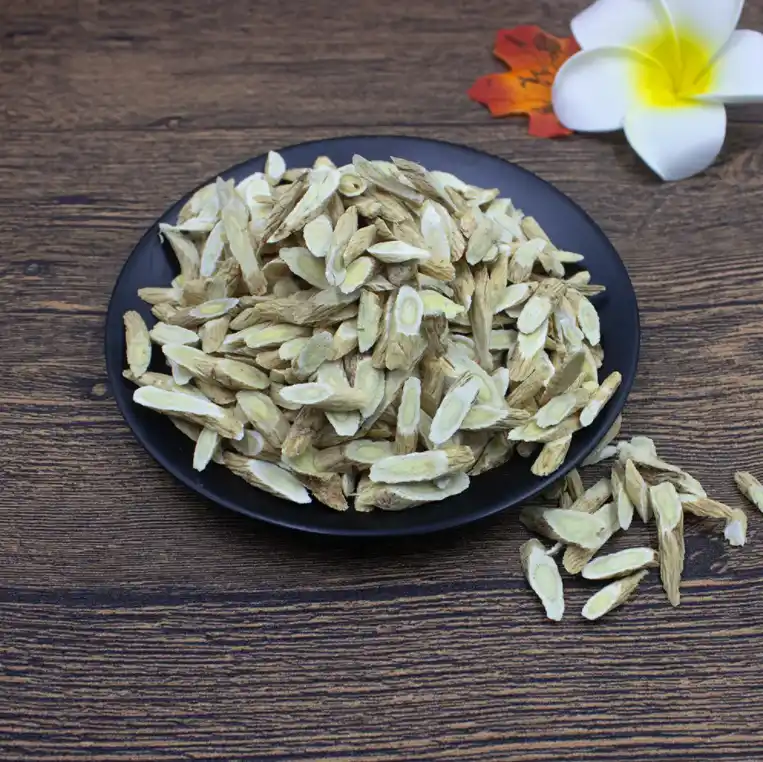
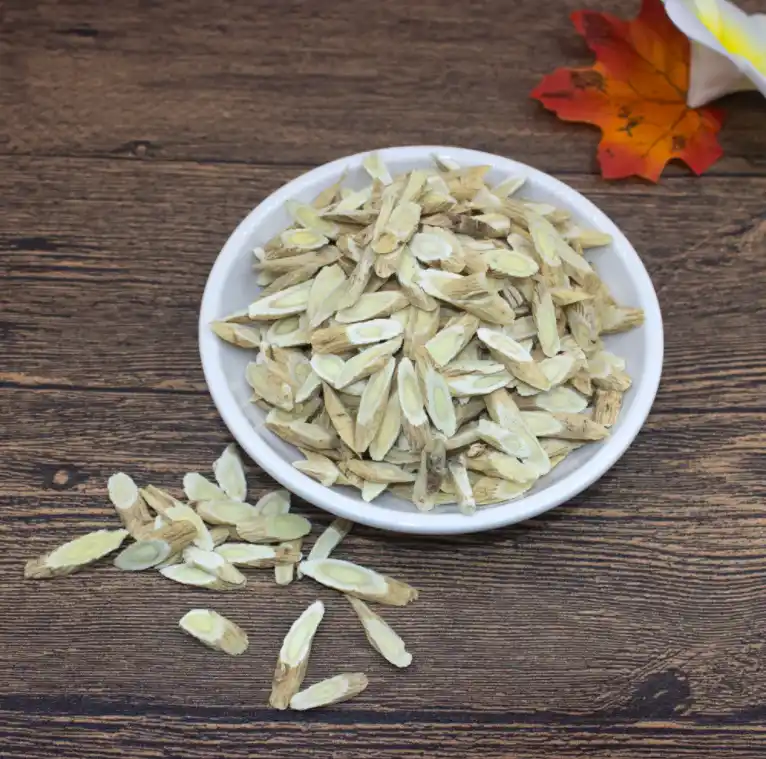
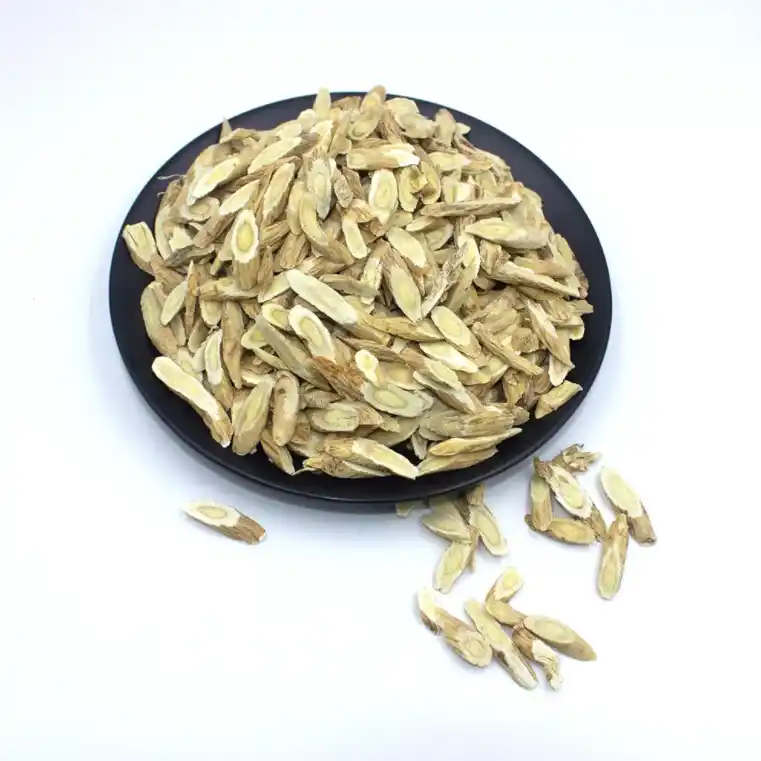
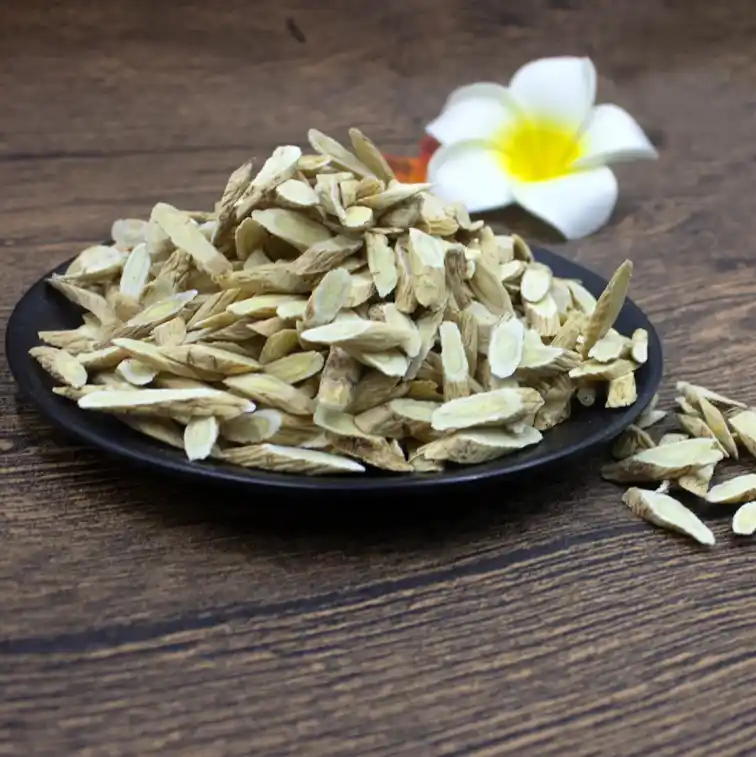
In bulk trade, buyers usually want that classic contrast: lighter bark layer plus deeper yellow wood. People call it “Jin Jing Yu Lan.” You can treat it like a real spec: clear ring contrast, even tone, no gray cast, no over-brown edges.
Carton check: what you should look for
Open one carton and don’t cherry-pick the pretty pieces. Go straight to:
the top layer (handling damage shows up here),
the middle (true average),
the carton bottom (this is where problems hide).
If the bottom looks like sand, your breakage control is already failing. If the color is uneven (pale mixed with dark brown), your slicing and drying control probably isn’t tight.
Why color drifts
Color is not only “hot or not hot.” It’s also:
moisture level before slicing (too wet can cause curling and bark lift),
drying curve (too aggressive can push browning and burnt notes),
storage conditions (humidity swings can dull appearance over time).
Here’s the practical buyer language: “We need stable slice color within the lot, clear bark–wood contrast, and low discoloration rate.” Simple, but it stops a lot of arguments later.
Fiber texture: strong fiber fracture and “difficult to break”
Fiber is the most underrated bulk grading point. It tells you if the slices will hold up in transport and if the decoction piece will look right in retail packs.
A lot of teams only stare at color. Then they ship the lot, and the buyer complains: “Too powdery,” “Too crumbly,” “Too many small pieces.” That’s fiber and structure talking.
Quick fiber tests you can run on the dock
You don’t need lab gear for a first pass:
Snap test: Does it resist breaking? Or does it shatter fast?
Fracture look: Do you see long fibrous threads, or a chalky crumb?
Feel test: Does it feel firm and dense, or light and “hollow”?
Also watch slice thickness. Thin slices can look nice, but they often create more fines in long shipping lanes. Thicker slices tend to travel better. Don’t over-think it.
Why fiber matters downstream
Different customer scenes need different structure:
Hospitals and decoction packs want slices that stay intact and dose evenly.
Extract and granulation can tolerate more small bits, but they’ll still hate dust because it clogs and slows.
Tea bag cutting can use smaller sizes, but you still want clean cuts, not crumb.
So write the spec based on your channel. If you sell “decoction pieces,” fiber becomes a top KPI, not a “nice to have.”
Sweetness indicators: sucrose, betaine, and consistent taste
Let’s be honest: buyers still taste Huang Qi. Even if they don’t say it, they do.
But tasting alone is messy. One person says “sweet.” Another says “flat.” Then you fight. So you need a repeatable tasting step and a lab backstop.
How to standardize a taste check (without making it weird)
Keep it simple and consistent:
same water temp,
same steep time,
same slice weight,
always compare to a retained reference sample from the last approved lot.
Write it in your incoming QC sheet. If you don’t, every inspector will do it different, and the results will be noise.
When to ask for lab support
Published research links Astragalus sweetness to specific compounds (like sucrose and betaine), and it also shows sweetness tends to track certain marker components more than others. You don’t need to turn your warehouse into a lab. You just need this rule:
If sweetness is a selling point in your market, ask for:
third-party COA testing capability,
consistent marker-style reporting in the COA pack,
stable storage conditions to avoid taste drift.
This is where GuoCao’s setup helps—GMP herbal slice lines, ISO 22000 food safety system, and third-party COA support. It keeps your “taste story” from becoming a customer service fire.
Breakage control: moisture window, drying, packing, and “fines” management
Breakage is where bulk buyers bleed margin, but nobody wants to talk about it. It’s not just the obvious shattered slices. It’s also:
fines that get thrown away,
rework time,
inconsistent pack-out weight,
bad-looking retail presentation.
Moisture window before slicing
If you slice too wet, slices can warp and separate (bark lift, curling, ugly edges). If you slice too dry, it gets brittle and chips like crackers. Either way, breakage goes up. You want a controlled cutting point, not “whenever the crew feels like it.”
Drying curve and “burnt smell” risk
Drying that’s too hot can darken color and create off-notes. Drying that’s too slow can invite other problems. So you don’t just ask “how do you dry.” You ask:
do you control temperature by stage?
do you monitor moisture during drying?
do you separate lots by thickness and size?
This is boring ops talk, but it prevents drama.
Packing and transport: the “shake test”
Even perfect slices can be ruined by lazy packing.
Industry black talk: “If it fails the shake test, it fails the customer.” Meaning: vibration in transit will expose weak cartons, thin liners, loose fill, and poor pallet wrap.
Write these into your RFQ:
max fines rate (define how you measure it),
double poly liner,
tight carton fill,
pallet wrap that doesn’t collapse,
photos before loading.
Sounds strict, but it saves you from “why is the bottom all powder?” emails later.
OEM/ODM customization, plus herbal enzyme beverage production
That matters because bulk grading isn’t “one-time.” It’s a program. You need repeatability across:
pharma companies,
supplement processors,
functional beverage makers,
cosmetic ingredient buyers,
hospitals,
distributors and agents.
And GuoCao sells across 30+ regions (US, Europe, Australia, Japan, Korea, Canada, Malaysia, Philippines, and more), so they’re used to document demands. Different markets, different paperwork, same core controls.
If you’re building a multi-category basket, you can route it through GuoCao’s catalog sections like:
Our low MOQ of 1 kg (2.2 lb) makes it easy to order Chinese herbal slices or wholesale Chinese medicine herbs. Private-label and bilingual labeling are also available.
Delivery Cycle & Support
We have a fast 7-day lead time. We provide free samples, COA reports, and technical support to help you bring high-quality bulk Chinese herbs to market.
Quality & Certifications
Our products are manufactured in a GMP-certified facility and meet ISO22000 standards. All Chinese herbs are third-party tested for heavy metals, pesticides, and microorganisms.