Powder Flowability Metrics (Angle of Repose, Carr Index, Hausner Ratio)
If you can’t measure flow, you can’t fix it. Use everyday metrics that QA and production both understand.
Quick table — what to measure and how to read it
Metric
How it’s taken
Typical “good” band
What it tells you
Where to use
Angle of Repose (AOR)
Funnel drop; measure heap angle
≲ 30–35°
Macro-flow, fast screening
Incoming QC, line checks
Carr Index (CI)
100×(tapped−bulk)/tapped
≲ 15
Compressibility, packability
Spec sheet, vendor compare
Hausner Ratio (HR)
tapped/bulk density
≲ 1.20
Cohesion proxy
Spec sheet, trend watch
Flow Function (FFc, ring shear)
Shear cell under stress
≥ 4 (easy-flow); 2–4 (cohesive)
Flow under consolidation; water-sensitive
R&D, root-cause on caking
Why multiple tests? No single number catches every failure mode; a spice that “flows” in a funnel can still arch in a hopper when humidity creeps up. Use AOR/CI/HR for speed, and ring shear when you’re tuning a sticky blend or chasing moisture-caused stoppages. (Yep, sounds nerdy, but it saves downtime.)
Ring Shear Test and Flow Function (FFc)
Ring shear maps how your blend behaves under load—exactly what happens in a tote, screw feeder, or FFS throat. Build a simple curve: same formula at low, mid, high moisture. You’ll see it: FFc nosedives as moisture rises; arching risk goes up. That’s your control knob.
Shop hint: when FFc drops < 4 after a humid day, pause big batches. Dry the batch or adjust anti-caking before you burn a shift clearing clumps.
Moisture, Water Activity, and Deliquescence (NaCl ~ 75% RH)
High salt rubs and bouillon-style blends hate humid air. Sodium chloride deliquesces around ~ 75% RH (≈ 25 °C)—once the room crosses that line, salt surfaces liquefy, capillary bridges form, and caking starts fast. Water activity (a_w) is your friend: set a release band for finished goods and stick to it. High-sugar or acid notes push stickiness even sooner.
Plain rule: keep the packaging zone below your worst-case ingredient’s humidity trigger. For salty systems, keep it safely under that threshold (don’t flirt with 70+% RH… it bites).
Moisture Sorption Isotherms of Garlic Powder (and other hygroscopic spices)
Garlic powder, onion powder, fine chili—tiny particles, big surface area. Their sorption isotherms sit higher than whole-herb equivalents at the same RH, so they grab moisture first. When you blend these with salt or sugar, the mix can cake even if bulk RH “looks okay.” That’s why you tune a_w, not vibes.
Takeaway: If your formula carries garlic powder, treat it like a humidity magnet. Push a bit more anti-caking (see next section), or jump to agglomeration to lift D50 and reduce cohesion.
Glass Transition (Tg) and Sticky Point in Sugar–Acid Systems
Amorphous sugars (maltodextrin, spray-dried extracts) go rubbery when the storage temperature rises above Tg (or when moisture depresses Tg). Past that “sticky point,” powders clump, smear, and blind sieves. Two levers:
Choose carriers with higher Tg (e.g., the right DE maltodextrin).
Finish drying to the right endpoint; don’t leave bound moisture “just a little high.” It will bite later.
Not rocket science. Just run Tg-aware trials and set your Tg – T safety margin.
Food-grade silica (E551) works well in salty, spicy mixes; calcium silicate helps in salt-heavy systems.
Regulatory guardrails (simple):
Agent
Common role
Use limit (headline)
Label notes
Silicon dioxide (E551)
Anti-caking in seasoning
≤ 2% of the food
Name as permitted additive
Calcium silicate (E552)
Salt anti-caking; baking
≤ 2% in table salt (up to 5% in baking powder)
GRAS where applicable
Stay inside those windows. Build a small factorial (silica grade × dose × moisture) to hit flow targets without dulling flavor.
Particle Size Distribution and Fluidized-Bed Agglomeration
Tiny powders (< 100 µm) pack tight and cling; larger, porous granules roll. Agglomeration (fluidized-bed or high-shear) lifts median size (e.g., D50 ≥ 200 µm), opens pores, and boosts wettability and flow. You also get smoother dosing on stick packs. Yes, it adds a step, but it often removes downstream pain—stoppages, rework, sieve blinding.
When to agglomerate: high-sugar TCM extracts, fine garlic/chili in rubs, instant soup bases. If your CI/HR improve and FFc clears 4+ after agglomeration, you’re good.
Packaging, Relative Humidity Control (35–45% RH), and Storage
For hygroscopic blends, run low-humidity rooms around ~ 35–45% RH at ~25–27 °C. Pair that with high-barrier film and the right desiccant load inside the pouch or jar headspace. In rainy season, add an airlock/ante-room so pallets don’t drag wet air into the line.
Practical stack:
Dehumidifier + closed doors (simple, but discipline).
Don’t over-dry rooms below ~30% RH for long—static will mess with fill weight (and operators).
OEM/ODM QA: a_w, Flow Specs, and Release Plan
Your spec sheet is your shield. Keep it short, but sharp.
Suggested release lines (tune to your market):
Stage
Spec / check
Typical target
Incoming
AOR ≤ 35°, CI ≤ 15, HR ≤ 1.20
Screen out bad lots
Blend (pilot)
FFc ≥ 4 at target moisture; sieve cut pass
Predict no-arch behavior
Finished goods
a_w ≤ setpoint (based on DRH of risky ingredient); CI/HR in band
Shelf-stable, no caking
Packaging env
RH in band; film OTR/MVTR fit product
Barrier matches isotherm
Retain
3/6-month C&C (clump & color) check
Early warning
If a lot slips, don’t panic. Dry blend back, bump silica within the legal window, or re-sieve. But write it down—SOP beats memory.
Case Scenarios (real-world patterns, no drama)
Rainy-season coastal warehouse Salt-forward BBQ powder shows clean flow in March, but arches in June. Packaging room peaks at 72–80% RH. Fix: cut RH to ~40–45% in the pack zone, move WIP in closed bins, +0.3–0.5% silica within limit, and ring-shear-validate at worst-case moisture. Downtime drops, hopper clears. Not fancy. It just works.
Garlic-heavy soup base Fine garlic pushes CI from 13→22. Fluidized-bed agglomeration lifts D50 to ~220–300 µm, CI falls back under 15, HR ≤ 1.20, and fill weight CV improves. Formulation stays the same; particle engineering does the job.
Business Value for GuoCao OEM Seasoning Powders
You’re not only buying powder—you’re buying stability. GuoCao runs GMP production with ISO 22000 food-safety, ambient/cool/MA warehousing, and third-party COA per lot. We ship globally and speak both herbal and spice. That matters when your seasoning includes TCM extracts or functional botanicals that behave a bit… stubborn.
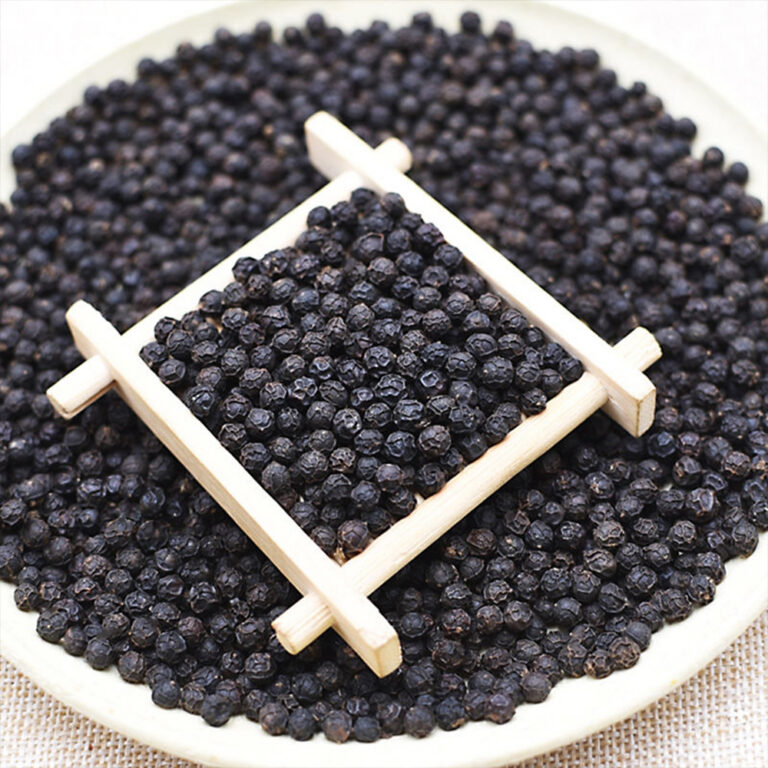
Explore our Dried Spices range for clean, origin-verified peppers, cloves, nutmeg, tsaoko.
We serve pharma, supplement makers, hospitals, functional-drink brands, and distributors across 30+ countries and regions. And yes, MOQ fits pilots; capacity (≈ 2,500 t/y) covers scale. Little typo here and there happens, but quality don’t slip.
Table — Caking Mechanisms and Straightforward Controls
Our low MOQ of 1 kg (2.2 lb) makes it easy to order Chinese herbal slices or wholesale Chinese medicine herbs. Private-label and bilingual labeling are also available.
Delivery Cycle & Support
We have a fast 7-day lead time. We provide free samples, COA reports, and technical support to help you bring high-quality bulk Chinese herbs to market.
Quality & Certifications
Our products are manufactured in a GMP-certified facility and meet ISO22000 standards. All Chinese herbs are third-party tested for heavy metals, pesticides, and microorganisms.