You are standing in the aisle of a busy Asian grocery store, or perhaps you are sitting at your procurement desk reviewing a spreadsheet for your company’s next herbal tea line. You see two distinct options: White Chrysanthemum and Yellow Chrysanthemum.
They look pretty similar, right? Just a slight shift in color tone?
To be honest, that is what most people think. But if you believe they are interchangeable, you are making a fundamental mistake. It is like trying to use a hammer when you really need a screwdriver. Both are tools, but if you use the wrong one, you are going to mess up the job.
Whether you are just a tea drinker trying to soothe a pounding headache or a global buyer looking for Wholesale Chinese Medicinal Herbs, you need to understand the real difference. It isn’t just about aesthetics. It is about chemistry, taste, and specific physiological results.
Let’s break this down. No fluff, just the facts you need to make the right choice.
The Core Difference: It’s Not Just About Color
In the vast world of Flowers & Whole Herbs, appearance tells a story, but the function is what truly matters.
In Traditional Chinese Medicine (TCM), we categorize herbs by their “nature.” Both yellow and white chrysanthemums are technically consider[2]ed “cooling.” They both help reduce heat in the body. But how they do it and where that cooling energy goes is totally different.
Think of it this way:
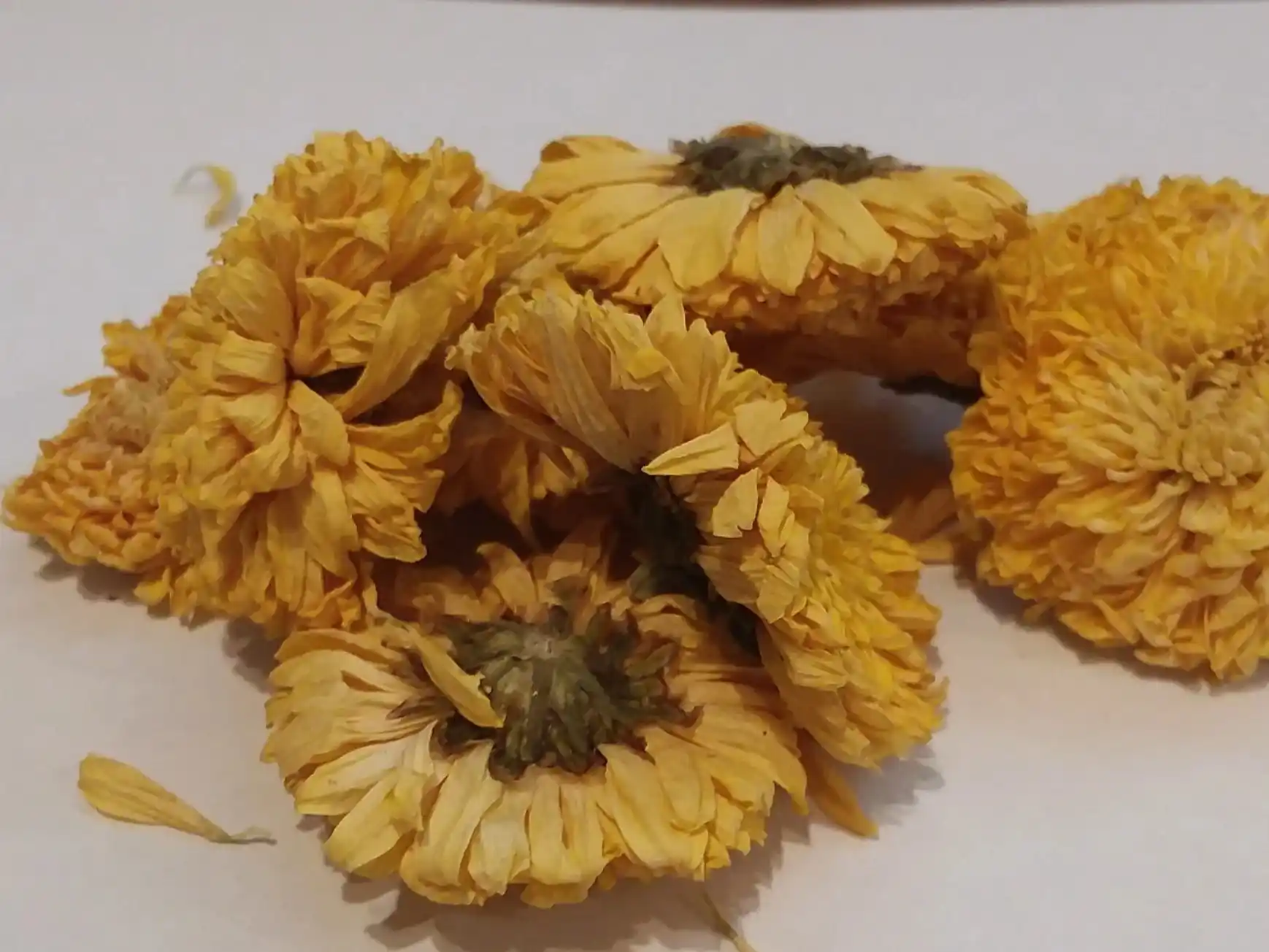
Yellow Chrysanthemum (Huang Ju) is the “Attacker.” It pushes energy outward. It is aggressive against external bugs and viruses.
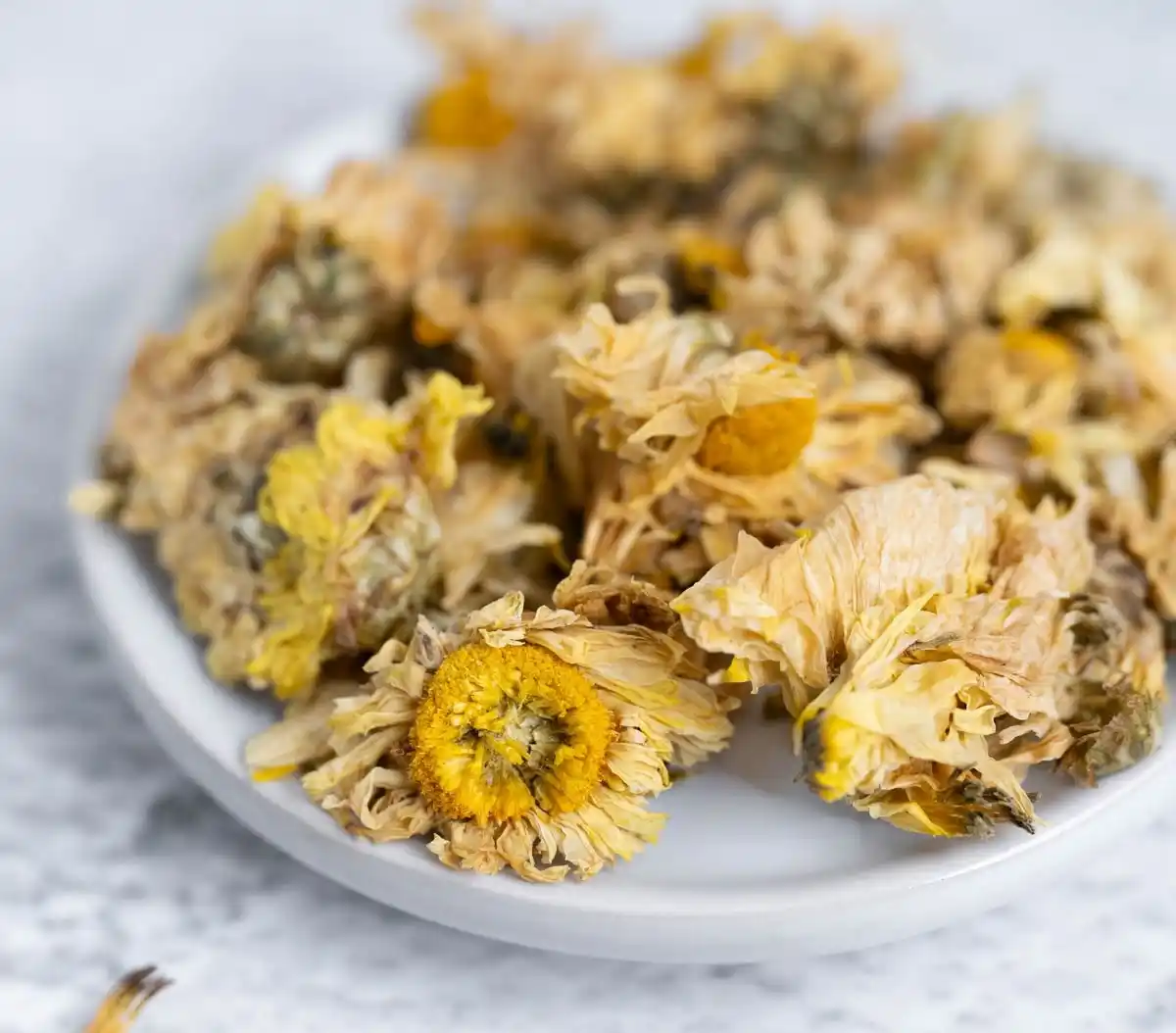
[3][4]White Chrysanthemum (Bai Ju) is the “Nurturer.” It stays inside. It nourishes the liver and brightens the eyes.
If you buy the wrong one, you simply won’t get the effect you paid for.
Yellow Chrysanthemum Slices (Huang Ju): The Virus Hunter
Let’s talk about the yellow guy first.
When you open a bag of high-quality Yellow Chrysanthemum, the smell hits you immediately. It is strong. It’s pungent. It smells like a field of wildflowers right after a heavy storm. This isn’t an accident. The yellow variety is genetically closer to the wild chrysanthemum, which means it is packed with volatile oils.
When You Should Use It
Picture this scenario: You wake up on a Tuesday morning. Your throat feels like sandpaper. Your head is heavy, and you feel a little feverish. This is what TCM calls “Wind-Heat.”
This is the absolute best moment for Yellow Chrysanthemum. Because it has a strong “dispersing” quality, it helps push that heat out of your body through your pores. It is fantastic for the early stages of a cold or flu.
We have clients at GuoCao who manufacture cold remedies or medicinal tea blends. They always ask for our premium Yellow Chrysanthemum slices because they need that potency. The flavor profile is robust—it has a sharp, slightly bitter kick. That bitterness? That is the medicine working.
A Tip for Formulators
If you are making a flu tea, pair Yellow Chrysanthemum with ingredients like Licorice (Gan Cao). The natural sw[3][4][7]eetness of the licorice balances the bitter bite of the yellow flower perfectly, making it palatable for the average consumer.
White Chrysanthemum Slices (Bai Ju): The Screen Savior
Now, let’s look at the white variety.
White Chrysanthemum is basically the best friend of the modern office worker. If you stare at a computer screen for 8 hours a day, listen up.
The taste is completely different from the yellow one. It is naturally sweet, delicate, and it doesn’t have that heavy “herbal” punch. You can drink it all day long without getting tired of it.
Why It’s a “GuoCao” Trend
You might have heard of the “GuoCao” trend (modern Chinese style). Young people are loving traditional ingredients mixed with modern lifestyles.
In TCM theory, your eyes are directly connected to your Liver. When you are stressed, staying up late scrolling through social media, or working overtime, you deplete your “Liver Yin.” The result? Dry eyes, blurry vision, and a short temper.
White Chrysanthemum doesn’t fight viruses. It “pacifies” the Liver. It gently cools down that internal fire without being too harsh on the stomach.
We see a massive demand for this in the Tea Bag Cut sector. Office workers want something easy. They want a pleasant, floral tea that keeps their eyes feeling fresh.
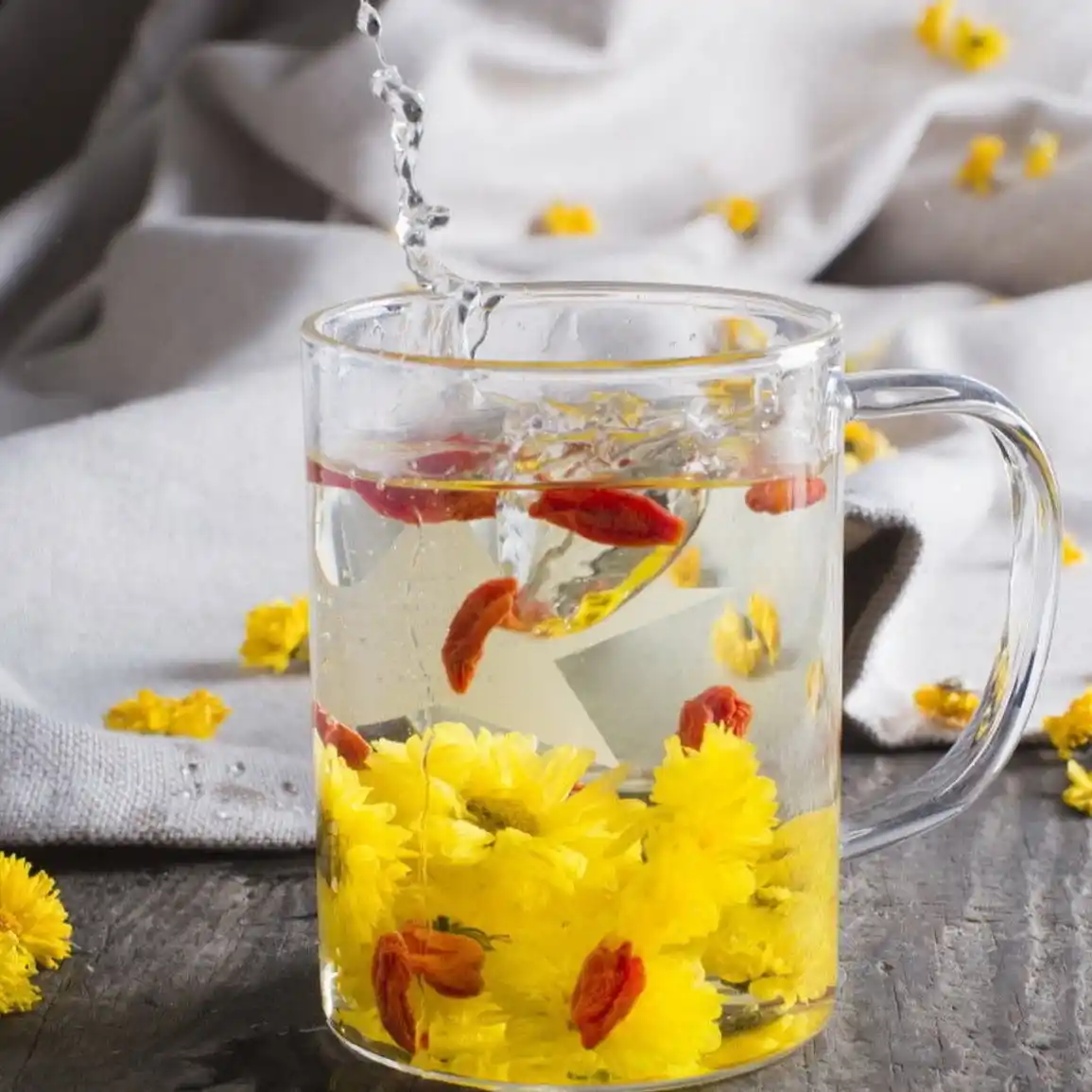
For commercial buyers, White Chrysanthemum (especially the Hang Bai Ju variety) is often considered a premium grade because it tastes so good. It mixes perfectly with Fruits & Seeds like Goji berries. In fact, “White Chrysanthemum + Goji” is the classic formula for eye health found in teahouses across Asia.
Comparative Data: A Quick Reference Guide
If you are sourcing for a Commercial Company or just want to know the specs for your own knowledge, check out this comparison table.
Feature
Yellow Chrysanthemum (Huang Ju)
White Chrysanthemum (Bai Ju)
Primary Action
Dispersing Wind-Heat (Strong Cooling)
Pacifying Liver (Gentle Nourishment)
Target Area
Lungs, Throat, Head (External)
Liver, Eyes (Internal)
Best Use Case
Sore throat, fever, headache, flu.
Dry eyes, blurry vision, screen fatigue.
Flavor Profile
Pungent, strong aroma, bitter notes.
Sweet, delicate, mild floral scent.
Key Compounds
High Chlorogenic Acid & Flavonoids.
Balanced Luteolin & Glycosides.
Market Application
Cold medicines, functional flu teas.
Daily hydration, beauty drinks, eye care.
Pairing Idea
Mint, Honeysuckle.
Goji Berries, American Ginseng.
The Industry “Dirty Secret”: Sulfur Fumigation
Okay, let’s get real for a second. This is the stuff most suppliers won’t tell you, but you need to know it to protect your business.
Chrysanthemums are flowers. Flowers attract bugs. It’s nature.
To keep the flowers looking “perfect” and to kill bugs cheaply, some unethical farmers and middlemen use Sulfur Fumigation. They blast the flowers with sulfur dioxide.
Why do they do it?
It kills pests instantly.
It bleaches the flower, making the White Chrysanthemum look bright white (unnaturally white) and the Yellow look neon yellow.
It adds water weight, so they can sell it for more money.
But here is the catch: It tastes terrible. It tastes sour and chemical. And it is bad for your health. If you brew a cup of tea and it smells like a burnt match, throw it away.
The GuoCao Standard
At GuoCao, we don’t play those games. We know that whether you are a hospital or a Supplement Manufacturer, you cannot afford a safety scandal.
We operate a strict GMP (Good Manufacturing Practice) production line. We control the whole process. Our annual capacity is 2,500 tons, but we treat every batch like it’s the only one.
Sulfur-Free: We use modern drying techniques, not chemicals.
ISO 22000: We are certified for food safety.
Third-Party Testing: We use COA (Certificate of Analysis) detection for heavy metals and pesticide residues.
We have seen too many small retailers get burned by buying cheap stock that turns brown in the warehouse or gets rejected by customs. Don’t let that be you.
Brewing and Manufacturing Applications
If you are in the business of making drinks or supplements, here is how you can use these slices effectively.
1. For the Beverage Industry
The functional drink market is exploding. People are tired of sugary sodas. They want “health in a bottle.”
The Concept: A sparkling White Chrysanthemum water with a hint of honey and lemon.
Why it works: It’s refreshing, low calorie, and you can market the “Eye Health” benefit to gamers and students.
Sourcing: You need consistency. We have climate-controlled warehouses (cool and dry) to ensure the flavor profile doesn’t fluctuate between batches.
2. For the Supplement Industry
The Concept: An “Eye Rescue” capsule using White Chrysanthemum extract.
Why it works: With everyone glued to phones, eye health is a top concern.
Sourcing: You might need to blend this with Animal & Mineral ingredients (like certain shell extracts used in TCM for eyes) or other synergists. We support OEM/ODM customization, so we can grind, mix, or extract to your specific mesh size.
3. For the Cosmetic Industry
Believe it or not, chrysanthemum extract is huge in skincare right now. It soothes inflammation and redness.
The Concept: A calming face mist for sensitive skin.
Sourcing: You generally want the Yellow variety here for its high anti-inflammatory flavonoid content. You can find these in our catalog.
How to Choose for Your Business
So, which one should you stock?
If your customers are looking for immediate relief during flu season, or if you are making a “Winter Wellness” blend, go with Yellow. It works fast, and customers feel the difference.
If your target market is lifestyle, beauty, or office wellness, go with White. It tastes better for repeat drinking. Most successful functional drink brands lean on White because the flavor is more approachable for the average consumer.
Final Thoughts
Chrysanthemum tea isn’t just hot water and dried flowers. It is chemistry. It is culture. And if you are selling it, it is your reputation on the line.
Whether you choose White or Yellow depends entirely on the problem you want to solve. Yellow fights the cold; White saves the eyes.
At GuoCao, we serve clients in over 30 countries—from the US and Canada to Japan and Malaysia. We know the regulations. We know the logistics. If you are ready to stop guessing and start sourcing real, clean herbs, check out our full range of Barks, roots, and flowers.
Our low MOQ of 1 kg (2.2 lb) makes it easy to order Chinese herbal slices or wholesale Chinese medicine herbs. Private-label and bilingual labeling are also available.
Delivery Cycle & Support
We have a fast 7-day lead time. We provide free samples, COA reports, and technical support to help you bring high-quality bulk Chinese herbs to market.
Quality & Certifications
Our products are manufactured in a GMP-certified facility and meet ISO22000 standards. All Chinese herbs are third-party tested for heavy metals, pesticides, and microorganisms.