If you’ve ever said, “Why did this pepper grind totally different today?” you’re not alone. You didn’t suddenly forget how to cook. Your grinder didn’t get moody. The raw material changed.
Most people blame the grinder setting. That’s the easy target. But in real sourcing—especially when you buy Hei Hu Jiao for production—your “grind yield” swings because your input specs are loose. And the #1 spec everyone skips is bulk density (g/L).
I’m going to argue this straight: if you don’t control density grade, your output will keep drifting, even if everything else looks “fine.” Fix that, and a bunch of other headaches go quiet too.
If you source black pepper through GuoCao’s one-stop system (GMP line, ISO 22000 food safety, third-party COA testing, and controlled warehousing), you can lock these specs into your PO so your team stops fighting lot-to-lot surprises. Start here: Black Pepper (Hei Hu Jiao) wholesale premium spice.
Bulk density (g/L)
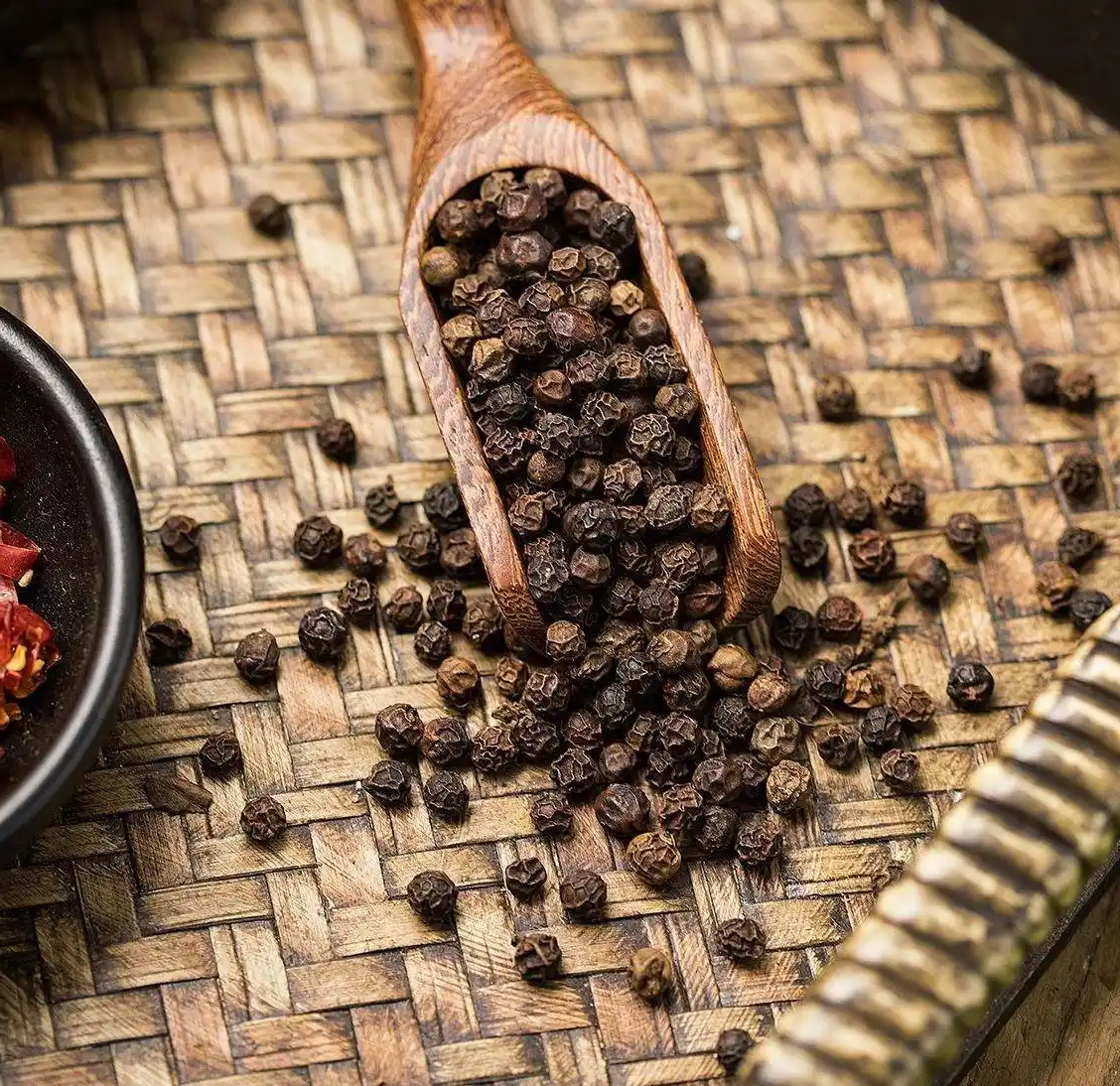
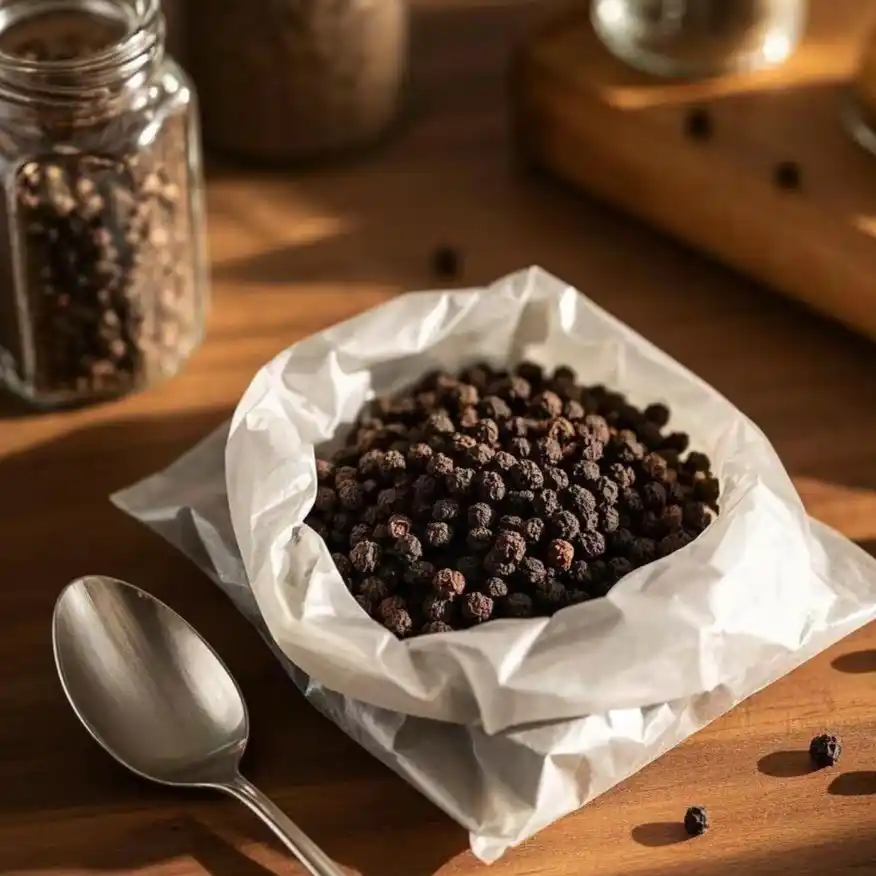
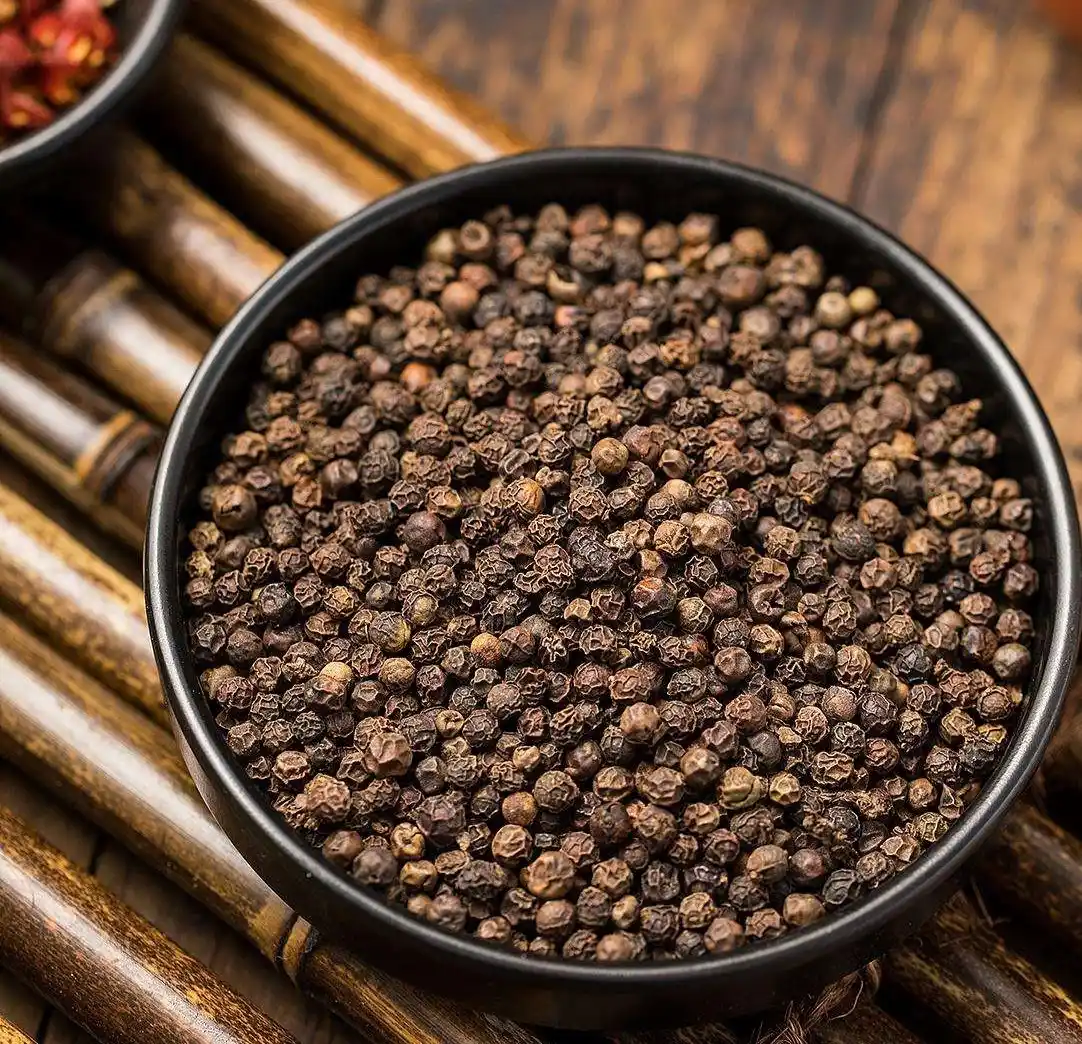
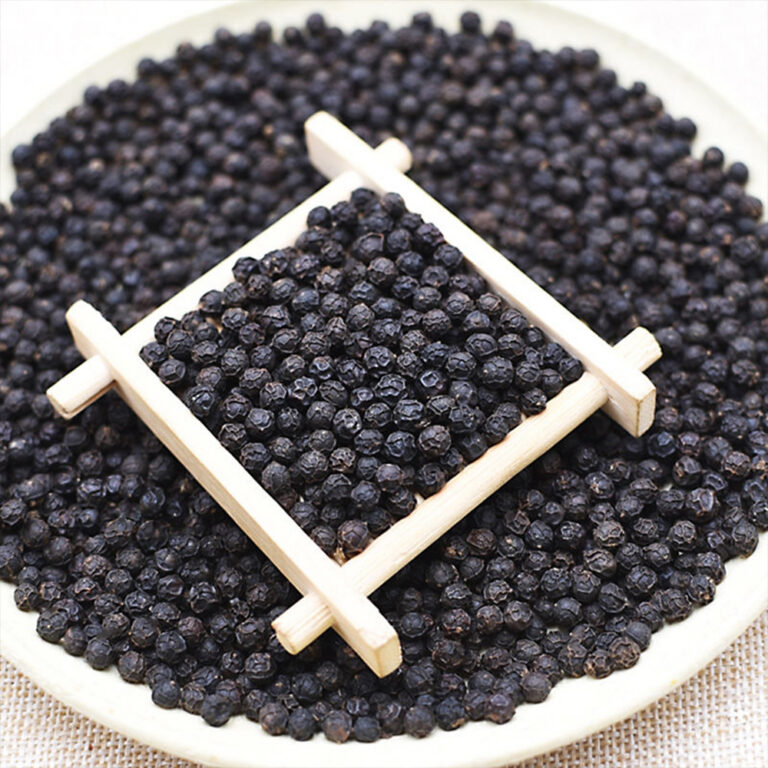
Bulk density (BD) is how much a fixed volume of whole pepper weighs, usually written as g/L. Think of it as “how heavy is a liter of peppercorns.”
Here’s the part people miss: many kitchens and factories still dose pepper by volume. A scoop. A cup. A hopper level. A “fill it to the line.” That’s where your grind yield starts lying to you.
The simple reason your yield moves
Same container. Different BD.
Lot A: 500 g/L
Lot B: 550 g/L
If you fill the same 1-liter bin, Lot B gives you about 10% more input weight than Lot A. You didn’t change anything. The pepper did. So your collected output changes too.
Argument: If you dose by volume, BD controls your “yield” before the grinder even turns.
Fast fix: Dose by grams. If you can’t (some lines are stubborn), then you must spec BD tightly.
Density grade (500/550/580) in trading language
In the spice trade, you’ll see black pepper labeled like 500 g/L, 550 g/L, 580 g/L. People call these “density grades.” Higher number usually means heavier, more filled berries, fewer light berries… and typically better processing value.
But don’t treat density grade like a “quality vibe.” Treat it like a production control lever:
Higher BD → more mass per scoop → more consistent batching if you still dose by volume
Lower BD → more airy berries → higher risk of particle size scatter after grinding
If you’re building a spec sheet, BD is not optional. It’s a QC gate.
IPC grade keywords: bulk density and light berries
A lot of purchasing teams say “we buy Grade I” and assume that solves everything. It doesn’t—unless your Grade language includes the physical items that hit grinding behavior.
Two keywords matter a lot here:
Bulk density (g/L)
Light berries (%)
Light berries are under-filled, lower-mass peppercorns. They crush and fracture differently. They can also drive a wider particle size spread after milling.
Argument: BD and light berries are the hidden drivers of grind consistency. If they aren’t controlled, your “same settings” won’t behave the same.
For practical purchasing and QC language around grade + aroma, GuoCao has a clear reference page you can share internally: black pepper grades & volatile oil.
ISO 959-1 volatile oil (ml/100 g) and piperine
Now let’s talk about the part your customers actually taste.
Two chemistry keywords show up again and again in pepper specs:
Volatile oil (ml/100 g): your aroma “nose”
Piperine (%): your heat “bite”
If your pepper grinds the same but tastes weaker, it’s often not your mesh. It’s that the volatile oil is lower, or the pepper sat too long after grinding, or storage wasn’t tight.
Argument: “Yield” isn’t just weight. In pepper, sensory yield matters. You can ship the same grams and deliver less flavor.
If you’re doing supplements, functional drinks, tea blends, or TCM-style formulas, this is where you protect the product promise. And it’s exactly why a supplier with structured QA and third-party COA capacity helps, not just “cheap raw.” GuoCao positions that clearly under Wholesale Chinese medicinal herbs & spices supplier.
Moisture content (%)
Moisture is the spec that quietly ruins grinding days.
Too dry and you get:
more fines
more dusting loss
more retention inside the mill (powder sticks in corners)
Too wet and you get:
smearing
clumps
inconsistent flow in hoppers
“why is the shaker clogging again??”
Argument: Moisture shifts how pepper breaks. It changes particle size distribution (PSD), retention, and what you collect as “yield.”
If your team only checks moisture when something goes wrong, you’re already late. Put it on the PO. Verify it on incoming inspection. Keep a retain sample. You’ll thank yourself later.
Mesh size and sieve curve
If your PO says “ground black pepper” with no mesh, you basically ordered a surprise.
You need at least:
target mesh range (example: 20–40)
or a sieve curve (percent passing each screen)
Why? Because grind size changes:
flavor release speed
dust fraction
packing density of the powder
flowability in filling lines
Argument: Mesh is not a preference. It’s a production setting written as a spec.
If you’re selling retail shakers, you care about flow and visual speck. If you’re blending for soup base, you care about dispersion. If you’re making capsules, you care about uniformity and dust control. Different game, different screen.
Grinding retention and dusting loss
This is the part nobody puts in marketing copy, but ops people live in it.
Even with the same input weight, your “collected output” changes when:
fines float off (dusting loss)
powder stays in the mill, chute, cyclone, or baghouse (retention)
static grabs particles (yes, static… annoying)
Low-moisture lots and very fine settings tend to push this problem harder.
Argument: Grind yield is not only “input minus output.” It’s also “how much stayed inside the system.”
Practical move: after you set your mesh, do a short run, then do a controlled purge/clean-out and weigh what comes out. It’s not perfect science, but it gives you a real retention baseline.
Storage: ambient, cool, and MAP (modified atmosphere packaging)
If you grind pepper and let it sit exposed, aroma walks out. Fast.
This is why storage and packing style matter:
Ambient vs cool storage: cooler usually slows aroma loss
MAP / nitrogen flush: less oxygen, less oxidation
Tight liners and fast sealing: less headspace drift
If you’re shipping to multiple markets (US, EU, Australia, Japan, Korea, Canada, SEA), you also need documentation and stable QC systems that don’t break under audits.
GuoCao’s setup—GMP production line, ISO 22000, controlled warehouse options, and COA capability—fits that export reality, not just local trade. If you want to browse the wider category (pepper plus other SKUs), use spices wholesale or the full Chinese herbs and spices catalog.
PO + COA spec table (copy/paste friendly)
Here’s a clean spec table you can drop into your purchasing workflow. It’s written in real buyer language, not academic style.
Spec keyword
What you write on the PO
What problem it solves
Who cares most
Bulk density (g/L)
“BD ≥ ___ g/L” (pick 500/550/580 per product)
Stabilizes volume dosing, reduces lot drift
Production + Purchasing
Light berries (%)
“Light berries ≤ ___%”
Prevents airy lots that grind weird
QC + Ops
Moisture (%)
“Moisture ≤ ___%”
Cuts clumping, improves flow, reduces dust swings
QC + Packing
Volatile oil (ml/100 g)
“VO ≥ ___ (d.b.)”
Keeps aroma consistent
Product + QA
Piperine (%)
“Piperine ≥ ___%”
Controls heat intensity
R&D + Product
Mesh / sieve curve
“20–40 mesh” or curve
Prevents PSD surprises
Ops + Filling
Cleanliness / defects
“Low extraneous matter, defect cap”
Avoids customer complaints & import friction
QA + Compliance
COA per lot
“COA required, third-party ok”
Makes disputes simple
Everyone (seriously)
No cost talk. Just control points.
Common grind yield complaints and the real root cause
What your team says
What it usually means
Fix you can actually do
“Same scoop, output changed again”
BD changed
Dose by grams or tighten BD grade
“Today it’s dusty, yield feels low”
moisture too low + fines + retention
adjust moisture window, avoid over-fine grind
“Looks ok but taste is weak”
volatile oil lower or storage/holding time too long
This is the stuff that kills consistency. And consistency is the product.
OEM/ODM: when you need “your pepper,” not generic pepper
If your business needs a custom grind, custom pack, or custom blend, you don’t want random lots. You want repeatable spec and repeatable paperwork.
GuoCao supports OEM/ODM style supply with structured compliance (GMP, ISO 22000, COA) and export-ready documentation. If you’re building private label or contract manufacturing programs, these two pages are useful:
And yes, they also support related categories like herbal slices, functional ingredients, and even enzyme beverage production. That matters if you’re consolidating vendors to reduce supply-chain mess.
The bottom line
If your grind yield keeps changing, don’t start by blaming the grinder. Start with your specs.
My stance is simple: lock bulk density (g/L), then lock moisture, then lock mesh, then protect volatile oil with smart milling timing and storage. Do that and your output becomes predictable. Not perfect, but stable. That’s what buyers and factories really want.
If you want to run this with a supplier who speaks in real QA terms (COA, QC gates, lot control, export compliance), reach GuoCao through contact GuoCao.
Tell them your target BD grade and mesh first. It saves time, and it makes the whole deal way less messy.
Our low MOQ of 1 kg (2.2 lb) makes it easy to order Chinese herbal slices or wholesale Chinese medicine herbs. Private-label and bilingual labeling are also available.
Delivery Cycle & Support
We have a fast 7-day lead time. We provide free samples, COA reports, and technical support to help you bring high-quality bulk Chinese herbs to market.
Quality & Certifications
Our products are manufactured in a GMP-certified facility and meet ISO22000 standards. All Chinese herbs are third-party tested for heavy metals, pesticides, and microorganisms.