If you run a TCM factory or a supplement plant, you meet this question sooner or later:
“Do we buy Dang Gui slices, or do we bring in whole roots and slice in-house?”
On paper it looks simple. In real life it touches yield, COA pass rate, GMP audits, even how your sales team position the product. Let’s walk through it from a factory point of view, in plain language, with some data and tables you can actually use.
Quality Markers for Dang Gui Slices and Whole Roots in Manufacturing
Before we talk about form, we need to agree what “good Dang Gui” means on the shop floor. Most factories now look at at least these markers:
Ferulic acid – classic marker for Dang Gui quality.
Ligustilide and other volatile oils – linked to aroma and traditional function.
Polysaccharides – often used for immune / tonic positioning.
Moisture – too high, you risk mold and aflatoxin; too low, you may crack and lose volatiles.
Microbial load and aflatoxin – for any export project, this is non-negotiable.
Extractable solids / dissolution – how much useful stuff actually goes into your extract.
You don’t need a PhD model to start. Many factories do something like this:
Quality marker
Why it matters in factory production
Typical control idea (no hard numbers)
Ferulic acid
Supports “this is real Dang Gui” claim; used on COA for pharma and supplement-grade products.
Set a minimum range; reject batches obviously below your internal spec.
Ligustilide / volatile oils
Drives smell and part of market “feel”; too much loss during drying = complaints.
Control drying temperature and time; avoid over-roasting slices.
Polysaccharides
Useful if you do tonic / immune-support positioning.
Track trend by batch; use as extra quality lever, not only selling point.
Moisture
Direct link with shelf life and aflatoxin risk.
Keep final slices under a tight moisture limit; check in-warehouse drift.
Microbial & aflatoxin
Import checks, retailer audits, Amazon style platforms all care.
Combine GMP controls, proper warehouse and 3rd-party COA.
Extractable solids
Impacts how much concentrate you can get from one ton.
Monitor extraction yield over time and back-link to slice size and form.
Whether you start from whole roots or ready slices, these markers stay the same. What changes is how easily you can control them batch to batch.
Factory Production: Comparing Dang Gui Slices and Whole Roots in Bulk Manufacturing
Dang Gui Slices in Bulk Production
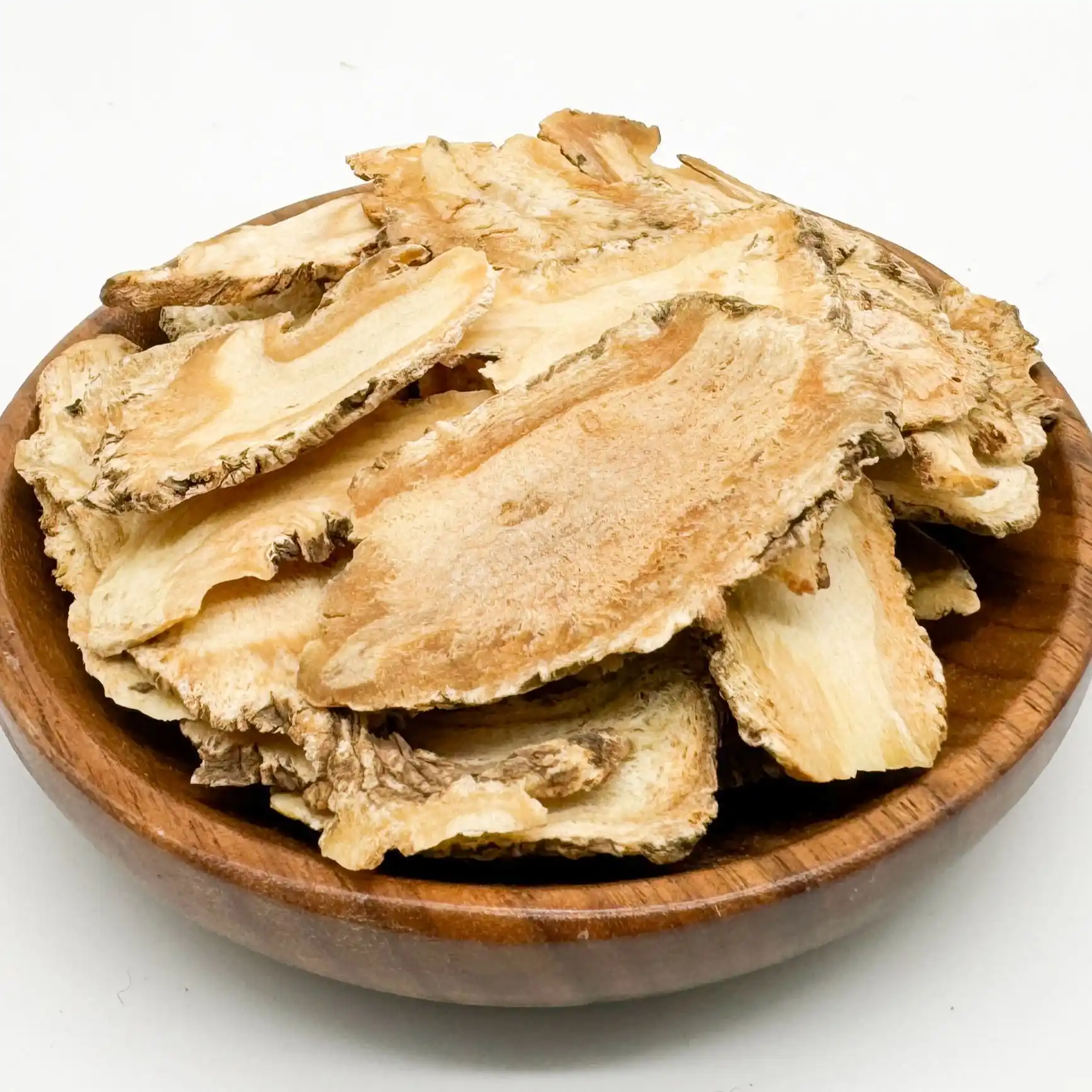
Buying ready slices feels easy: pallet comes in, QC sample, pass or fail, move to extraction or packing. No slicing line, no blades, less early-stage dust.
In reality, a lot is hiding under that “easy”: spec drift between suppliers, slice thickness all over the place, mixed moisture levels. One month your extractor runs smooth, next month the filter cake behaves like mud. You know that feeling.
Dang Gui Whole Roots in Bulk Production
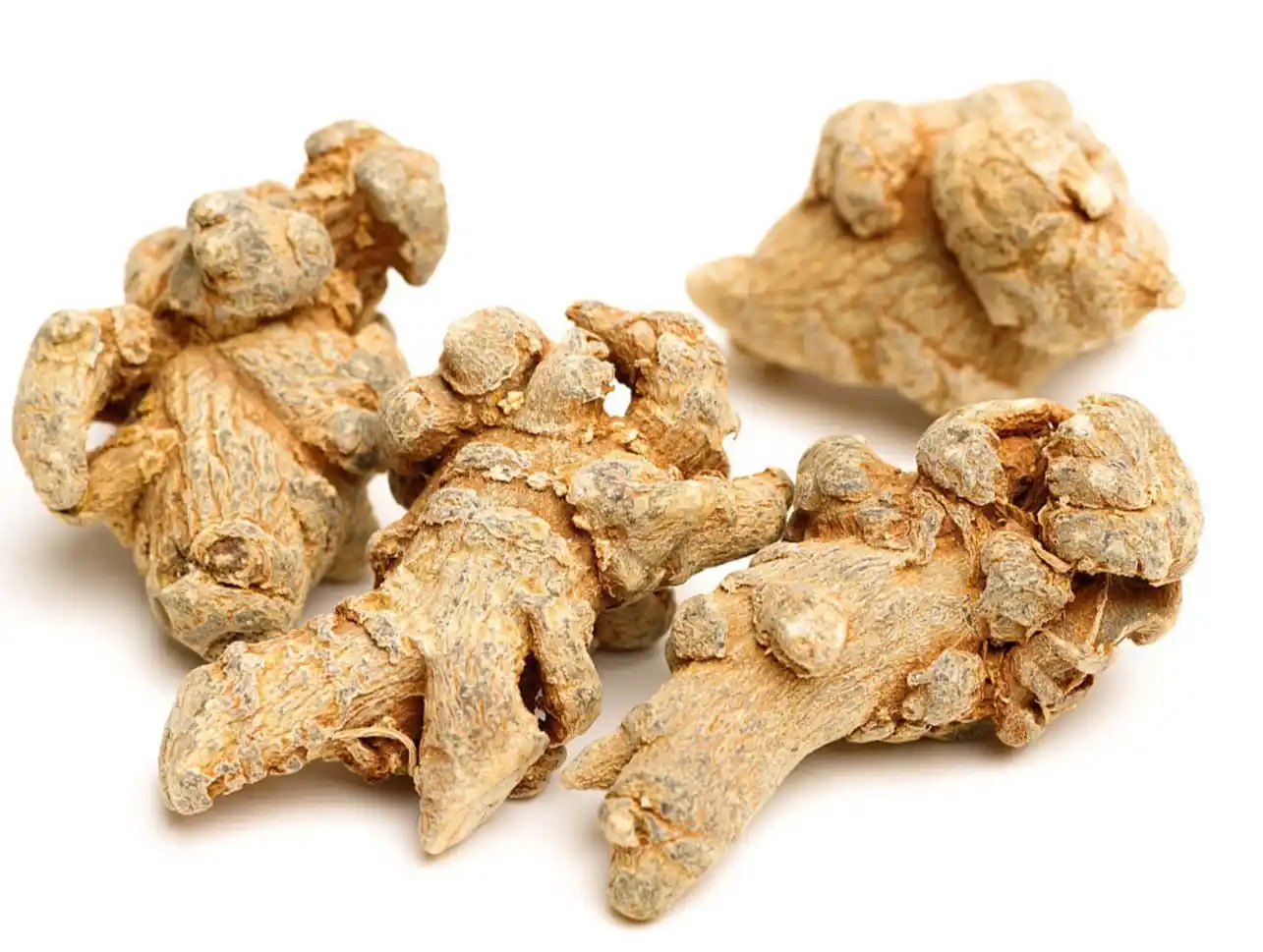
Whole roots ask more from your plant:
You need slicing equipment, feeding system, maybe softening tanks.
You need to handle roots of different sizes, hardness and shapes.
You must control softening time, slice thickness, drying curve.
But you win something important: you own the process. Once you lock a parameter window, your slices start to look and behave the same, lot after lot.
Side-by-Side: Dang Gui Slices vs Whole Roots (Factory View)
Use this comparison table as a quick talking tool inside your team.
Dimension
Start with wholesale Dang Gui slices
Start with whole Dang Gui roots
Incoming inspection
Some visual cues still there, but roots already cut; harder to see center defects and some adulteration. Heavy reliance on lab data.
Full root shape visible; easier to detect mold, insect damage, mixed species before slicing. Better for old-school TCM style inspection.
Process control
You accept supplier’s softening, slicing, drying decisions. Slice thickness and moisture may vary by supplier and season.
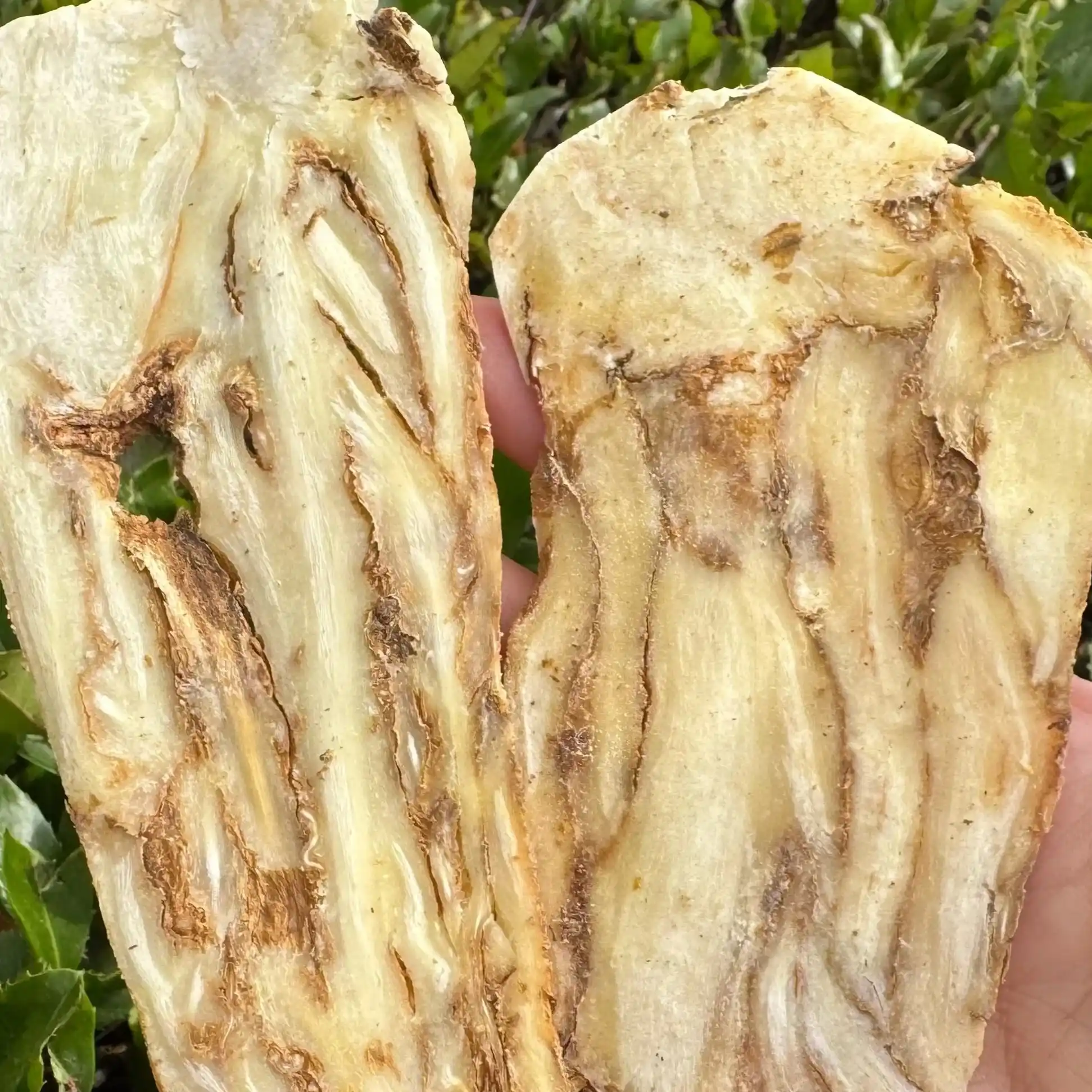
You set softening time, slice thickness (often 1–2 mm), and drying temperature / time. Once optimized, behavior in extraction is much more predictable.
Capex & Opex
No slicer line, less engineering; but you pay for someone else’s slicing and drying and live with their way of doing it.
Need investment in slicers, conveyors, dust control, maybe MA warehouse. But you spread that over years and many products.
Labour & safety
Less cutting in-house; lower direct blade injury risk. If you mill slices, dust control still critical.
Need operators for slicing but can use mechanical slicers, guards, interlocks. Blade injuries go down vs hand-cut operations. Dust extraction becomes a must-have, not optional.
Flexibility of specs
You depend on how many slice specs market offer; custom thickness or special cut can be hard to source stable.
You can offer thin slices for granules, thick slices for decoction, broken grade for tea bags, all from same raw material batch. Real “one herb, many SKUs”.
Authentication & fraud risk
Better than powder, but still reduced morphology. If upstream already messed up, you only see it late.
Strong morphology signal. Easier to build vendor score and blacklist high-risk sources early.
Warehousing & shelf life
Lower volume per kg, more surface area; faster moisture exchange, need better packaging.
More compact, less surface; slightly more forgiving in storage. Slices still need good warehouse once you process them.
Sales story & branding
Easy to show “ready-to-use Dang Gui slices” in B2B decks. But harder to explain what exactly you control.
You can say “we start from whole roots and slice in our own GMP line”, sounds like you actually run the herb, not only pack it. Clients like that.
You dont have to choose one forever. Many factories run mixed strategy:
Anchor products based on whole roots sliced internally.
Some fast-moving SKUs on contract Dang Gui slices from solid partners.
Authenticity, Safety and Compliance: Roots, Slices and Powdered Dang Gui
Nobody want to see that “suspected adulteration” email from a customer. Form of the herb matters for that too.
Whole roots keep the full morphology.
Experienced QC can spot abnormal color, texture, “too perfect” roots that look suspicious.
Easier to confirm species before slicing and blending.
Dang Gui slices keep part of the structure.
You still see vascular pattern, outer bark, internal color.
Some fakes slip through if the supplier already mixed them.
Powder is where risk explodes.
Once everything is brown powder, morphology is gone.
Only lab tools (HPLC, DNA, fingerprint) can tell you if it’s real Dang Gui.
For export-grade projects, combine:
Good vendor control (especially if you buy slices or powder).
Routine identity testing on incoming lots.
Sane moisture and warehouse management to keep aflatoxin away.
GuoCao builds this into our own process: GMP herb slice line, ISO 22000 food safety system, multi-zone warehouses (normal temp, cool, modified atmosphere), plus third-party COA when clients need extra peace of mind. That’s how we keep large volumes of wholesale Chinese medicinal herbs moving to the US, Europe, Australia, Japan, Korea, Canada, Malaysia, Philippines and more than 30 regions without burning QC teams out.
Functional Use Cases: Dang Gui Head, Body, Tail and Balanced Slices
Traditional practice splits Dang Gui root roughly into:
Dang Gui head – more “blood-tonifying” style use.
Dang Gui tail – more for “promote circulation / move blood” type of formulas.
Whole-root slices – mixed head + body + tail, more balanced traditional profile.
From a factory side, that gives you several product ideas:
Whole roots for decoction and hospital channels
Hospitals and TCM clinics often prefer visible, “trustable” herbs.
Whole roots or thick slices let them see what they decoct.
You can still slice roots to a hospital-friendly spec but keep clear root structure.
Standardized Dang Gui slices for extraction plants
If you make granules, tablets, capsules, you usually want thin slices for better extraction.
Once you lock in a thickness and moisture window, you get stable extraction times and yields, less “today is weird” moments in the cooker.
Crushed slices / small cuts for tea bags and RTD drinks
Functional tea and herbal drink brands often want fast flavor release.
Crushed Dang Gui slices based on a controlled slice line give better flow and filling in tea bag machines.
With whole roots in-house, you can serve all three styles from one raw material batch. That’s why many plants see roots as more work at first but more “playable” in long term.
Sourcing Scenarios for Pharma, Supplement and Beverage Brands
Let’s map this to real-world buyers GuoCao works with: pharma companies, supplement factories, functional drink brands, cosmetic ingredient buyers, distributors and local herbal shops.
High-quality Dang Gui slices with tight thickness and moisture window.
Sometimes mixed with other roots & rhizome from the same supplier to simplify logistics.
For this group, roots and rhizome wholesale in slice form cuts a lot of complexity. They don’t want to run slicing lines; they want reliable inputs and smooth validation docs.
Scenario 3: Functional beverage and herbal enzyme drink brand
Focus: RTD herbal drinks, concentrate, enzyme drinks with TCM strains.
Pain points: flavor consistency, extraction time, clarity, consumer perception.
Better fit:
Thin Dang Gui slices or broken slices optimized for extraction.
Maybe a mix designed specially for liquid projects.
If you produce herbal enzyme drinks or fermented beverages, you care how Dang Gui interacts with your strains. Too dusty input, you get filtration nightmare. Too thick, you get under-extraction. Here, purpose-built TCM herb slices OEM is usually smarter than random market slices.
Scenario 4: Spice wholesalers, local retailers, cross-border e-commerce
Clean, even Dang Gui slices in food-grade bags ready for private label.
In some markets, a mix of slices and smaller whole roots works well.
In this scene, the visual look of the slice often sells more than minor extraction differences. Good slicing and drying line beats everything.
How GuoCao Handles Dang Gui Slices and Whole Roots for Global Clients
GuoCao sits in the middle of all these needs as a wholesale Chinese medicinal herbs and spices supplier. A quick snapshot so you see why we talk about this topic a bit obsessively:
GMP Chinese herb slice lines for Dang Gui and hundreds of other herbs.
Normal / cool / modified-atmosphere warehouses to control moisture and volatiles.
ISO 22000 food safety system on top of GMP, so both food and supplement clients can sleep at night.
Third-party COA capability when your project or regulator demands extra proof.
Annual capacity around 2,500 tons, enough for big OEM / ODM orders but still flexible for custom specs.
OEM / ODM support not only for Chinese medicinal herb slices, but also for herbal enzyme drinks, tea bags and blended formulas.
Product lines covering animal & mineral materials, roots & rhizome, fruits & seeds, flowers & whole herbs, barks, all under one roof.
For Dang Gui specifically, that means we can:
Supply whole roots for clients who want full control or hospital-grade decoction pieces.
Offer standard Dang Gui slices for extraction plants and supplement factories.
Build private label lines where Dang Gui is just one of many herbs in your mix.
If you’re a pharma company, supplement maker, functional drink brand, cosmetic raw material buyer, distributor or local herb retailer, the choice between slices and whole roots is less about “right vs wrong” and more about fit with your scene.
When you talk with GuoCao, be open about your real pain points:
Small note at the end: dont overthink it. Start from your end product and work backwards. If the end product needs visible, trust-heavy presentation, whole roots make sense. If it lives inside a capsule or drink, a good slice program is usually enough. And if you want both, GuoCao can help you build a layered sourcing plan across your full TCM portfolio, from Dang Gui to the rest of your Chinese medicinal roots and rhizome range.
Our low MOQ of 1 kg (2.2 lb) makes it easy to order Chinese herbal slices or wholesale Chinese medicine herbs. Private-label and bilingual labeling are also available.
Delivery Cycle & Support
We have a fast 7-day lead time. We provide free samples, COA reports, and technical support to help you bring high-quality bulk Chinese herbs to market.
Quality & Certifications
Our products are manufactured in a GMP-certified facility and meet ISO22000 standards. All Chinese herbs are third-party tested for heavy metals, pesticides, and microorganisms.