
걱정하지 마시고 즉시 담당자에게 문의하세요.
서두르지 마시고 지금 바로 상사에게 직접 문의하세요. 보통 1시간 이내에 답변해 드립니다.
한방 허브와 향신료 제조업체
글로벌 한약재 및 향신료 도매
당사는 SSL/3.0을 사용하여 개인 정보를 암호화합니다.
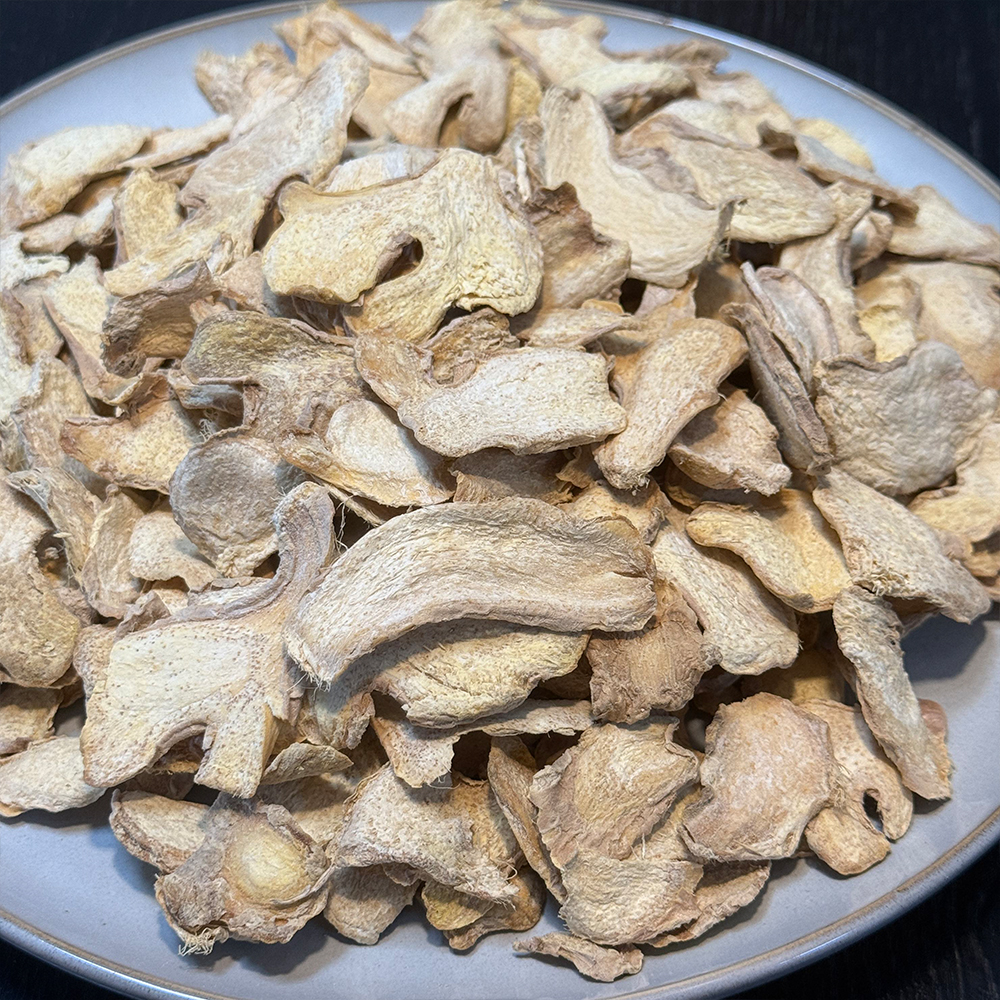
Should manufacturers choose dried ginger flakes or powder? Explore verified research on ginger chemistry, FDA safety findings, processing performance, and practical specifications for sourcing industrial ginger ingredients.
Particle size matters.
When manufacturers compare dried ginger flakes vs powder, the conversation usually starts with price, convenience, and appearance, although the real financial consequences often emerge later through inconsistent flavor, inefficient extraction, problematic filling behavior, or rejected batches.
So which form actually makes more sense?
For seasoning blends and powdered supplements, dried ginger powder is generally the more practical choice. For herbal teas, visible botanical blends, and certain extraction processes, dehydrated ginger flakes often provide greater flexibility.
But there is a more important distinction.
Grinding ginger does not automatically improve its chemical quality. And purchasing whole or sliced ginger does not guarantee better food safety.
The right decision depends on three things: the finished product, the processing conditions, and the supplier’s ability to document what is being delivered.
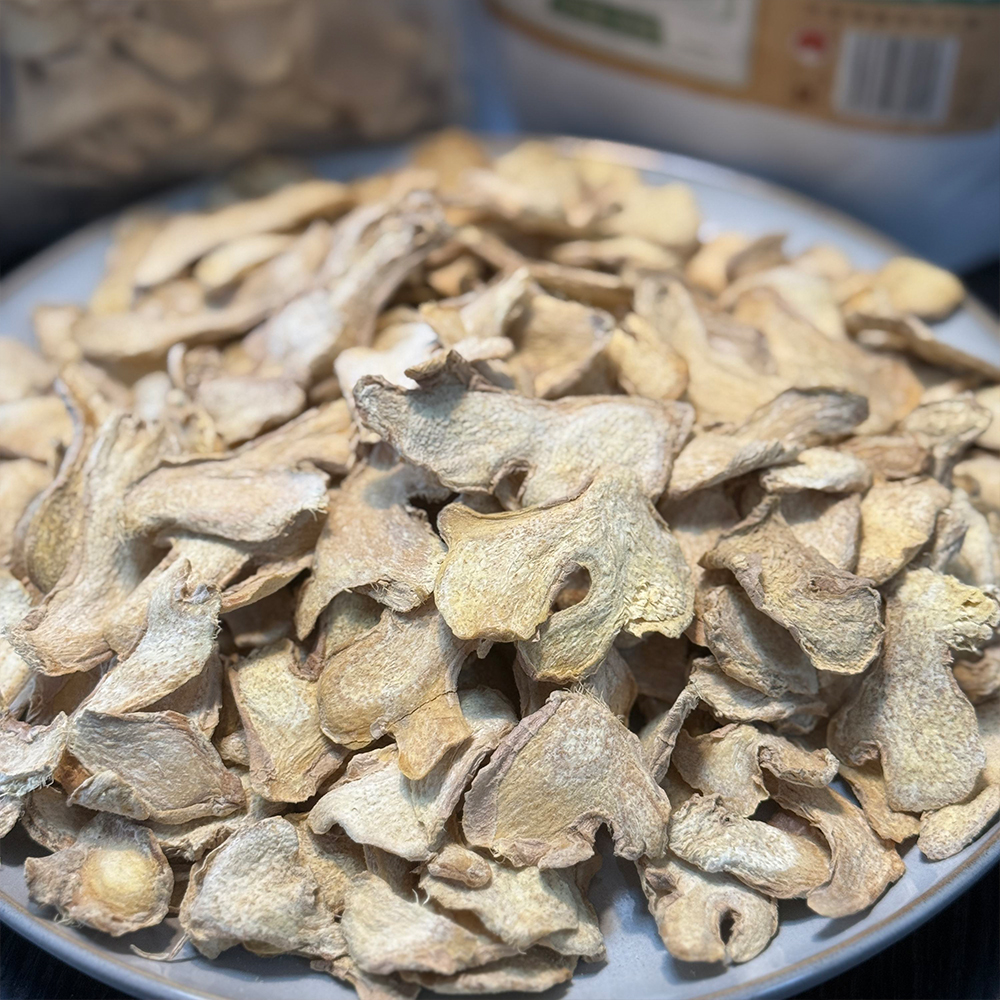
Both ingredients come from the rhizome of 생강 Roscoe, a plant in the Zingiberaceae family.
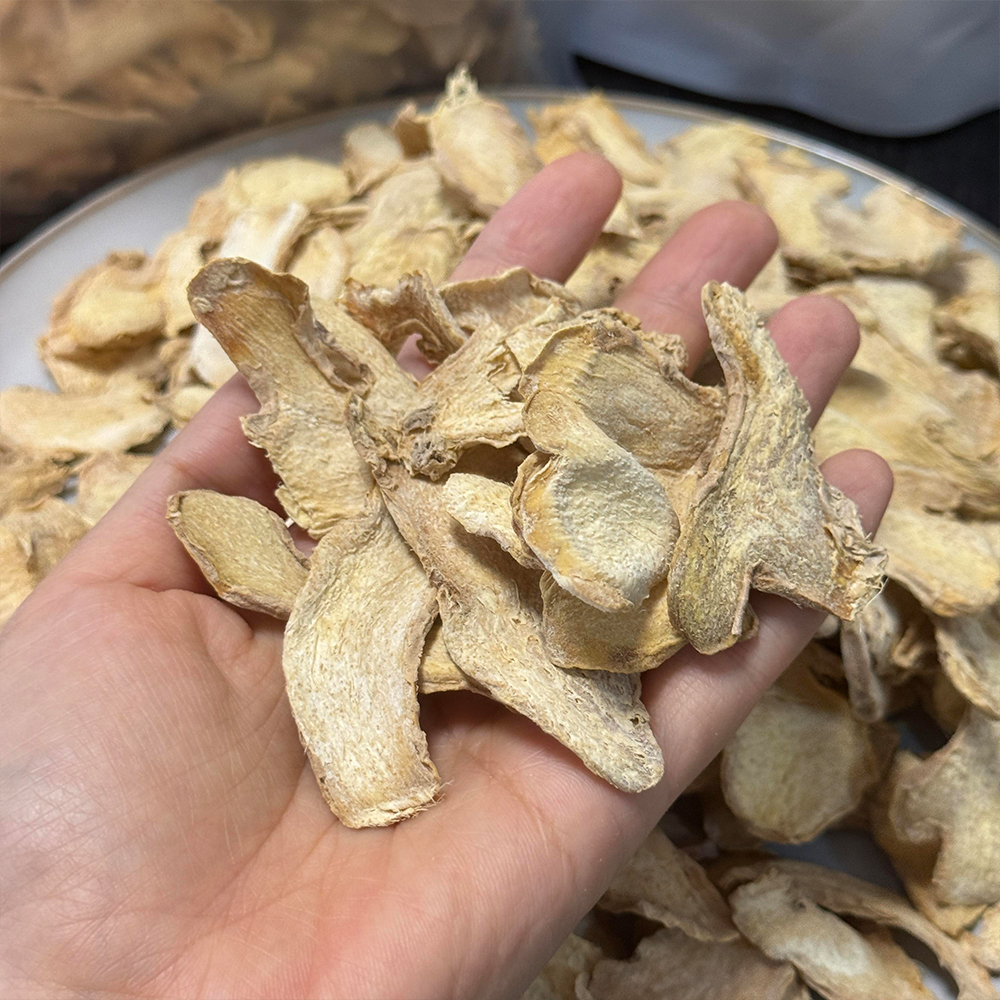
Dried ginger flakes are dehydrated rhizome pieces, commonly cut or sliced before drying. Dried ginger powder is produced through additional milling and usually screening to obtain a specified particle size.
That additional processing changes how ginger behaves in manufacturing equipment.
| Comparison Factor | 말린 생강 조각 | Dried Ginger Powder |
|---|---|---|
| 물리적 형태 | Slices, chips, or coarse pieces | Fine or medium-ground particles |
| Flavor release | Typically slower during short contact times | Often faster due to increased surface area |
| Dry blending | May segregate from finer ingredients | Generally easier to distribute in compatible powder blends |
| 허브차 | Suitable for visible botanical blends | Can create sediment and filter-bag dust |
| 추출 | Suitable for controlled extraction and filtration | May improve mass transfer but complicate filtration |
| Capsule production | Usually requires grinding | More suitable if particle size and flow meet requirements |
| Visual inspection | Botanical structure remains more recognizable | Identity is harder to judge visually |
| Dust generation | Usually lower during handling | Greater dust-management requirements |
| Manufacturing flexibility | Can be milled into different grades | Already committed to a particle-size range |
| Primary applications | Herbal tea, infusion, extraction, coarse blends | Seasonings, premixes, supplements, powdered formulations |
The practical distinction is not simply coarse versus fine. It is flexibility versus immediate usability.
For buyers evaluating raw botanical formats, the bulk dried ginger flakes (Gan Jiang) product page provides a starting point for discussing cut ginger specifications.
A frequent assumption in ginger procurement is that stronger aroma or a finer grind indicates better quality.
I would challenge both assumptions.
Ginger contains pungent compounds such as 6-gingerol (C17H26O4) and 6-shogaol (C17H24O3), along with volatile constituents that contribute to aroma.
Their relative concentrations can change during drying and other thermal processing.
A study published on September 4, 2026, in 식품, titled Effects of Different Drying Methods on the Active Ingredients of Ginger Powder, examined three ginger varieties under two drying methods.
Researchers compared conventional drying at 80°C for 360 minutes with a two-stage process using 120°C for 90 minutes followed by 80°C for 150 minutes.
For the Xiaolin Huangjiang variety, the study reported:
| Measured Property | Conventional Drying | Two-Stage Drying |
|---|---|---|
| Gingerol content | 7.12 mg/g | 11.87 mg/g |
| Volatile oil content | 3.46% | 1.29% |
The two-stage process produced approximately 67% higher measured gingerol content for that variety, while retaining substantially less volatile oil.
This is the trade-off that purchasing teams should understand.
A manufacturer developing a pungent spice blend may prioritize one chemical profile, while a company producing ginger tea or aromatic beverages may prioritize another.
Importantly, the study also found variety-dependent differences. One ginger cultivar did not respond in exactly the same way as another.
These findings do not establish a universal industrial drying recipe.
They demonstrate why drying history and cultivar identity deserve attention alongside particle size.
For products requiring chemical standardization, I would request batch-specific analytical results for relevant gingerols and shogaols, with methods and acceptance limits agreed before purchase.
The most useful way to compare ginger formats is to start with the finished product and work backward.
Powder has an obvious processing advantage in finely blended products.
In soup bases, instant noodle seasonings, bakery premixes, and powdered sauces, properly sized ginger particles can distribute more evenly than large flakes.
However, very fine grinding creates its own problems.
Powders may generate dust, absorb moisture, form lumps, or bridge in hoppers. Different particle densities can also cause segregation during transport or vibration.
For an industrial seasoning line, I would investigate three parameters before approving bulk dried ginger powder:
A supplier’s statement that the product is “80 mesh” is not enough without an agreed testing method and passing criterion.
Manufacturers also need to distinguish dispersibility from solubility. Standard ginger powder contains insoluble components and will not necessarily dissolve into a clear beverage.
Flakes are often the better format when visible plant material forms part of the product.
Herbal tea bags, loose-leaf botanical blends, and traditional dried-herb preparations may benefit from recognizable pieces of ginger rhizome.
Flakes can reduce some of the dust and sediment problems associated with fine powder.
But cut size matters.
Pieces that are too large may release flavor slowly during a short infusion. Excessively small fragments can escape through filter material or increase fines during packaging.
For formulation considerations, see the guide to dried ginger flakes for spice, herbal, and functional food applications.
Smaller particles can increase contact between ginger solids and an extraction solvent.
That sounds beneficial.
Yet excessive fines can create difficult filter cakes, increase clarification requirements, and slow industrial separation.
I would not select a ginger powder for extraction solely because it achieves a faster laboratory extraction rate.
The real comparison should include recovered target compounds, filtration performance, solvent consumption, and processing time.
For many extraction systems, coarse ginger or appropriately sized flakes deserve a trial alongside milled powder.
Low moisture is not sterilization.
Manufacturers sometimes treat dried botanical ingredients as inherently low risk because microbial growth is restricted under sufficiently dry conditions, but pathogens can survive in low-moisture environments even when they are unable to multiply.
How long can that survival last?
A 2015 investigation involving FDA researchers, Survival of Salmonella During Drying of Fresh Ginger Root and Storage of Ground Ginger, tested pathogen survival during drying and storage.
Under experimental storage conditions of 25°C and 33% relative humidity, Salmonella populations remained relatively constant over 365 days in ground ginger.
The researchers also found that drying temperature, airflow, and water-activity changes influenced pathogen reduction.
The findings do not mean every commercial ginger lot contains Salmonella.
They mean low moisture alone is not evidence that a contaminated ingredient has become microbiologically safe.
In April 2017, Lords Organics voluntarily recalled Organic Veda ginger powder after Salmonella was detected in finished-product sampling.
그리고 FDA’s recall announcement identified Batch A324DGRP. No illnesses had been reported at the time of the announcement, and the recall was subsequently completed.
This incident highlights a problem that extends beyond any one brand.
A batch can appear normal, have the expected smell, and still fail a microbiological safety requirement.
For manufacturers sourcing dried ginger for herbal products or food formulations, documentation should include appropriate hazard-control information, not merely a moisture result or an attractive Certificate of Analysis (COA).
A specification sheet should allow a buyer to accept or reject a shipment without arguing over subjective descriptions.
“Premium quality” is not a measurable industrial requirement.
Neither is “high potency” without a defined analytical method.
For food grade ginger powder for manufacturing, these are the essential starting points:
| 사양 | 요청 사항 |
|---|---|
| 식물학적 정체성 | 생강 Roscoe, rhizome |
| 물리적 형태 | Defined powder grade or flake dimensions |
| 수분 | Maximum permitted value with test method |
| 수상 액티비티 | Measured value and application-specific limit |
| 입자 크기 | Agreed distribution or sieve-passing requirements |
| 미생물학적 품질 | Relevant limits, testing methods, and sampling plan |
| 화학적 지표 | Gingerol and shogaol results when needed |
| 중금속 | Results against applicable destination-market limits |
| 잔류 농약 | Risk-based testing against applicable requirements |
| 추적 가능성 | Lot identification, origin, and processing records |
| 패키징 | Food-contact suitability and appropriate moisture protection |
Exact numerical limits should be defined by the manufacturer’s product risk assessment and destination-market requirements.
A single specification cannot automatically cover culinary ginger, dietary supplement ingredients, and regulated medicinal materials.
I would rather receive a small set of reliable, lot-specific records than a large collection of generic certificates.
At minimum, verify whether the COA corresponds to the actual batch, whether the test methods are appropriate, and whether the sampling plan provides meaningful assurance.
For ready-to-consume products, ask how microbiological hazards are managed, including any validated pathogen-reduction process and controls preventing recontamination.
A COA supports a supplier qualification program. It does not replace one.
The cheapest quotation may be the most expensive ingredient to use.
Consider two sourcing options:
The flakes may offer better control over final particle size, particularly if the manufacturer produces several ingredient grades.
But milling introduces labor, equipment use, cleaning, product loss, and additional quality-control responsibilities.
Finished powder removes some of these costs, provided it already meets the approved specification.
I would compare suppliers using:
Effective Usable Cost per kg = (Purchase + Freight + Testing + Additional Processing + Expected Handling Loss Costs) / Accepted Usable Quantity
This approach also helps prevent a common mistake: comparing nominal price per kilogram while ignoring usable yield.
수입업체의 경우, guide to importing wholesale herbal slices from China offers additional context on supplier verification, documentation, and incoming quality checks.
When a manufacturer needs a specific cut size, grind level, blend, or package configuration, custom herbal and spice processing solutions may be more appropriate than purchasing an off-the-shelf format.
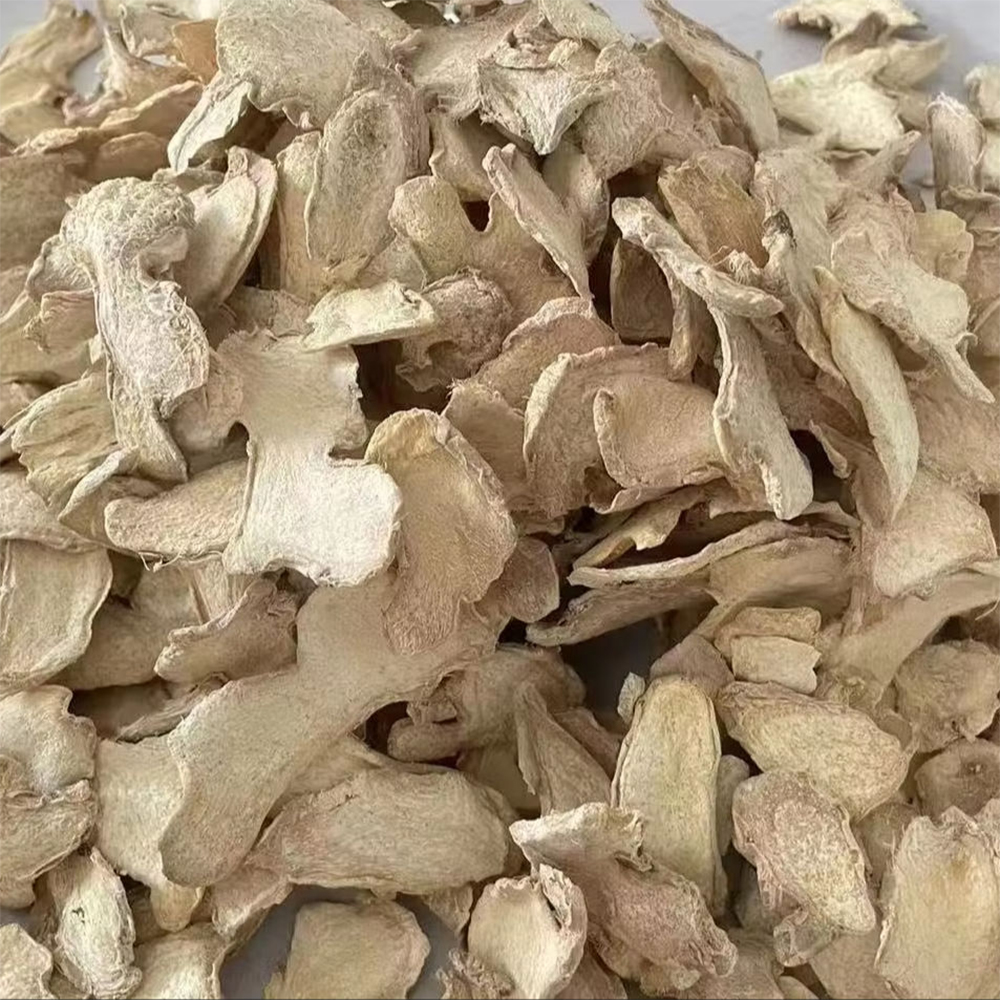
Dried ginger flakes are generally better for herbal manufacturing processes requiring recognizable botanical pieces, controlled infusion, or further milling, while dried ginger powder is more convenient for capsules, powdered blends, and fine-texture formulations where particle-size consistency and direct incorporation are important to production efficiency.
Neither form is automatically more potent or safer. Manufacturers should compare identity, chemical markers, contamination controls, and performance in the intended application.
Dried ginger powder is not inherently more potent than dried ginger flakes because its measured gingerol and shogaol content depends primarily on the botanical material, drying and thermal processing conditions, and storage history, rather than particle size alone, although finer particles may release certain constituents more rapidly during extraction.
Where standardized chemical composition matters, an HPLC analysis is more meaningful than a visual comparison.
The best ginger powder for manufacturing is a botanically verified, appropriately processed ingredient that meets the buyer’s defined particle-size, microbiological, chemical, moisture, packaging, and traceability requirements while performing consistently in the intended formulation, rather than simply having the finest grind, strongest smell, or lowest quoted purchase price.
Manufacturers should qualify suppliers using representative samples, batch documentation, and actual production trials.
Dried ginger flakes can be processed into powder through controlled milling and screening when their moisture, fiber content, and cleanliness are suitable, but the resulting ingredient still requires defined particle-size acceptance criteria, appropriate foreign-material controls, and food safety verification before it can be approved for industrial production or commercial packaging.
The required equipment and processing conditions depend on the intended powder grade.
Choosing dried ginger flakes vs powder should not depend on appearance or price alone.
For a reliable manufacturing decision, compare ingredient samples, review chemical and microbiological documentation, and confirm how each format performs in the finished product.
GuoCao offers wholesale dried herbal materials, spices, and custom processing services for professional ingredient buyers.
If you are developing a seasoning blend, botanical tea, herbal powder, or extraction product, prepare the following details before requesting a quotation:
Contact GuoCao to request dried ginger samples, technical specifications, and a bulk quotation.
Start with a traceable sample. Validate it against your manufacturing requirements. Then compare the real cost of producing an acceptable finished product.
The best ginger ingredient is not the one that looks better on a specification sheet. It is the one that performs reliably when production starts.