Zakupy hurtowe kardamonu: Zachowanie aromatu i wybór opakowania
Zakup kardamonu luzem to po części decyzja dotycząca zaopatrzenia, a po części kwestia inżynierii opakowań. W niniejszym przewodniku omówiono, w jaki sposób profesjonalni nabywcy powinni określać specyfikację zielonego kardamonu, chronić lotne związki aromatyczne, oceniać dostawców oraz dobierać opakowania przeznaczone do przechowywania i transportu międzynarodowego.
Bulk cardamom is expensive enough that buying it by color, pod size, and price per kilogram is a surprisingly poor procurement strategy.
Aroma disappears first.
When several tonnes of green cardamom move from processor to warehouse, then into a container, through customs, and finally into a seasoning, tea, beverage, or extraction plant, every uncontrolled week of heat, humidity, oxygen exposure, and weak sealing quietly changes what the buyer actually receives.
So why do purchasing specifications still devote three lines to packaging and twenty lines to appearance?
I would reverse that priority.
Dla nabywców poszukujących dostawców bulk Cardamom (Dou Kou) or comparing several international cardamom suppliers, the commercial question is not simply whether the pods look green at loading. The question is whether the same lot still delivers its expected aroma, volatile oil, moisture condition, and sensory profile after 30, 60, or 120 days in the real supply chain.
That distinction matters more than many purchasing teams admit.
Bulk Cardamom Is Not a Generic Commodity
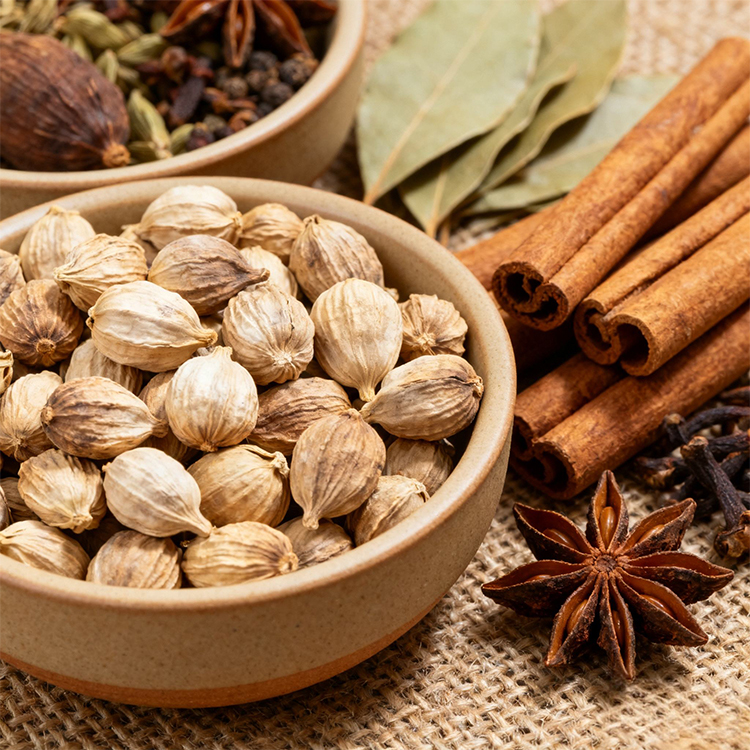
Green or small cardamom, Elettaria cardamomum, should be treated as an aroma-sensitive agricultural ingredient rather than just another dry spice.
That sounds obvious. Procurement behavior often says otherwise.
India’s cardamom market alone shows why specification discipline matters. The Spices Board’s 2024-25 annual report recorded 20,696 metric tonnes of small-cardamom production, podczas gdy 23,335 MT moved through e-auction/manual auction at a weighted average price of ₹2,575.98 per kg.
The Kerala Economic Review reported another useful signal: India exported 6,728 tonnes of small cardamom in 2024-25, up from 6,168 tonnes the year before, while export value rose from roughly ₹99,960 lakh to ₹156,682 lakh. That is a 9% increase in export quantity but a 57% increase in rupee value.
Those numbers should change how procurement teams think.
When raw material carries that level of value, shaving a little from packaging cost while accepting avoidable aroma deterioration makes little commercial sense.
Buyers comparing a broader portfolio of suszone przyprawy prosto z fabryki should therefore separate the purchase price from the usable sensory value at the end of storage.
Cheap spice that arrives flat is not cheap.
Aroma Retention Starts Before Cardamom Enters the Bag
Packaging cannot rescue poor raw material.
The aromatic profile of cardamom is shaped by cultivar, maturity, drying, processing, storage, and temperature history. Key volatile constituents associated with cardamom include 1,8-cineol oraz α-terpinyl acetate, and their balance contributes to the recognizable fresh, sweet, eucalyptus-like and citrus-spicy character buyers expect.
Research published in the Journal of the Science of Food and Agriculture found that cardamom maturity altered both volatile-oil content and composition, including changes in 1,8-cineole and α-terpinyl acetate. The same study found that controlling moisture during storage helped retard chlorophyll loss.
That creates an uncomfortable sourcing problem: two lots can look similar in supplier photographs yet behave differently after storage.
Start With a Numeric Specification
Rok 2024 Codex CXS 357-2024 Standard for Small Cardamom gives procurement teams a useful external reference rather than leaving words such as “premium” or “high aroma” undefined.
For whole small cardamom, Codex specifies a maximum moisture content of 13% w/w, maximum total ash of 9.5%, and minimum volatile oil of 3.5 mL/100 g on a dry basis for whole product; the minimum shown for opened capsules is 2.5 mL/100 g. Powdered seed has a tighter maximum moisture level of 11%.
I would not treat 13% moisture as the target.
It is a maximum specification, not a promise that every shipment sitting near 13% will behave equally well across hot and humid logistics routes. Procurement teams should set their own working specification based on destination climate, transit duration, pack size, storage temperature, processing use, and acceptable shelf life.
And moisture percentage is only one number.
A serious wholesale cardamom specification should normally define:
botanical identity and product form; origin and crop/harvest period; pod size or grading method; moisture; volatile oil where aroma performance matters; foreign matter and damaged or split pods; pesticide residues; heavy metals; microbiological limits; sensory acceptance criteria; packaging structure and pack weight; sealing method; lot coding and traceability; storage instructions; COA requirements; and destination-market documentation.
That is what makes a specification useful when a shipment goes wrong.
“Fresh aroma, green color” does not.
What Actually Causes Cardamom Aroma Loss?
Aroma retention is essentially a fight against exposure.
Oxygen can participate in deterioration of aroma compounds. Heat accelerates chemical change and volatilization. Moisture movement changes storage stability. Light can damage color and sensitive compounds. And every poor seal creates another path between the product and the outside atmosphere.
Heat deserves particular attention.
University of California researchers examining cardamom volatile constituents found marked compositional changes when seeds were exposed to temperatures above 149°C, demonstrating how sensitive cardamom aroma chemistry can become under severe thermal treatment.
Container shipping is obviously nowhere near 149°C, but the finding illustrates the broader point: aroma chemistry responds to temperature.
Hot warehouses matter.
Hot trucks matter.
Containers sitting in direct sun matter.
So does leaving opened bulk bags beside a production line for days.
Whole Pods Have an Advantage
If aroma is the feature you are paying for, I favor whole pods over pre-ground cardamom whenever the manufacturing process allows it.
Grinding increases exposed surface area dramatically. Once the seeds are fractured and their internal oils are exposed, oxygen and aroma-loss pathways multiply.
That means a purchasing team asking how to preserve cardamom aroma should not begin with “Which pouch should we buy?”
The first question should be: Do we actually need to buy it ground?
Grinding nearer to use can eliminate a storage problem that expensive packaging is otherwise forced to manage.
Cardamom Packaging Choices: What Works and What Fails
There is no universal best packaging for bulk cardamom.
A 500 g retail pouch, 10 kg B2B pack, 25 kg export shipment, whole-pod ingredient, and ground spice should not automatically receive the same packaging structure.
Here is the comparison I would use during supplier qualification.
Wybór opakowania
Aroma Protection
Ochrona przed wilgocią
Bulk Handling
Where It Makes Sense
Main Weakness
Unlined woven PP sack
Niski
Low to moderate
Doskonały
Very short handling stages
Too permeable for aroma-sensitive long storage
PE/LDPE inner liner + outer sack/carton
Umiarkowany
Umiarkowany
Good
Cost-sensitive whole-pod shipments
Barrier depends heavily on liner gauge, closure, and sealing
PET/PE laminate pouch
Good
Good
Good
Whole cardamom and medium-duration storage
Performance varies by laminate structure and seal quality
Vacuum does not compensate for poor film; compression can affect pod appearance
Rigid food-grade container with sealed liner
Good to very high
Good to very high
Doskonały
Premium ingredients and demanding distribution
Weight, space and packaging cost
A Central Food Technological Research Institute study offers a particularly useful warning here, although buyers need to read it correctly.
Researchers stored large cardamom, Amomum subulatum, rather than green Elettaria cardamomum, under different conditions and packaging formats. Under normal conditions of approximately 27°C and 65% RH, capsules in PP and PET/PE showed only marginal changes in moisture and volatile-oil content, with reported retention of the major flavor component 1,8-cineole in the 93.9-97.4% range. Under dry accelerated conditions, unlined woven sacks showed appreciable volatile-oil loss.
Do not copy those percentages directly into a green-cardamom specification.
Different species. Different chemistry.
But the packaging lesson is highly relevant: an outer sack designed mainly for mechanical handling is not necessarily an aroma barrier.
That distinction gets missed constantly.
Vacuum Packaging for Cardamom: Useful, but Frequently Oversold
Vacuum packaging is not magic.
Its main advantage is straightforward: removing air reduces the oxygen-rich headspace around the product. With a genuinely high-barrier film and reliable heat seals, that can materially improve storage conditions for aroma-sensitive ingredients.
But vacuum alone does not define package performance.
Put cardamom in a highly permeable film, pull a vacuum, and oxygen can still migrate back through the package during storage. Use a poor seal, and the vacuum disappears. Pack sharp stems or hard pods against a weak laminate, and microscopic punctures can undo the whole system.
For whole green cardamom, aggressive vacuum can also compress the pods.
That may be irrelevant for industrial extraction. It may be unacceptable when intact premium-looking capsules are part of the customer’s quality specification.
So nitrogen flushing deserves consideration too. It reduces oxygen without applying the same physical compression, although the actual result still depends on residual oxygen, package barrier properties, seal integrity, and how long the product must remain stable.
Moja zasada jest prosta: specify the performance first, then choose vacuum or gas flushing.
Do not specify “vacuum pouch” and assume the engineering has been solved.
Primary Barrier Packaging and Outer Packaging Have Different Jobs
This is where packaging discussions often become confused.
The primary package controls the product environment. It needs appropriate food-contact compliance, moisture resistance, oxygen/aroma barrier properties, and dependable sealing.
The secondary package protects that primary pack from crushing, abrasion, puncture, handling damage, and retail-distribution abuse.
They should work together.
For example, a sealed high-barrier inner pouch can carry the actual aroma-retention burden while a carton, corrugated shipper, or rigid paper tube provides structural protection and branding. Packaging suppliers such as Zhibang’s custom food and beverage boxes illustrate the secondary packaging formats available for dry-food programs.
For more premium or smaller retail formats, rigid paper tube food packaging can provide structural presentation around an appropriate food-contact liner or inner pack.
To rozróżnienie ma znaczenie.
Paperboard does not become a high-performance oxygen barrier simply because it looks premium.
And a sophisticated barrier pouch still fails commercially if the outer carton lets it get punctured during transport.
Good packaging is a system.
How I Would Audit Cardamom Suppliers Before a Bulk Order
I would begin supplier approval with one question: Can this supplier prove that the commercial lot will behave like the sample?
That question eliminates a lot of noise.
A polished sample tells me very little if the production lot comes from another harvest period, spends weeks in uncontrolled storage, or ships in a different liner.
The supplier should be able to connect the sample, production batch, COA, packing record, and shipment identification into one traceable chain.
Those capabilities are useful only when the paperwork follows the lot.
A generic annual test report is not a substitute for batch evidence.
Ask for Packaging Evidence Too
A packaging statement saying “vacuum packed” or “food grade” is incomplete.
I would want to know the actual material structure, nominal thickness, pack weight, closure or seal method, carton configuration, whether a liner is heat sealed or merely tied, and what packaging is used for samples versus full production.
If the planned route crosses humid tropical ports or spends several weeks at sea, the supplier should know that before quoting the package.
This is procurement engineering, not decoration.
The U.S. FDA likewise treats food packaging components as food-contact substances subject to regulatory controls, including packaging materials, adhesives, colorants, antioxidants and other components that contact food.
“Food grade” therefore should lead to a documentation discussion, not end one.
The Receiving Inspection Is Where the Contract Becomes Real
Buyers often write careful specifications and then weaken them at receiving.
Nie rób tego.
Check the seal. Check lot numbers. Inspect cartons for water exposure. Compare actual packaging with the approved sample. Measure moisture according to the agreed method. Retain a representative reference sample.
Then open the product.
Cardamom should not merely “smell good.” The sensory assessment should be performed consistently enough that a weak lot can be distinguished from natural evaluator variation.
For higher-value programs, volatile-oil testing adds a more defensible numeric marker.
The 2024 Codex standard matters here because it gives the market a published baseline for chemical characteristics rather than leaving every disagreement to subjective sensory language.
And when a rejected shipment represents several tonnes of material at thousands of rupees per kilogram, objective evidence becomes very valuable very quickly.
The Procurement Decision I Would Make
For aroma-led applications, I would normally buy whole green cardamom, set moisture and volatile-oil requirements in writing, approve a sealed barrier system before production, require lot-specific testing, and minimize the interval between grinding and use.
For shorter supply chains, a properly sealed PE-based liner with durable secondary protection may be enough.
For long export routes, humid destinations, extended warehousing, ground product, or premium aroma specifications, I would move toward a stronger oxygen-and-moisture barrier, potentially foil or another validated high-barrier laminate.
And I would never pay extra for vacuum packaging unless the supplier could tell me what film was being vacuumed.
That detail matters.
Najczęściej zadawane pytania
What is the best packaging for bulk cardamom?
The best packaging for bulk cardamom is a sealed, food-contact-compliant high-barrier inner pack matched to the product form, shipment climate, and storage period, with a protective outer carton, drum, or sack; whole pods tolerate gentler structures than ground cardamom, which needs stronger oxygen and aroma barriers.
For long storage or difficult export routes, laminate structures with stronger oxygen and moisture barriers generally deserve consideration. For shorter whole-pod supply chains, a well-sealed liner inside a protective outer package may be sufficient. The actual film specification and seal integrity matter more than marketing names such as “premium pouch.”
Does vacuum packaging preserve cardamom aroma?
Vacuum packaging preserves cardamom aroma by removing much of the oxygen-containing headspace around the spice, but it only works well when the pouch itself has low oxygen and moisture transmission, strong heat seals, and enough puncture resistance to survive transport without losing vacuum.
Vacuum is therefore one part of a packaging system, not an aroma guarantee. Whole premium pods may also be compressed under strong vacuum, so nitrogen flushing can be worth evaluating when appearance and capsule integrity matter.
What moisture level should buyers specify for bulk green cardamom?
For whole small cardamom, a practical procurement moisture ceiling is informed by Codex CXS 357-2024, which sets a maximum of 13% w/w for whole product; buyers should still set tighter internal targets when climate, transit time, or mold risk justifies them, rather than treating 13% as an ideal operating point.
Codex also lists a maximum moisture content of 11% for powdered seeds. Buyers should define the agreed test method in the specification because disputes over methodology can be just as expensive as disputes over the number itself.
Is whole or ground cardamom better for aroma retention?
Whole cardamom pods are generally the safer procurement form for aroma retention because the capsule and seed structure limit exposed surface area, while grinding sharply increases exposure to oxygen and accelerates volatile loss; brands needing ground spice should therefore shorten storage time and use smaller, higher-barrier packs.
If your plant has grinding capability, purchasing whole cardamom and milling nearer to production is usually the more defensible aroma strategy. Ground cardamom can still perform well, but the packaging and inventory discipline have to work harder.
How do you preserve cardamom aroma during international shipping?
Preserving cardamom aroma during shipping means controlling four variables together—temperature, moisture, oxygen exposure, and package integrity—because a premium crop can still arrive flat if it spends weeks in hot containers, absorbs humidity through a weak liner, or loses seal integrity during handling.
Specify the packaging before the purchase order is finalized, minimize excessive storage, use protective secondary cartons or sacks, keep lots away from heat and moisture, and inspect seals immediately on arrival. Long transit time should trigger stronger packaging, not simply a longer shelf-life claim.
Your Next Step: Buy the Aroma, Not Just the Pod
Bulk cardamom procurement should end with a specification that another person can audit.
Define the species. Define moisture. Define volatile oil where relevant. Define the acceptable sensory profile. Define the packaging structure, pack weight, seal method, storage conditions, testing documentation, and what happens when a shipment falls outside specification.
Then ask the supplier to quote against that document.
If you are sourcing whole pods, ground cardamom, or other suszone przyprawy luzem, compare the commercial lot against the approved sample before committing to repeat volume. For customized blends, packing formats, batch documentation, or export requirements, use GuoCao’s bulk spice inquiry and contact channel to submit the required product form, quantity, destination, testing standard, and packaging specification.
Because with cardamom, the expensive failure is rarely an ugly bag.
It is opening a beautiful one and discovering that the aroma has already left.
Nasze niskie MOQ wynoszące 1 kg (2,2 funta) ułatwia zamawianie chińskich plastrów ziołowych lub hurtowych ziół medycyny chińskiej. Dostępne są również etykiety prywatne i dwujęzyczne.
Cykl dostawy i wsparcie
Czas realizacji zamówienia wynosi 7 dni. Zapewniamy bezpłatne próbki, raporty COA i wsparcie techniczne, aby pomóc Ci wprowadzić na rynek wysokiej jakości chińskie zioła luzem.
Jakość i certyfikaty
Nasze produkty są wytwarzane w zakładzie z certyfikatem GMP i spełniają normy ISO22000. Wszystkie chińskie zioła są testowane przez niezależne firmy na obecność metali ciężkich, pestycydów i mikroorganizmów.